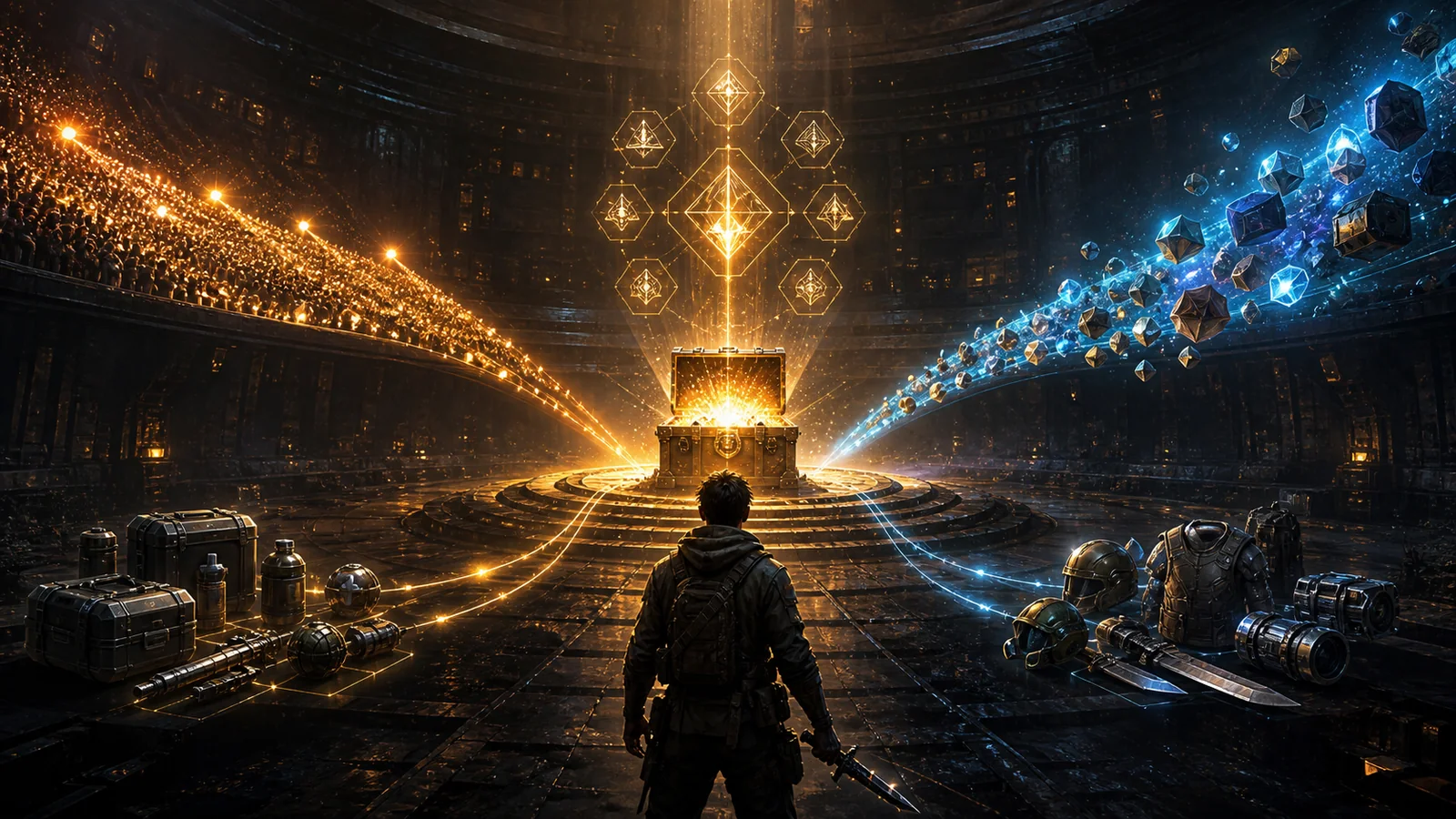
This article discusses achievements, sponsorships, audience systems, loot, equipment, and related character decisions through This Inevitable Ruin, Book 7 of Dungeon Crawler Carl. Dungeon Crawler World does not separate entertainment from survival. It makes survival dependent on entertainment. That relationship is established almost immediately. Carl enters the dungeon with no real understanding of the interface and is hit with a chain of achievements that reward circumstances ranging from entering with Donut to arriving without pants, supplies, or a weapon. Those achievements generate boxes. Boxes generate gear, skills, consumables, and options. The rewards are funny, humiliating, and mechanically useful at the same time. Before Carl knows how the larger economy works, the dungeon has already begun teaching him a central lesson: attention and survival are connected.[1] Mordecai makes the connection explicit only a few chapters later. The Ratings screen tracks views, followers, favorites, and patrons. He explains a progression in which views lead to followers, followers lead to favorites, and favorites make crawler sponsorship more likely. Patrons are usually organizations. They buy boxes for crawlers as part of an advertising system. Mordecai's explanation is blunt about the stakes. Strong dungeon loot matters, but the best support can come from benefactors, and cultivating an audience can become essential to staying alive.[2] That is the beginning of the sponsor economy. As the series develops, the system becomes more elaborate. Achievements teach crawlers what behaviors the AI notices. Fan boxes allow audience members to influence rewards. Sponsorship bidding turns crawler popularity into a market. Sponsor contracts can include product placement. Sponsor advertisements appear on crawler feeds. Emergency benefactor boxes can deliver urgently timed tools. Corporate and political sponsors can use rewards to influence choices far beyond ordinary combat. Even gods can become part of the sponsorship system. The result is not simply a fictional version of esports endorsements. It is a closed economy in which the people who own the show, the organizations that advertise through it, the audience watching it, and the contestants trying to survive all exchange value through the same mechanisms. For crawlers, this creates a terrible dependency. The rewards can save their lives. But accepting those rewards also makes them more visible, more marketable, more useful to sponsors, and easier to steer. The economy works because the reward is real. The control works because the crawler needs it. The sponsor economy can be summarized as a repeating chain: Action -> achievement -> reward -> stronger build -> more spectacle -> more views -> more followers -> more favorites -> sponsor interest -> benefactor support -> stronger build Not every event follows every step, and not every box comes from a sponsor. But the structure explains why systems that initially look separate eventually become one economy. Achievements provide the first feedback. Loot boxes convert feedback into tangible power. Equipment turns power into a build. Audience metrics convert crawler performance into market value. Sponsors turn market value back into loot, advertising, and influence. The crawler then returns to the dungeon stronger, but also more entangled in the system that rewarded them. This loop is one of the most important structural ideas in the series because it explains why crawler fame is not optional flavor. A crawler who attracts attention may gain resources unavailable through ordinary dungeon drops. A crawler who becomes boring can lose opportunities. A crawler who becomes extremely popular can command bidding wars and receive high-value boxes. A crawler who attracts the wrong sponsor can gain power while simultaneously becoming a piece in someone else's political game. The economy therefore rewards exactly the thing Borant wants from the crawl: memorable content. Carl's first achievements arrive before he understands almost anything else about Dungeon Crawler World. Book 1, Chapter 2 establishes the pattern. The System recognizes his unusual circumstances and immediately assigns rewards. Entering with Donut results in pet-related achievements. Being an early entrant produces another. Arriving unarmed, without supplies, and without pants all trigger additional achievement notices and boxes.[1] The sequence is comic, but it performs several important functions. First, achievements teach the crawler what the System notices. Second, they teach the crawler that unusual behavior can be profitable. Third, they introduce reward tiers before the crawler fully understands their value. Fourth, they normalize the idea that humiliation and advantage can arrive in the same notification. This matters because achievements are not morally neutral acknowledgments. The System does not reward only efficient survival. It recognizes novelty, spectacle, danger, absurdity, violence, risk, and behavior that makes the show more interesting. Later Book 1 material makes that problem darker. Frank Q. and Maggie My receive loot from player-killing achievements, including equipment that directly improves their ability to hunt or ambush other crawlers.[3] The system does not merely record that violence occurred. It can convert violence against other human survivors into better tools for repeating the same behavior. That creates an incentive loop. A crawler does something dramatic or extreme. The System recognizes it. The crawler receives power. The new power makes future escalation easier. This is why achievement design cannot be understood only as progression. It is also behavioral architecture. The AI does not need to issue a direct command saying, "Be more reckless." It can make recklessness economically attractive. The AI's achievement voice is one of the series' most recognizable comic elements. It mocks crawler decisions, exaggerates sexual or social implications, and turns serious danger into entertainment copy. That humor serves the show in at least three ways. It makes the notifications memorable. It transforms danger into shareable content. It deprives crawlers of control over how their actions are framed. Carl can perform an action for one reason and then watch the System redefine it for the audience through an achievement description. The reward and the public interpretation arrive together. That is important in an economy based on attention. The System is not only paying Carl. It is packaging him. Loot boxes are the mechanism that converts achievement language into physical consequences. In the opening chapters, the relationship is simple. Carl earns achievements and receives boxes. Later, the box ecosystem becomes much more complicated, with adventurer boxes, apparel boxes, weapon boxes, pet boxes, boss boxes, quest boxes, fan boxes, benefactor boxes, emergency deliveries, and quality tiers that extend from Bronze through Celestial.[1][2] The important point is not the complete taxonomy. The important point is what boxes do to decision-making. A box can contain exactly the resource that changes what a crawler is capable of doing. Equipment, spellbooks, consumables, tools, upgrades, skill improvements, and specialized items all alter survival odds. Some rewards are minor. Others can redirect a build. Book 1 repeatedly shows this in practice. Items from boxes become part of Carl's combat identity. Donut gains systems and spell access from rewards. Boss and achievement boxes do not merely increase a number. They introduce new tactics.[4] The uncertainty is part of the design. A crawler may know a box tier and category without knowing the exact contents. That means every reward creates a short delay between earning power and understanding what kind of power has been earned. This produces anticipation for the crawler and the audience simultaneously. The box opening becomes content. The item becomes content. The crawler's reaction becomes content. The future use of that item becomes content. The reward system therefore extends the life of a single achievement far beyond the notification that created it. The sponsor economy complicates this further because the source of a box can matter as much as its tier. Mordecai explains in Book 1 that sponsors can purchase boxes for favored crawlers and that the highest-quality benefactor support can exceed what a crawler typically finds in ordinary dungeon loot.[2] By Book 3, Carl notes that even a Bronze Benefactor Box from the Valtay Corporation is expected to outperform a much higher-tier ordinary box.[5] The reward is stronger because the sponsor is spending real resources. That creates dependency. If a crawler's best equipment increasingly comes from outside organizations, audience appeal becomes part of build planning. Survival strategy expands from: What can I loot? into: What can I earn, what can I attract, and what will somebody pay to send me? The sponsor economy matters because the rewards are not symbolic. They become equipment. Equipment is where audience economics becomes physical survival. A spectacular moment may create an achievement. The achievement may produce a box. The box may contain an item. The item may later prevent a death, open a tactic, or create the condition for another spectacular moment. That is the economic loop in its most concrete form. Carl's build is a history of these conversions. Tools, armor, weapons, consumables, patches, books, traps, and bizarre specialized items accumulate over time. Some come from ordinary dungeon sources. Some come from achievements. Some come from quests. Some come from sponsors. The source may differ, but once an item enters inventory, it becomes part of the same survival calculation. This has several consequences. A crawler's gear changes what kinds of problems they can solve. Items do not simply raise attack or defense. They can create synergies with skills, modify movement, support crafting, alter traps, increase survivability, or open strange tactical possibilities. Over time, gear contributes to recognizable crawler identities. Carl becomes associated with a particular kind of improvisational equipment use. Donut's rewards reinforce her magical, pet, and performance-oriented strengths. Katia's equipment interacts with her unusual physical mechanics. The economy therefore does not merely help crawlers survive. It helps define what kind of crawler they become. Power attracts attention. Rare gear can make a crawler valuable to teammates, threatening to enemies, interesting to viewers, and potentially more attractive to sponsors. It can also make the crawler a target for theft, ambush, political pressure, or tactical planning. The better the reward, the more visible its consequences may become. Powerful items can require knowledge, consumables, upgrades, repairs, charges, or complementary abilities. A crawler who receives advanced gear may become stronger while also becoming dependent on the systems that keep the gear relevant. That is another way rewards produce control without direct commands. The crawler is not told, "Remain inside the economy." The crawler simply discovers that leaving the economy would mean giving up tools needed to remain competitive. Book 1, Chapter 4 is the foundational source for understanding the sponsor economy. Mordecai identifies the Ratings menu as one of the most important interfaces Carl has. The menu tracks Views, Followers, Favorites, and Patrons. He explains that the First Floor is initially unavailable to live viewers, but Borant can feature crawlers in edited programming. A crawler who appears in prominent broadcasts can receive enormous attention. Mordecai then explains the progression from views to followers to favorites to patrons.[2] Each stage represents a deeper level of audience commitment. Views mean someone watched. Followers mean someone wants to find the crawler again. Favorites indicate a more limited and valuable form of attention, including updates on crawler status and combat. Patrons or sponsors represent organizations willing to spend money on the crawler. This makes attention a resource hierarchy. A trillion passive views are not the same as a smaller number of highly committed favorites. The system measures not only reach but engagement. For modern readers, the logic is immediately recognizable. The vocabulary resembles streaming platforms, social-media follows, paid sponsorships, influencer metrics, live notifications, and audience funnels. Dungeon Crawler World takes that familiar media logic and makes it lethal. If engagement falls, rewards can fall. If rewards fall, survival can become harder. Carl has Strength, Dexterity, Constitution, Intelligence, and other conventional game attributes. But the Ratings screen introduces an unofficial stat that can be just as important: marketability. A crawler who fights effectively but attracts no audience may have fewer sponsor opportunities than a crawler who creates memorable television. Mordecai understands this immediately because he survived his own crawl partly through audience support. His advice to Carl is not simply to kill monsters. It is to stand out.[2] That is a profound distortion of survival incentives. The dungeon does not merely ask: Can you win? It asks: Can you win in a way people want to watch? Book 2 and Book 3 deepen the audience relationship through fan boxes. Carl receives a Gold Fan Box after an achievement, and the System explains that fan boxes contain items voted on by the people following a crawler. There is a waiting period while the audience votes on the contents.[6] This turns spectators into limited participants in the crawler's progression. The audience is no longer simply watching Carl's build. It can influence it. That creates a new form of dependency because popularity affects not just whether a crawler receives attention, but potentially what kind of resources arrive. Book 3 makes the connection even sharper. Zev warns that if viewers stop watching, the group will get fewer views, which means fewer prizes from fan boxes and sponsors.[7] The conversation occurs while Zev is pressuring Carl and Donut about Katia's entertainment value. Katia is described as insufficiently interesting to the audience. The problem is not her combat effectiveness. It is that her presence may reduce engagement. That scene reveals the economy's cruelty in a particularly clear way. A human being's personality becomes a revenue variable. A teammate's emotional state becomes a programming problem. Party composition becomes a content decision. The reward system turns audience taste into pressure on private relationships. Carl is forced to confront a question that should not exist in a survival crisis: Is keeping a teammate worth losing audience support? His refusal to reduce Katia to a ratings problem is a character choice. The fact that the system makes the question financially relevant is the sponsor economy at work. Mordecai describes sponsorship in Book 1 with unusual directness. Patrons are typically organizations. They identify popular crawlers and sponsor them by purchasing boxes. He explicitly describes the arrangement as advertising.[2] That framing remains accurate as the system grows more complicated. Sponsors are not charitable donors in the ordinary sense. They are buying association with crawler attention. They want exposure. They want influence. They may want political access. They may want product placement. They may want the crawler to survive because the crawler is useful to their brand, cause, faction, or future plans. Book 4 makes the advertising function visible. When Carl receives an additional sponsor, the System informs him that viewers watching his feed will now see advertisements produced by both sponsors.[8] That means the crawler's body, decisions, battles, and near-death experiences are media inventory. The sponsor is buying access to the audience gathered around a human being in mortal danger. This is not metaphorical advertising. It is part of the interface. Carl's Open Intellect Pacifist Action Network sponsorship complicates the assumption that sponsors always want to supply gear. Mordecai suggests that an anti-crawl organization might purchase sponsorship primarily to show commercials and may have little interest in sending boxes.[8] That is important because it separates two values often treated as identical: supporting the crawler and buying the crawler's audience. A sponsor can want the second without prioritizing the first. The slot itself has value. The system becomes even more recognizable when Donut receives a sponsorship-related product sample. Loita explains that the item will appear to be a regular benefactor box, but it is actually part of the sponsorship contract. Donut is expected to interact with the product, and Carl is encouraged to comment on it without disparaging it if they want the sponsor to send real benefactor support later.[9] This is direct brand integration. The loot box is an advertisement. The crawler's reaction is an advertisement. The item's use in the dungeon is an advertisement. The possibility of future rewards is leverage to ensure the advertisement goes well. The line between survival equipment and sponsored content disappears. As crawler populations shrink and individual contestants become more recognizable, sponsorship becomes a competitive market. Book 2 introduces collective bidding for sponsorships.[6] Book 3 shows that sponsorship bidding can become intense enough to affect media scheduling and fan-box planning.[7] Later, Loita tells the group that all three commanded high sponsorship fees and that Carl and Donut both attracted bidding wars that continued until the final possible moment. Donut's winning bid is described as historically enormous.[9] By Book 5, the Sixth Floor announcement explicitly opens final sponsorship slots to bidding and gives crawlers a deadline for those auctions.[10] The crawler is therefore not just a performer. The crawler is an asset being priced. The market value reflects audience attention, perceived survival odds, entertainment potential, brand fit, and strategic value. This changes the meaning of popularity. Popularity is no longer merely fame. It has a bid price. Book 3 explains that sponsor spending affects the cost of benefactor boxes. Carl notes that sponsors who paid more for their crawler may receive different economics on future box purchases, while even low-tier benefactor boxes remain extraordinarily expensive and can outperform ordinary high-tier loot.[5] That means the initial sponsorship relationship affects the ongoing cost of support. The crawler becomes part of a long-term customer-acquisition and retention model. Even the economics of keeping someone alive are monetized. The sponsor economy is not merely a relationship between crawler and benefactor. The showrunner takes a cut. Mordecai explains in Book 1 that Borant receives advertising revenue, government support, and a commission on credits spent by patrons.[2] This makes Borant the platform operator. The company creates the environment. It owns the broadcast. It attracts the audience. It sells advertising access. It facilitates patron spending. It takes a commission. It controls many of the rules governing delivery. The crawl therefore resembles a platform economy more than a conventional contest. Everyone is producing value for the platform. Crawlers produce content. Viewers produce attention. Sponsors produce money. The platform monetizes the exchange. Book 2's epilogue adds another thread. The host company must pay Syndicate taxes on non-sponsored boxes, while only a limited number of Celestial rewards can be distributed without additional expense. Successive high-end rewards become increasingly costly to the showrunners.[11] That means the AI's reward generosity is not economically invisible. A spectacular achievement may create entertainment value, but the resulting box can also create a bill. Sponsor-funded boxes shift part of that cost away from the showrunner and onto outside organizations. This helps explain why sponsorship is so structurally useful to the production. The sponsors are not merely advertisers. They subsidize progression. Ordinary sponsorship already gives outside organizations influence over crawler progression. Emergency boxes add timing to that influence. Book 3 shows Borant prioritizing emergency benefactor deliveries when the sponsor pays an additional emergency delivery fee.[5] This creates a premium service inside a death game. Money can move a box up the queue. Money can make support arrive at the moment it matters. The difference between a useful item arriving today and arriving tomorrow can be the difference between survival and death. This is one of the clearest examples of how the sponsor economy turns capital into tactical power. The wealthier or more motivated the sponsor, the more capable it may be of intervening in a crawler's immediate circumstances. The most important evolution of the sponsor economy is that sponsor boxes eventually do more than improve builds. They can direct behavior. Book 6 provides one of the clearest examples through Katia. She explains that a sponsor box from Princess Formidable contained a scroll of worship. Because it was an emergency box, she used it immediately. The action connected her to Eileithyia and exposed a larger sponsor-driven political agenda involving Huanxin Jinx and future Celestial Ascendancy plans.[12] This is the endpoint of the economy's logic. A sponsor sends a reward. The reward appears useful. The crawler uses it under pressure. Using it creates a relationship the crawler did not fully understand in advance. That relationship carries future obligations. The reward is therefore both assistance and recruitment. A quest usually announces itself as an obligation. A sponsor reward can arrive as help. That makes it more subtle. The crawler is grateful because the resource may solve an immediate problem. Only later does the strategic purpose become visible. This is how gifts become instruments of control. The sponsor does not need to threaten the crawler directly. The sponsor can shape the crawler's available choices so that the desired path appears to be the best survival option. By the middle and later books, sponsorship is no longer limited to crawler endorsement. Outside powers can sponsor gods connected to the Celestial Ascendancy.[11][12][13] This expands the sponsor economy into a larger political and military market. The same logic still applies: Money buys access. Access creates influence. Influence changes outcomes. But the scale has grown from sending a crawler a box to positioning divine entities inside a much larger game. Book 7's discussion of Theia demonstrates how a sponsored deity can remain strategically significant long after the original sponsorship decision. The sponsorship affects how characters evaluate the goddess as a potential weapon, threat, or political variable.[13] The economy therefore becomes part of the series' larger political architecture. What begins in Book 1 as "get viewers so somebody sends you a better box" eventually intersects with factions, corporations, religions, gods, and future-floor power struggles. Money matters in the sponsor economy, but attention comes first. Without viewers, there is no advertising market. Without engagement, there is no reason to sponsor a crawler. Without favorites, the crawler is less visible to potential patrons. Without compelling content, viewers may leave. This is why Zev's role matters so much. She is not simply a publicist. She is managing a survival resource. Her concern with interviews, appearances, audience reactions, controversies, rivalries, and crawler presentation is directly connected to the reward economy. Book 1 repeatedly shows Carl's ratings exploding after dramatic public events.[14] By Chapter 47, the combination of media controversy and Donut's interactions with Mongo has produced enormous audience growth.[15] The absurdity is deliberate. A crawler may spend hours preparing for a deadly fight, but something comic, humiliating, emotional, or controversial can generate the audience spike that later attracts better support. The market does not reward effort. It rewards attention. The crawler does not merely fight. The crawler performs. The crawler manages audience expectations. The crawler appears on programs. The crawler generates controversy. The crawler thanks sponsors. The crawler may demonstrate products. The crawler monitors views, followers, favorites, and sponsor status. The crawler uses equipment obtained through those relationships to survive long enough to produce more content. That is labor. It is coerced labor under lethal conditions, but it is still labor in the economic sense because the crawler is producing media value that other organizations monetize. Carl recognizes the degradation of this arrangement even when he uses it. When Valtay sends him a benefactor upgrade in Book 3, he discovers that he can send messages to the sponsor but the sponsor cannot freely communicate back through that interface. He sends a thank-you message despite feeling revulsion toward the entire system because useful items may continue arriving.[5] That small moment captures the sponsor economy perfectly. Carl hates the institution. Carl needs the resources. Therefore Carl performs gratitude. The sponsor does not have to make him sincerely loyal. It only has to make continued cooperation materially rational. Carl's relationship to sponsor rewards is fundamentally adversarial. He does not reject the boxes. He does not refuse equipment because it came from a corporation. He understands that such purity would get him killed. Instead, he attempts to separate usefulness from loyalty. Take the box. Study the item. Exploit the system. Avoid becoming what the sponsor expects. This strategy is possible only because Carl increasingly understands that rewards are not neutral. A sponsor may want advertising. A sponsor may want political influence. A sponsor may want access to Carl's audience. A sponsor may be trying to manipulate a later floor. A sponsor may genuinely oppose the crawl while still using the sponsorship infrastructure. Carl survives by treating every gift as both a resource and a potential message. The question is never only: What does this item do? It is also: Why did they want me to have it? Donut is unusually well suited to the sponsor economy because she understands performance instinctively. She likes attention. She likes status. She cares about presentation. She communicates naturally in the exaggerated style that the crawl rewards. That does not make her controlled by the system. It makes her good at one of its most important currencies. Book 3's sponsorship bidding makes this clear. Donut's sponsorship commands an extraordinary price, and she reacts with obvious pride.[9] Her popularity becomes leverage. But Donut's value to the economy also creates pressure. Sponsors can send products and expect interaction. Viewers can reward or punish interpersonal choices. Zev can identify party members as ratings liabilities.[7][9] Donut therefore exists inside a contradiction. Her public persona helps keep the party alive. The same public persona gives outside organizations incentives to shape her behavior. She is both beneficiary and product. Katia illustrates the darker side of the system because her sponsor-related support becomes entangled with identity, survival, and future obligations. The Book 6 worship-scroll example is not simply a bad item choice.[12] It demonstrates how a reward can exploit incomplete information. Katia receives a box from a powerful outside figure. The box arrives under emergency conditions. She acts quickly. Only afterward does the larger political structure become clear. That is exactly how the sponsor economy creates control. The best manipulation does not look like coercion at the moment of choice. It looks like help. The three functions are easiest to see side by side.
| Reward mechanism | Progression function | Advertising function | Control function |
|---|---|---|---|
| Achievements | Generate boxes, status, and recognition | Create memorable crawler moments for the audience | Encourage repeat behavior through rewards and framing |
| Ordinary loot boxes | Supply equipment, consumables, spells, and tools | Box openings become content | Randomness and scarcity keep crawlers dependent on future rewards |
| Fan boxes | Provide audience-selected resources | Deepen audience participation and loyalty | Make crawler progression partly dependent on maintaining fan approval |
| Benefactor boxes | Deliver high-value sponsor-funded items | Attach sponsor identity to crawler success | Create gratitude, dependence, and opportunities for targeted influence |
| Emergency benefactor boxes | Move critical support quickly | Demonstrate sponsor commitment publicly | Let money affect timing during high-pressure decisions |
| Product-sample boxes | Provide a potentially useful item | Directly integrate a sponsor product into crawler content | Future support is implicitly linked to acceptable product interaction |
| Sponsor advertisements | No direct mechanical benefit required | Monetize the crawler's feed | Turn crawler attention into sponsor inventory even when no box is sent |
| Sponsored religious or divine items | Can grant boons or strategic options | Connect sponsor identity to larger political narratives | Can steer worship, alliances, and future-floor commitments |
The system works because these functions overlap. If rewards were only advertisements, crawlers could ignore them. If rewards were only progression, sponsors would have less reason to fund them. If rewards were only control mechanisms, crawlers would resist more openly. By combining all three, the dungeon makes the system difficult to reject. The box may save your life. The box may sell somebody's product. The box may make you owe somebody. All of those can be true at once. One of the most disturbing implications of the system is that reward value does not track moral value. Player killers can receive useful boxes.[3] Dangerous stunts can produce better achievements.[4] Controversy can produce audience growth.[14] A sponsor can back a crawler for reasons unrelated to the crawler's well-being.[8] A political actor can send an item that creates obligations far beyond the immediate encounter.[12] The economy does not ask whether an action is good. It asks whether the action creates value for the system. That distinction explains why Carl's ethical resistance matters. The dungeon repeatedly offers incentives that would make cruelty, betrayal, or spectacle economically rational. Carl's challenge is not simply to survive. It is to survive without allowing the reward economy to define which lives are worth saving. The sponsor economy grows with the scale of the crawl. Book 1 introduces ratings and patrons. Book 2 introduces fan boxes and more sophisticated sponsorship mechanisms.[6] Book 3 turns sponsorship into a formal bidding market, establishes benefactor logistics, and shows product-placement arrangements.[5][7][9] Book 4 adds multiple sponsors, feed advertisements, political and anti-crawl sponsorships, and sponsor relationships tied to broader floor economics.[8][16] Book 5 explicitly opens final sponsorship slots while placing crawlers and outside hunters into direct conflict.[10] Book 6 reveals how sponsor-funded items can alter religious and political trajectories.[12] Book 7 treats sponsorship as part of the strategic background of gods, factions, and future political outcomes.[13] The pattern mirrors the overall escalation of the series. What begins as personal progression becomes institutional power. A Bronze box on the First Floor is about one crawler's immediate survival. A sponsored deity in the later game can affect entire political strategies. The underlying mechanism has not changed. Someone with resources pays for influence inside the dungeon. Only the scale changes. The sponsor economy ties together parts of Dungeon Crawler Carl that might otherwise feel like separate jokes or mechanics. Why do views matter? Because views can become followers. Why do followers matter? Because followers can become favorites and fan engagement. Why do favorites matter? Because intense audience interest attracts sponsors. Why do sponsors matter? Because sponsor support can produce boxes. Why do boxes matter? Because boxes produce equipment. Why does equipment matter? Because equipment keeps crawlers alive. Why does survival matter to the platform? Because surviving crawlers produce more content. The entire system closes into a loop. That loop is economically elegant and morally grotesque. It rewards contestants for remaining entertaining enough to receive the resources required to continue entertaining the audience. The crawler survives in order to perform. The crawler performs in order to survive. Book 1 presents them as progressively deeper levels of audience engagement. Views represent people watching, followers allow viewers to track a crawler more easily, favorites are more limited and provide stronger status updates, and patrons or sponsors are organizations that spend resources to support and advertise through crawlers.[2] They can be. Book 3 explicitly states that a Bronze Benefactor Box can generally contain better material than an ordinary Platinum box, although exact results vary.[5] Fan boxes are rewards whose contents are voted on by people following the crawler. Book 2 establishes that the box remains unopened while followers vote.[6] Yes. Book 4 states that when Carl gains an additional sponsor, viewers watching his feed will see advertisements from both sponsors.[8] Yes. Book 3 shows Donut receiving a product sample disguised as a normal benefactor box because interaction with the product is part of the sponsor contract.[9] Yes. Book 3 establishes emergency benefactor boxes and an emergency delivery fee that can move sponsor deliveries ahead in the fulfillment process.[5] Yes. Book 6 provides a strong example when Katia receives a sponsor-provided worship scroll that connects her to a deity and a larger political agenda she does not fully understand before using it.[12] Yes. Mordecai explains in Book 1 that Borant receives advertising revenue and a commission on credits spent by patrons.[2] No. The System rewards behaviors that create game value or entertainment value, not necessarily ethical value. Book 1 player-killing rewards are a clear example.[3] Because it converts audience attention into real survival power while giving corporations, political actors, fans, and the showrunner ways to influence crawler behavior. It connects the media satire directly to the progression mechanics. 1. Dungeon Crawler Carl, Book 1, Chapter 2. Carl's first achievement chain immediately awards multiple categories and tiers of boxes. 2. Dungeon Crawler Carl, Book 1, Chapter 4. Mordecai explains the Ratings menu, the views-to-followers-to-favorites-to-patrons funnel, sponsor boxes, advertising, Borant's advertising income, and Borant's commission on patron spending. 3. Dungeon Crawler Carl, Book 1, Chapter 43. Frank Q. and Maggie My receive player-killing loot that improves their ability to target other crawlers. 4. Dungeon Crawler Carl, Book 1, Chapters 5, 22, 30, and related boss-reward sequences. Achievement and boss boxes supply spells, tools, equipment, and specialized upgrades. 5. The Dungeon Anarchist's Cookbook, Book 3, Chapter 13. Carl receives a Valtay Bronze Benefactor Box, benefactor delivery economics are discussed, emergency delivery is prioritized for a fee, and Carl uses the Sponsorship tab to send thanks despite distrusting the sponsor system. 6. Carl's Doomsday Scenario, Book 2, Chapter 13. Collective sponsorship bidding is mentioned and Carl receives his first fan box, whose contents are voted on by followers. 7. The Dungeon Anarchist's Cookbook, Book 3, Chapter 6. Zev connects audience engagement to future fan-box and sponsor prizes while pressuring the group over Katia's entertainment value. 8. The Gate of the Feral Gods, Book 4, Chapter 7. Carl receives a second sponsor, sponsor advertisements are attached to his feed, and Mordecai discusses an anti-crawl organization potentially buying sponsorship for advertising rather than boxes. 9. The Dungeon Anarchist's Cookbook, Book 3, sponsorship-bidding and Loita communication sequence. Carl and Donut command major sponsorship bids, and Donut's sponsor sends a product sample as a contractual promotional placement. 10. The Butcher's Masquerade, Book 5, Chapter 1. Sixth Floor announcements open final sponsorship slots to bidding. 11. Carl's Doomsday Scenario, Book 2, Epilogue. Non-sponsored boxes create tax costs for the host company, high-end Celestial reward distribution is economically constrained, and deity sponsorship is discussed. 12. The Eye of the Bedlam Bride, Book 6, Chapter 19. Katia explains receiving an emergency sponsor box containing a worship scroll, connecting sponsor support to Eileithyia and Huanxin Jinx's future plans. 13. This Inevitable Ruin, Book 7, Chapter 49. Theia's sponsorship remains strategically important in later Celestial Ascendancy planning. 14. Dungeon Crawler Carl, Book 1, Chapter 44. Carl's ratings increase after media appearances and controversy, and Zev discusses publicity and sponsor concerns. 15. Dungeon Crawler Carl, Book 1, Chapter 47. Carl's views, followers, and favorites rise dramatically as Donut and Mongo generate audience interest. 16. The Gate of the Feral Gods, Book 4, Chapter 34. Sponsor economics, emergency benefactor support, sponsor access to markets, and the financial consequences of crawler actions become explicit strategic concerns.