A narrative map of the crawl
Dungeon Crawler World: Earth changes its rules, scale, and visual language every time the surviving crawlers descend. The atlas below follows the floors Carl and Princess Donut actually experience through Book 8, pairing interpretive maps with the decisions and consequences that make each place matter.
Book 1: Dungeon Crawler Carl
First Floor
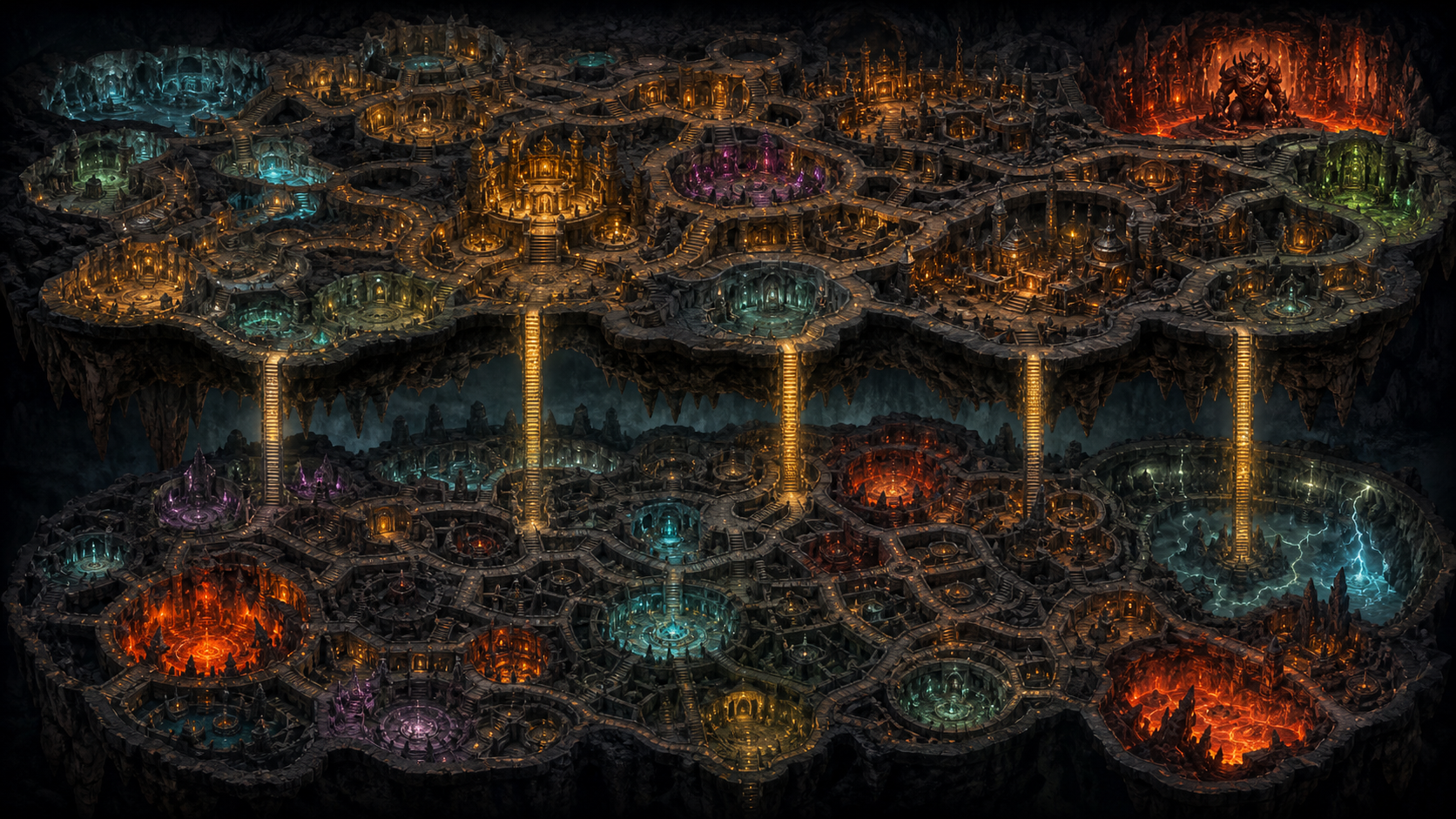
The First Floor turns the end of Earth into a tutorial under lethal pressure. Carl enters carrying Donut, finds a tutorial guild and Mordecai, and learns the dungeon's basic language: achievements, loot, safe rooms, monster neighborhoods, boss gates, floor timers, and stairwells.
Geography and route
The floor is not a tidy corridor map. It is a huge network of tunnels, neighborhood territories, guild doors, safe rooms, workshops, boss chambers, and widely scattered routes down. Its local spaces include the goblin workshop and chopper route, monster neighborhoods, the Hoarder encounter, the Krakaren clone fight, Meadow Lark's refuge points, and the Borough Boss approach.
Why this floor matters
The First Floor establishes the series' central bargain: surviving requires Carl and Donut to become entertaining enough to receive attention and resources, even while that attention gives the crawl more ways to exploit them. It also turns Carl from an isolated survivor into someone other people begin to follow.
Reading the rendering
Read the upper layer as a story network rather than a measured blueprint: warm doors mark refuge and instruction; industrial zones mark goblin territory and Carl's early sabotage; large circular chambers mark the boss gates that turn descent into spectacle.
Book 1: Dungeon Crawler Carl
Second Floor
The Second Floor removes the comfort of calling the crawl a tutorial. Carl and Donut have more tools, a growing reputation, and a wider group to worry about, but the routes are denser, the mobs are stronger, and the transition to the Third Floor forces permanent race and class choices.
Geography and route
Its tunnels include safe rooms and storm-shelter refuges, reward spaces, boss routes, ordinary-looking chambers turned into traps, and descent points that matter because separated crawler groups must reach them before collapse. Agatha's trail adds a mystery running through the practical problem of moving safely.
Why this floor matters
By the time the Second Floor collapses, Carl and Donut are no longer anonymous survivors learning an interface. Their build choices, public image, new companion, and ties to other crawlers will shape every later floor. The dungeon has taught them enough to plan—and enough to understand how deliberately it creates impossible choices.
Reading the rendering
The lower layer is intentionally tighter and more hazardous than the First. Glowing vertical shafts show the importance of descent, while the larger enclosed chambers represent reward and boss spaces that interrupt normal travel.
Book 2: Carl's Doomsday Scenario
Third Floor: The Over City
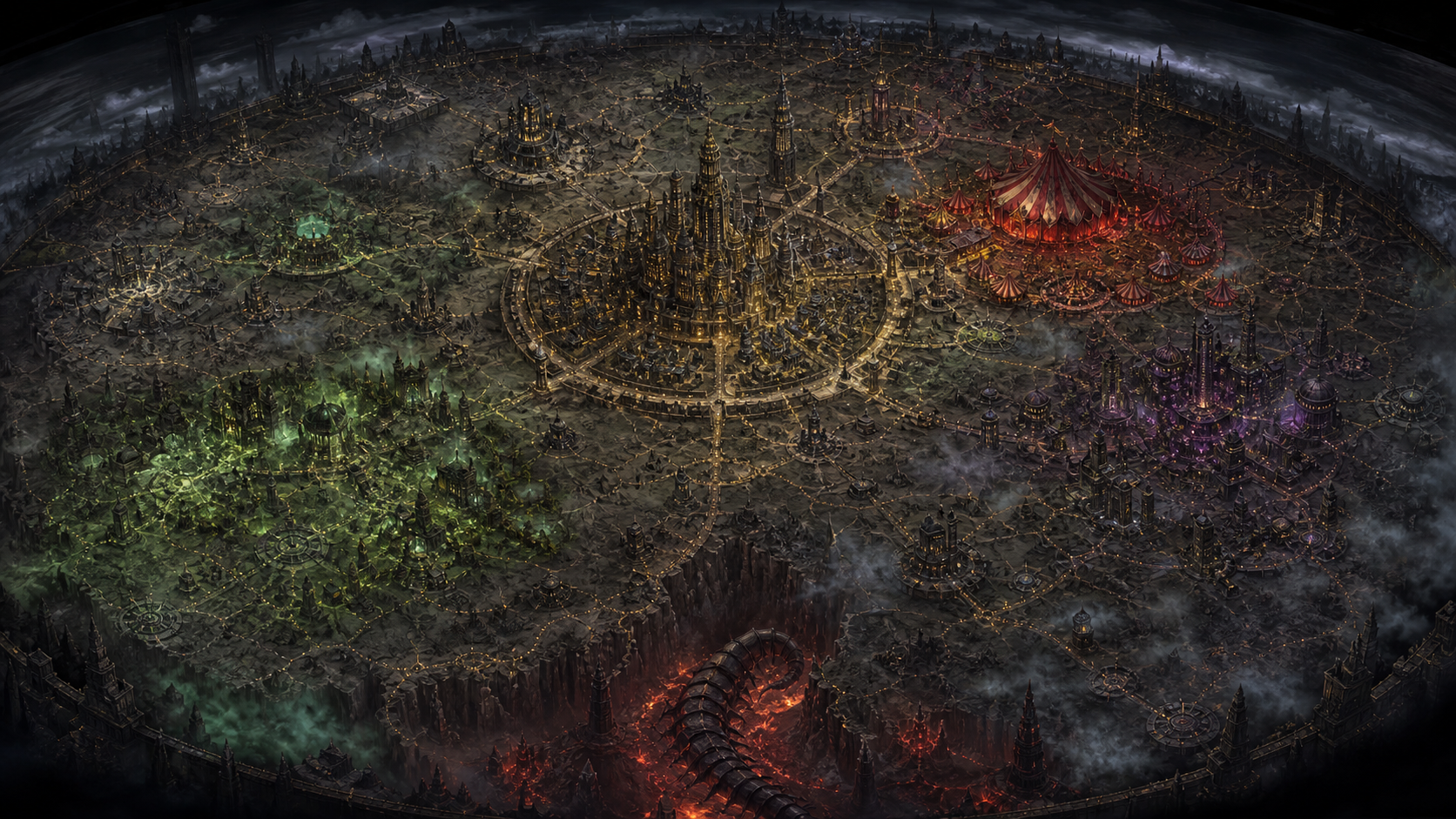
The Over City replaces tunnel survival with a populated urban-fantasy world. Carl and Donut arrive after choosing new races and classes, then move among unnamed settlements, monster-filled ruins, administrative spaces, clubs, and quests that reveal the recurring Scolopendra story beneath the floor.
Geography and route
A main metropolis and many settlements sit inside a broad ruined landscape. Tutorial guilds remain in medium villages, while roads and signposts connect safe rooms, quest areas, settlement bosses, the administrative district, the Desperado Club, and the nightmare centered on Grimaldi's circus. The layout mixes inhabited streets with areas transformed by the old nine-tier attack.
Why this floor matters
The Third Floor teaches Carl that each floor's story is connected to a larger inherited mythology. It also expands his problems beyond immediate combat: quests, administrators, clubs, sponsors, and other crawler teams all influence which routes are possible.
Reading the rendering
The central city is the navigation anchor; the red circus quarter represents the Grimaldi arc; green and violet districts suggest regions altered by the cataclysm. Routes radiate outward to show how the floor makes travel between settlements part of the danger.
Book 3: The Dungeon Anarchist's Cookbook
Fourth Floor: The Iron Tangle
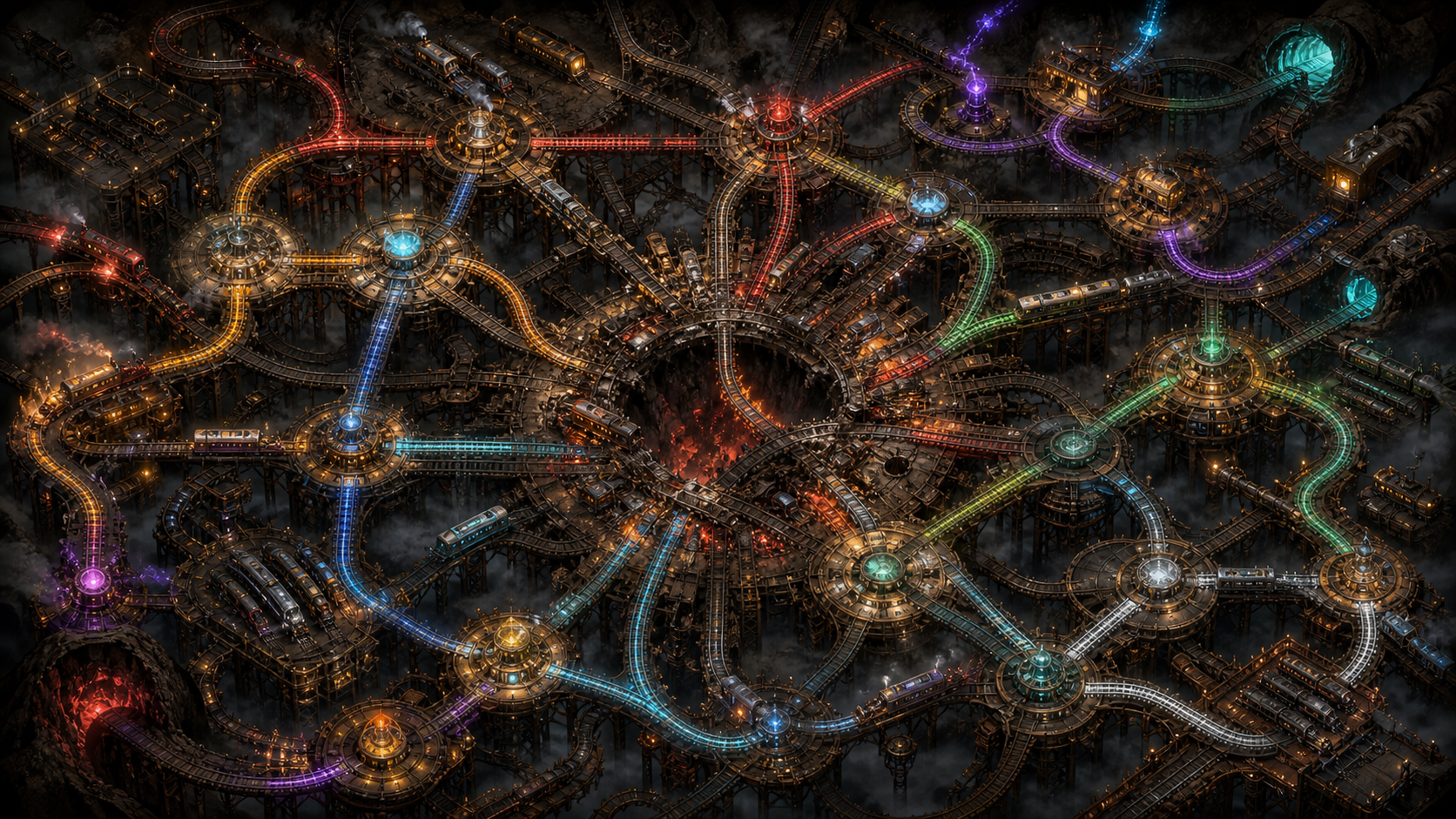
The Iron Tangle is a transit system turned into a floor-wide logic trap. Colored train lines, stations, transfers, trainyards, portals, souvenir hats, false stations, and the Abyss make movement itself the main enemy.
Geography and route
The floor is an interconnected rail web rather than a series of rooms. A station can be refuge, trap, boss arena, transfer point, or false destination. Trainyards and repair portals reveal how the system resets and services its own machinery. Stairwell stations and collapsing routes eventually force separated crawler groups toward shared chokepoints.
Why this floor matters
The Iron Tangle proves that Carl's most important weapon is systems thinking. He stops treating survival as a sequence of fights and starts treating the whole floor as infrastructure that can be understood, rerouted, and broken. That shift makes his later coalition leadership believable.
Reading the rendering
Colored rails are conceptual route families, not an exact station chart. Hubs show transfers and trainyards; dead ends and dark platforms suggest mimic stations and damaged lines; the central void represents the Abyss and the danger of assuming every route is meant for crawlers.
Book 4: The Gate of the Feral Gods
Fifth Floor: The Bubbles
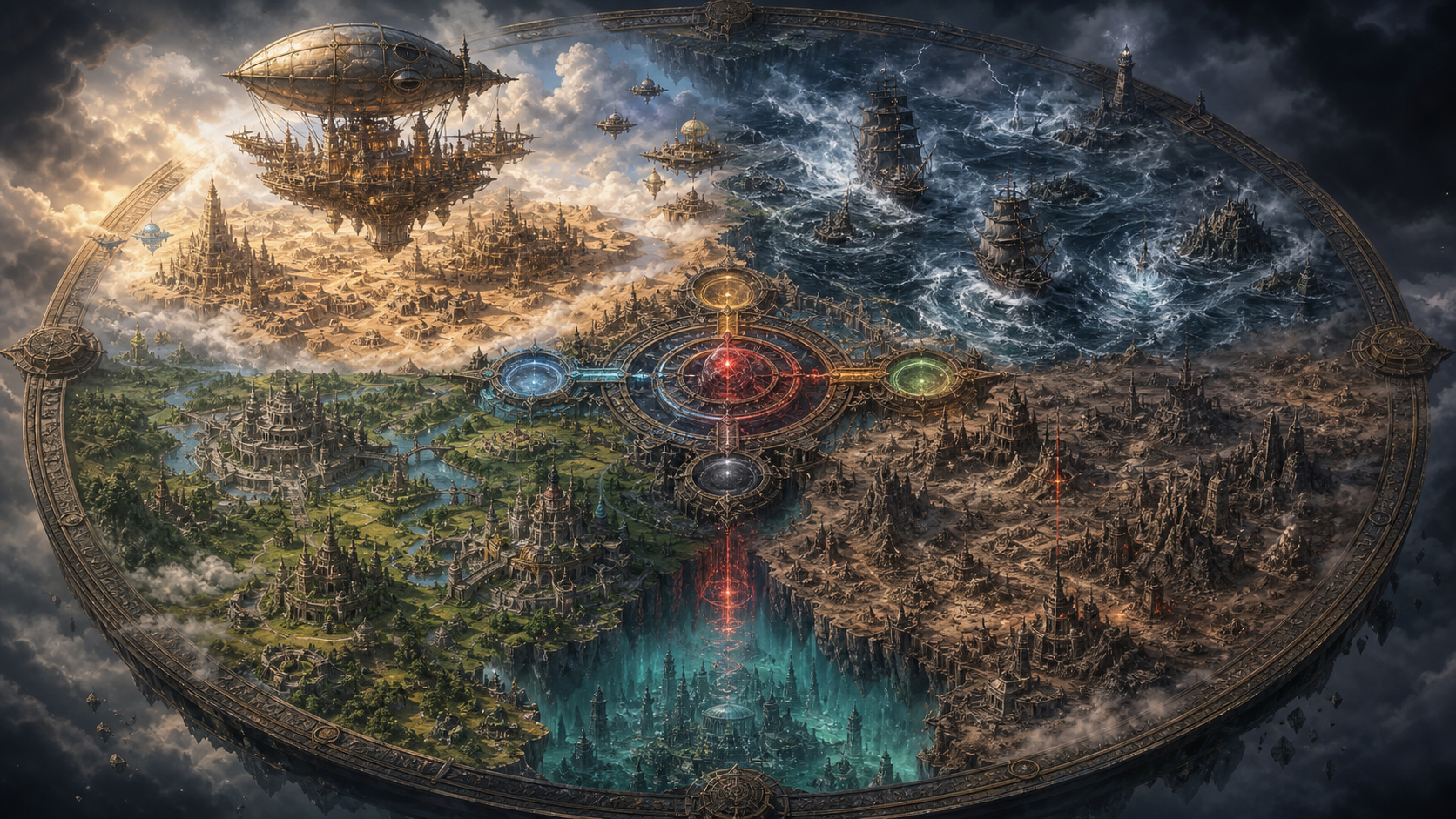
The Fifth Floor divides the surviving crawlers among self-contained worlds called bubbles. Carl, Donut, and Katia enter Bubble 543 in the Air Quadrant, where a desert settlement and the Wasteland Fortress open a quest that eventually connects all four environmental sectors.
Geography and route
Bubble 543 contains air, water, land, and wasteland environments, each with its own settlements, rulers, hazards, and liberation condition. Hump Town anchors the party's opening desert route; the gnome fortress dominates the sky; other crawler teams contend with stormy water and separate land conflicts. The Gate of the Feral Gods turns these isolated zones into a network.
Why this floor matters
The Fifth Floor is where Carl's floor-breaking starts changing geography he has not reached yet. Flooding Larracos damages future faction armies but also kills NPCs and creates consequences the party must face on the Ninth Floor. The Gate becomes both rescue tool and weapon of mass disruption.
Reading the rendering
The four sectors are shown as a single interpretive bubble for clarity, even though travel and sightlines are controlled by the floor's rules. The central mechanism represents the assembled Gate linking formerly separate story regions.
Book 5: The Butcher's Masquerade
Sixth Floor: The Hunting Grounds
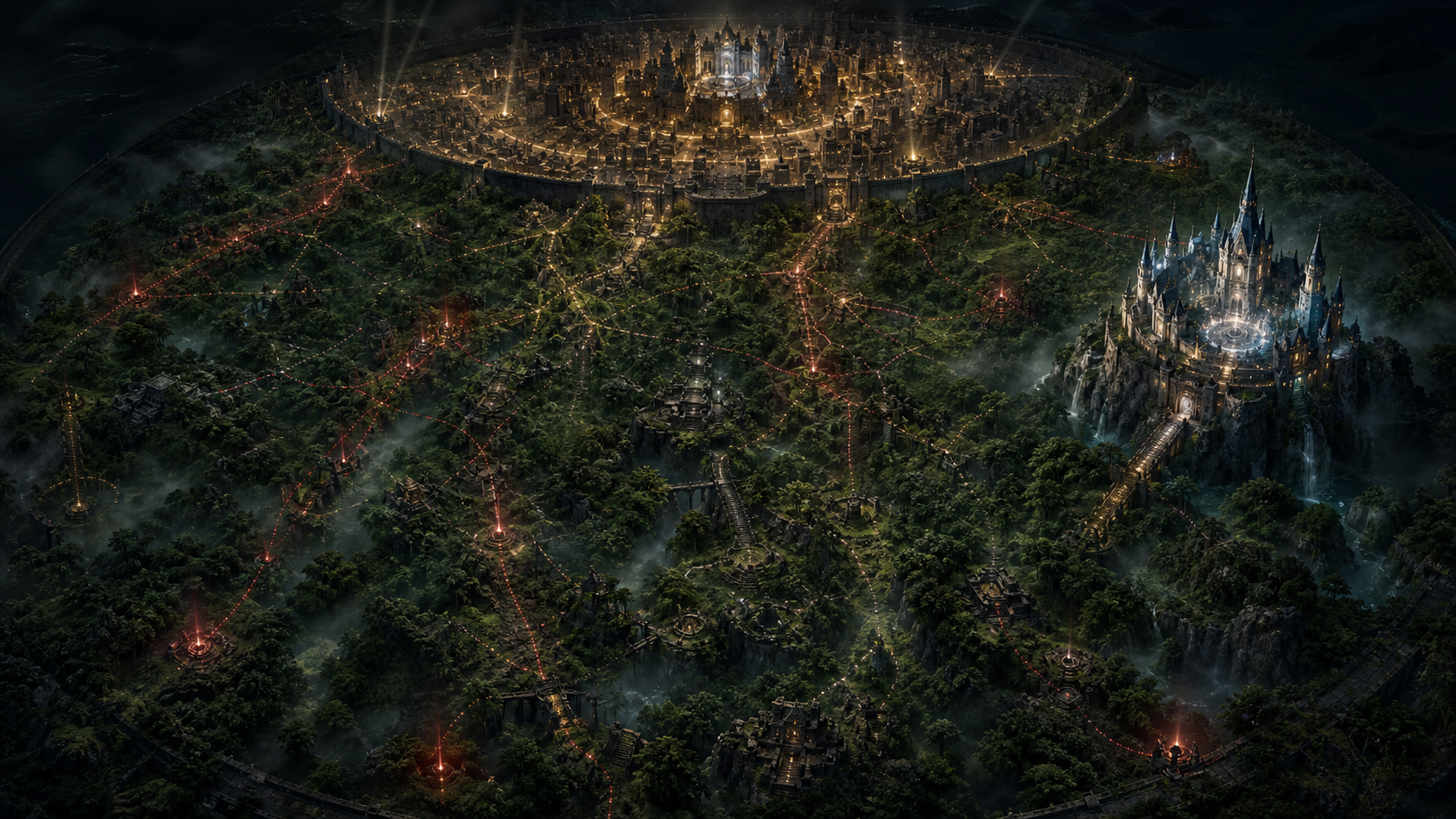
The Hunting Grounds turns wealthy off-world hunters loose against crawlers. All hunters begin in Zockau and receive a grace-period delay before spreading through a round world of jungle, ruins, rebuilt settlements, traps, and hidden exits.
Geography and route
The floor echoes the Third Floor's scale but replaces many abandoned ruins with jungle. Zockau is the named northern city and the hunters' starting point. Trails lead through settlements and dinosaur country toward stairwells, Desperado access, hidden objectives, and the high elf castle where the Butcher's Masquerade gathers hunters and top crawlers.
Why this floor matters
The Sixth Floor converts Carl's rebellion into a public counter-hunt. The party kills every hunter, moves an NPC army and castle toward the Ninth Floor, and leaves with the Crown crisis threatening Donut and Katia. Victory makes the coming war more personal rather than safer.
Reading the rendering
The red paths show the implied pressure of hunters radiating from Zockau, while the isolated castle marks the Masquerade's separate spectacle space. Stairwell lights are distributed across the jungle because finding an exit is possible, but reaching it safely is the real problem.
Transition between Books 5 and 6
Seventh Floor: The Great Race
The Seventh Floor is the Great Race, a one-way branching tube maze that Prepotente destroys almost immediately. The surviving crawlers move from the Sixth to the Eighth before undertaking the intended race.
Geography and route
The planned course begins in Pole Position Chambers and feeds into hundreds of kilometers of one-way tubes, branching nodes, puzzle routes, limited zero-danger paths, pitstop safe rooms, and a central exit pull. Because the floor breaks within minutes, the crawlers do not travel enough of that geography to support a conventional route map.
Why this floor matters
Destroying the Great Race demonstrates that a dungeon floor can be broken, deprives the survivors of progression time, and humiliates the production system. The Tenth Floor later uses a separate seven-heat format called Don't Come in Last.
Reading the rendering
No conventional route map is shown because the Great Race is destroyed before normal traversal. The atlas records the planned tube-maze concept and the broken threshold without inventing a journey the crawlers never make.
Book 6: The Eye of the Bedlam Bride
Eighth Floor: The Ghosts of Earth
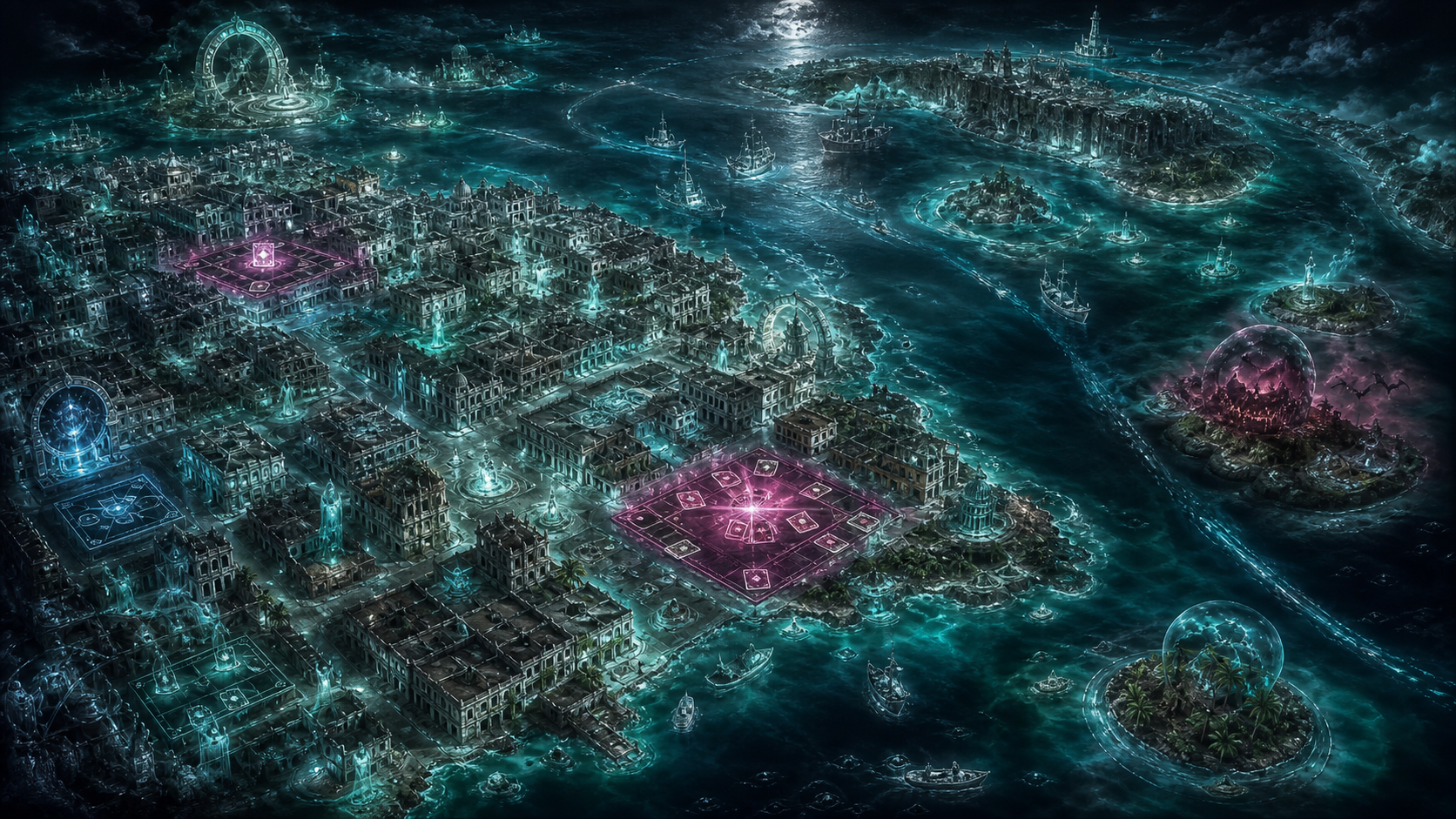
The Ghosts of Earth rebuilds 293 regions from the lost planet as haunted environments whose dead residents continue fragments of their former routines. Carl's route begins in Havana and expands through ocean and island spaces while the floor's card-based combat turns remembered places into tactical arenas.
Geography and route
Havana's streets look lived-in but are populated by ghosts trapped in loops. Water separates regional zones and makes boats, coastlines, and island routes important. Safe rooms and battle spaces overlay the recreated geography, while holiday bosses and card encounters impose a second, artificial map on top of human memory.
Why this floor matters
The Eighth Floor makes the destruction of Earth physically present again. Its ghosts deny the crawl's attempt to reduce the planet to a game board, while its card system forces the party to turn people, monsters, and relationships into playable combinations.
Reading the rendering
The spectral city and islands represent the party's region and routes, not all 293 regions. Magenta fields mark the card layer superimposed on familiar geography; cyan figures and lights represent memory loops rather than a living population.
Book 7: This Inevitable Ruin
Ninth Floor: Faction Wars
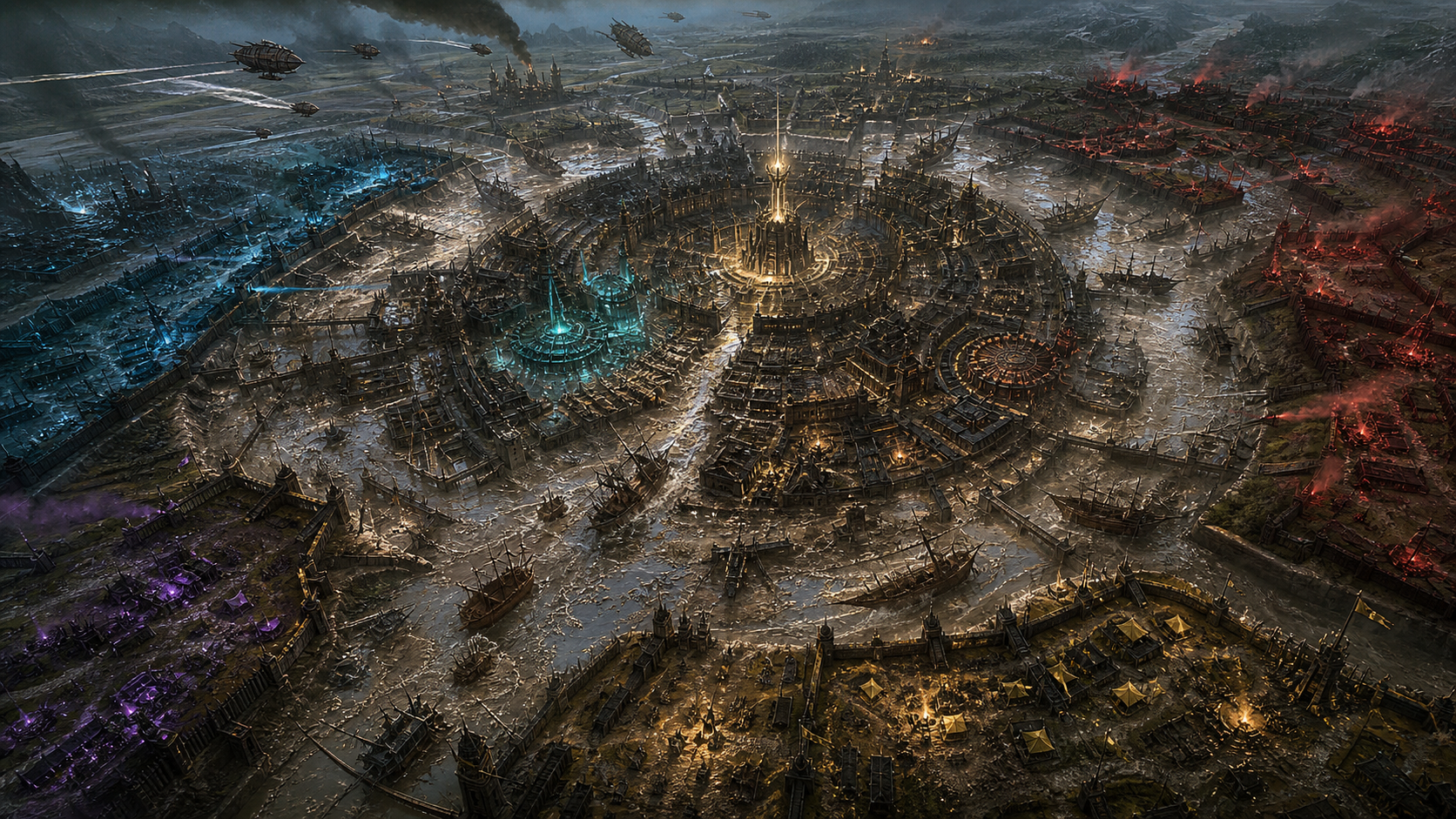
The Ninth Floor turns the disputed lands around Larracos into open war. Outside powers bring armies to compete for the city, while the Princess Posse, allied crawlers, freed NPCs, former crawl figures, and faction enemies fight under rules Carl has spent several books trying to change.
Geography and route
Larracos is a funnel-shaped capital with a college, theater and commercial districts, clubs, streets, canals, and access to surrounding territories. The flood caused on the Fifth Floor reshapes the battlefield before the crawlers arrive. Bases, castles, trenches, air routes, NPC positions, and faction borders turn the broader map into a military system.
Why this floor matters
Faction Wars makes explicit what earlier floors implied: the crawl is a political machine backed by governments, corporations, armies, and spectators. Carl's refusal to remain chaff changes the conflict, but the cost leaves the survivors exhausted, traumatized, and immediately exposed to another lethal format.
Reading the rendering
The drained flood basin and stranded vessels show the Fifth Floor's delayed consequence. Colored encampments represent competing forces rather than exact faction boundaries; the central city remains the prize and the location where independent objectives collide.
Book 8: A Parade of Horribles
Tenth Floor: Don't Come in Last
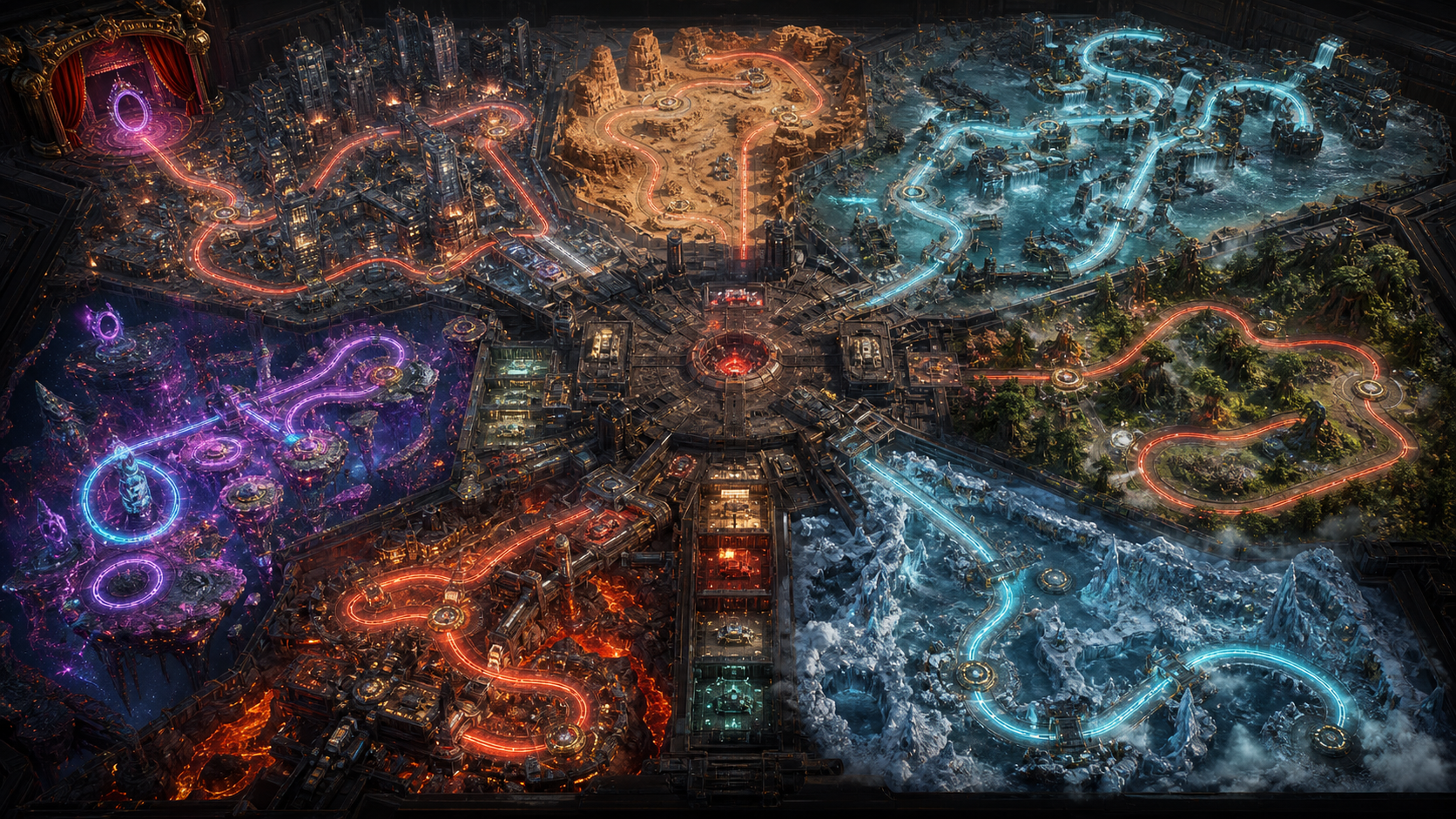
The Tenth Floor presents a second, distinct race format. “Don't Come in Last” consists of seven heats, with teams of no more than four travelling from point A to point B by mechanical or biological conveyance while the last-place survival containment fails.
Geography and route
Each team receives a garage, support staff, and a vehicle or mount that becomes both transport and survival system. The seven routes change environments and problems, with upgrade opportunities between stages. Safe-room access is blocked during heats, and the Pineapple Cabaret thread opens a second route through the floor's backstage politics.
Why this floor matters
The Tenth Floor compresses the war's survivors into a cruel elimination format before they can recover. It is structurally distinct from the Seventh Floor's branching Great Race maze: seven separate heats rather than one course shattered before traversal. Only twenty-three crawlers reach the Eleventh.
Reading the rendering
The seven environmental circuits are shown as one hub-and-spoke atlas for comprehension. The central structure represents garages and inter-heat preparation; the route plates represent changing courses rather than simultaneous neighboring regions.
Book 8: A Parade of Horribles
Eleventh Floor: The Parade of Horribles
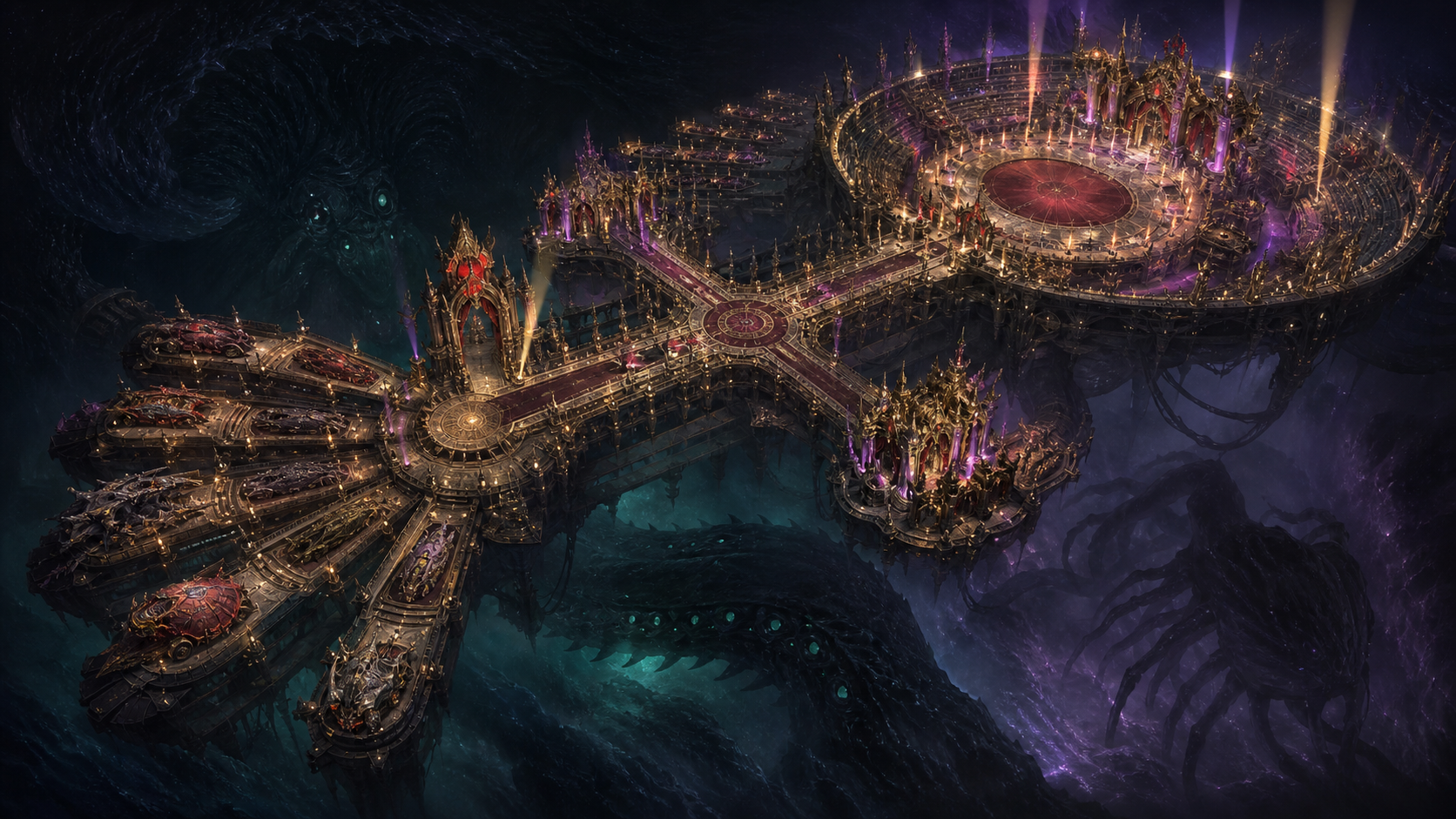
The Eleventh Floor begins with only twenty-three crawlers and almost no recovery time. Its Parade of Horribles turns staging bays, assigned floats, judging, performance, and a climactic arena into the public face of a much larger system crisis.
Geography and route
Crawler staging areas feed into a ceremonial parade route and arena surrounded by an audience and powerful observers. Floats are not decoration; they are assigned platforms inside the challenge. The floor's architecture concentrates surviving crawlers and outside threats into a single spectacle while events on deeper floors and inside the system press against it.
Why this floor matters
The Eleventh Floor collapses the distinction between show finale and real catastrophe. What looks like another produced challenge becomes a point where the AI's condition, divine conflicts, the Nothing, Krakaren Prime, and the Scolopendra narrative can no longer be treated as separate background systems.
Reading the rendering
The staging petals feed a single parade spine and arena. The shapes beneath the structure are intentionally abstract: they communicate pressure from deeper threats without pretending the books provide a clean, conventional floor plan.