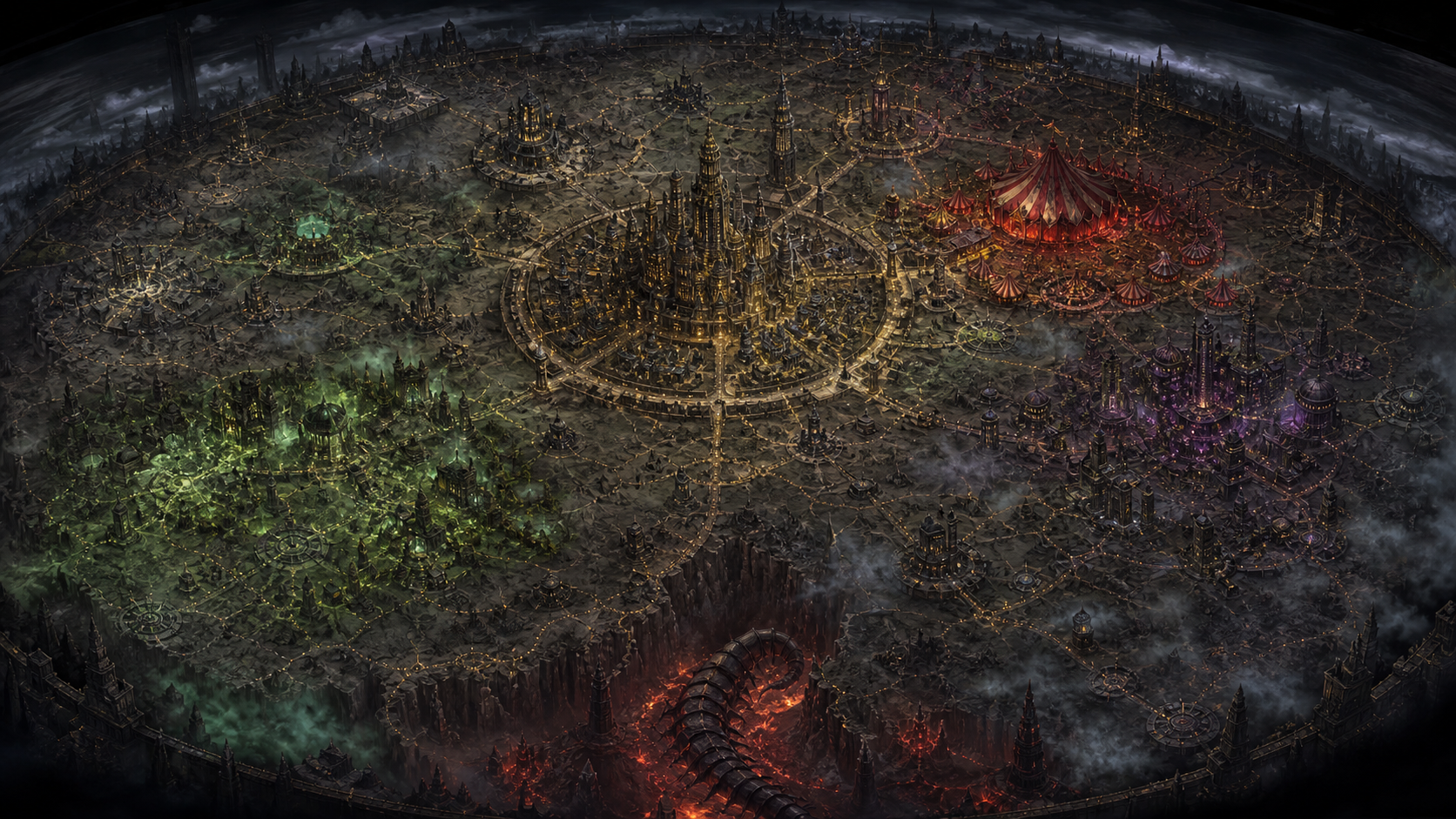
Overview
The Third Floor is the point where the dungeon stops feeling like a tutorial extension and becomes a structured urban game space. It is tied to quests, city routes, borough or zone logic, and the first major lesson that geography is also story design. The recommended scope is Book 2 to Book 3 continuity, with the Over City and the lead-in to the Iron Tangle depending on the route being discussed, with primary setting pressure around Third Floor or early multi-floor infrastructure. The larger continuity arc is urban quest logic, rule announcements, borough pressure, and the first clear sense that dungeon geography is designed as an interconnected entertainment product.
Location role
The Third Floor is the point where the dungeon stops feeling like a tutorial extension and becomes a structured urban game space. It is tied to quests, city routes, borough or zone logic, and the first major lesson that geography is also story design. A strong location page does four jobs. First, it tells readers which book or floor they are looking at. Second, it explains what kind of story happens there: travel, combat, social pressure, divine bargaining, faction politics, broadcast manipulation, rescue logistics, or endgame setup. Third, it lists the most important characters or groups connected to the location. Fourth, it points readers toward adjacent routes so The story becomes part of a navigable floor map.
Narrative function
The recommended context for Third Floor is Book 2 to Book 3 continuity, with the Over City and the lead-in to the Iron Tangle depending on the route being discussed and Third Floor or early multi-floor infrastructure. The location participates in the larger arc of urban quest logic, rule announcements, borough pressure, and the first clear sense that dungeon geography is designed as an interconnected entertainment product. This matters because Dungeon Crawler Carl locations are not neutral backdrops. A hallway, station, club, temple, battlefield, or race chamber can define what choices are possible. The series repeatedly turns geography into rules. For example, rail spaces create timing and rescue problems. Temples and divine spaces create authority and bargain problems. Masquerade spaces create social and status problems. Faction-war spaces create command, siege, alliance, and betrayal problems. Race-floor spaces create speed, position, repair, and elimination problems. The final page can make clear which kind of pressure Third Floor creates.
Characters, factions, and routes
This article identifies the major characters, parties, factions, or creature groups connected to the location. Do not overfill the opening paragraph with every related name. Instead, use a short relationship-and-route section with links. If The story belongs to a larger location family, such as Iron Tangle stations, Bubble quadrants, Hunting Grounds venues, Larracos battlegrounds, or Tenth Floor race sites, include a small "Part of" line near the top.
Map and source notes
If the site later adds visual maps, This article includes a compact map note rather than a long speculative layout. For now, use prose that helps readers understand relative function: entrance, route, staging point, command point, hazard zone, social venue, divine site, or exit path. Exact chapter numbers, route diagrams, and coordinate-style details can be verified before publication.
Series Context
Within Dungeon Crawler Carl, Third Floor anchors a location thread shaped by floor geography, hazards, safe-room routes, factions, and major events. Its strongest related threads include Spoiler-Safe Reading Guide, Books and Floors Map, Carl, Princess Donut, and Full-Series Timeline Spine, connecting crawl geography with character movement and story consequences.