Spoiler notice
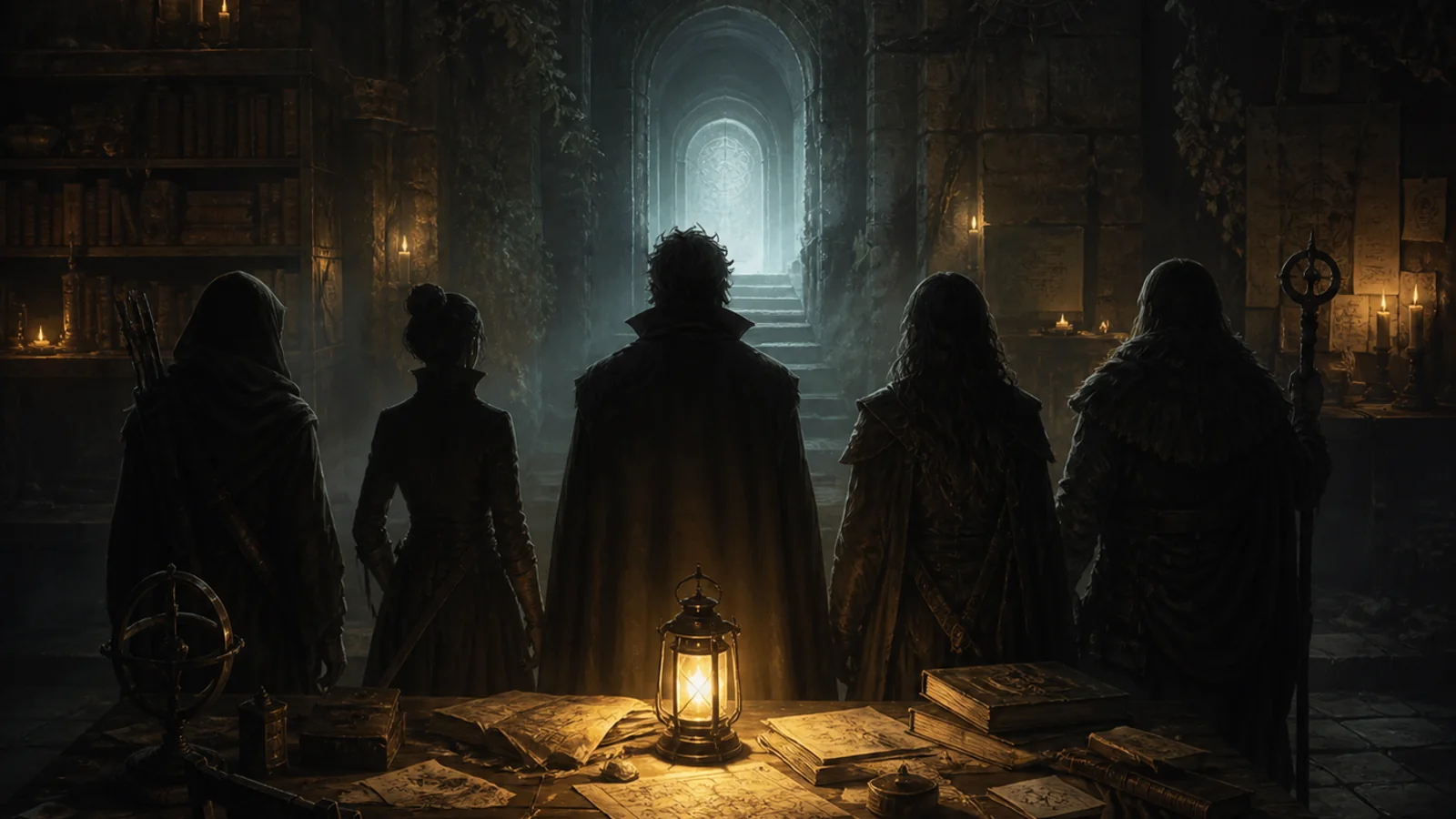
Spoilers for Dungeon Crawler Carl through Book 8 and the named source franchise may appear. This article discusses team roles, research, magic, emotional cohesion, and monster-hunting experience. The imagery is environment/object-only and does not depict Buffy, the Scooby Gang, teenage characters, actors, violence against minors, or recognizable franchise costumes.
Buffy's Scooby Gang may be one of the most naturally DCC-compatible crossover teams for a reason that has little to do with raw strength.
They already treat apocalypse as a research problem.
Hulu's official series description identifies Buffy the Vampire Slayer as a comedy-action story about Buffy Summers, a teenage girl gifted with the strength and skill to hunt vampires. Hulu's own retrospective material emphasizes that Buffy works together with mortal friends to protect the world from supernatural threats while navigating fear and uncertainty.
That combination matters.
Buffy is not a solo monster-hunter story wearing a friend group for decoration.
The group is the method.
One person fights.
One researches.
One uses magic.
One finds the obscure translation.
One notices the emotional problem nobody wants to name.
One makes a terrible joke at the wrong time and somehow keeps everyone functioning.
DCC rewards exactly that kind of distributed competence.
The question is not whether the Scoobies understand monsters.
They do.
The question is how they respond when monster knowledge is no longer enough because the environment is also a game, a broadcast, a sponsor economy, and a rule system that can change the meaning of every encounter.
The Scoobies Already Think Like a Party
Their role translation is best read with Crawler Team Dynamics Map, Safe Rooms: Strategy, Recovery, and Emotional Reset, and Rules as Character Pressure.
Many crossover teams have to learn party specialization.
The Scoobies already live it.
Buffy's role is physical response and field leadership.
Willow's role increasingly becomes magical research and spellcasting.
Giles provides institutional knowledge, languages, history, and judgment.
Xander contributes practical support, social continuity, and surprising usefulness precisely because he is not defined by supernatural power.
Different later members expand the group in different directions, but the basic Scooby method remains stable: research first, improvise second, survive the apocalypse together.
That is extremely DCC-compatible.
Probable Dungeon Roles
Any exact class assignment is speculative, but broad party roles map cleanly.
Buffy: Frontline leader / damage / protector
Buffy would be the party's immediate combat anchor. Her supernatural physical advantages translate well to melee-heavy early floors. More importantly, she is accustomed to fighting things that do not obey normal human assumptions.
She would probably choose a class emphasizing mobility, close combat, monster specialization, and protection rather than pure tanking.
Willow: Caster / researcher / support
Willow's value would escalate rapidly as the crawl becomes more magical. She would be invaluable for identifying spell systems, magical classifications, ritual interactions, and unconventional solutions.
Her biggest danger would be power escalation. DCC loves offering increasingly extreme capability at increasingly strange cost.
Giles: Lore specialist / analyst / support
Giles is almost a DCC cheat code in conceptual form. He is a dedicated researcher in a universe where obscure monster history routinely determines whether a fight is survivable.
He would be less physically dominant but essential in safe-room planning, item interpretation, translation, and distinguishing real mythology from system-invented nonsense.
Xander: Utility / engineering / morale
Xander would be underestimated by the audience and possibly by the System. That could become an advantage. DCC repeatedly rewards people who can improvise with ordinary tools, stabilize teams, and contribute without having the obvious glamorous build.
His role would probably expand through crafting, construction, logistics, or support mechanics rather than direct magical power.
Anya: Economy / social systems / practical analysis
If included in the lineup, Anya could become surprisingly important once sponsor economics, shopping systems, pricing, and social rules matter. DCC turns commerce into survival. Someone comfortable thinking concretely about value would help.
Tara: Magical support / emotional stabilizer
Tara's strengths would lie in careful magic, empathy, and reducing the volatility of a team containing stronger and more impulsive personalities.
Research Is Their Greatest Advantage
DCC is full of monsters, but the most dangerous feature of many monsters is not raw damage.
It is hidden logic.
A creature may have a specific weakness.
A quest may depend on old history.
An item description may contain a clue.
An NPC may be reenacting mythology inaccurately.
The Scoobies are used to research changing the outcome of a fight.
That is a huge advantage.
They would not treat the bestiary as flavor text.
They would compare sources.
They would argue over translations.
They would look for recurring motifs.
They would ask whether the System is lying by omission.
This behavior would make them extremely effective on puzzle-heavy and mythology-heavy floors.
Monster Knowledge Versus Dungeon Taxonomy
The main complication is that DCC's monsters are often not drawn from one coherent supernatural tradition.
They may be original.
Artificial.
Mixed.
Comedic.
Rule-dependent.
The Scoobies would therefore need to unlearn one habit: assuming a monster name implies a familiar set of folklore rules.
If the System calls something a vampire, that does not guarantee Sunnydale vampire logic applies.
Giles would recognize this quickly.
Buffy might require one painful demonstration.
Willow would start building a new taxonomy.
Once the group accepts that the dungeon is an unreliable bestiary editor, they become much stronger.
Magic and the System AI
Magic is where the crossover gets dangerous.
DCC magic is heavily formalized through skills, spells, classes, cooldowns, item interactions, and system rules. Buffy-universe magic is often more ritual, research, intention, and consequence oriented.
Willow and Giles would be fascinated and suspicious.
The System AI would probably love giving Willow a highly powerful spell with an outrageous description and a hidden long-term implication.
That could become one of the party's central risks.
The group has experience with magical consequences.
That means they might actually handle DCC temptation better than many teams.
They already know power can change the person using it.
Repeated-Apocalypse Experience
One of the Scooby Gang's biggest advantages is psychological normalization of impossible threats.
They have seen the world almost end more than once.
That does not make catastrophe easy.
It does make catastrophe cognitively survivable.
When the dungeon announces a floor collapse, demon invasion, god-related quest, or reality-changing event, they are less likely to waste time on disbelief.
Buffy would ask what kills it.
Giles would ask what text mentions it.
Willow would ask what magic interacts with it.
Xander would ask what everyone forgot to bring.
That is an excellent crisis pattern.
Emotional Cohesion
The Scoobies are not emotionally simple.
That is an advantage and a danger.
They know one another deeply.
They also carry histories of secrecy, resentment, romantic conflict, trauma, jealousy, and betrayal.
Dungeon Crawler World would exploit all of it.
The crawl repeatedly turns relationships into mechanics. It separates teams, rewards visibility, creates unequal item distribution, and places individuals under different forms of pressure.
The Scoobies have enough history to survive conflict.
They also have enough history for conflict to become catastrophic if communication breaks.
Their survival would depend less on whether they love one another and more on whether they can keep telling the truth under pressure.
Buffy as a Public Figure
Buffy would likely become a major audience draw despite not seeking celebrity.
The archetype is easy to understand: young woman with extraordinary strength, leadership burden, dark humor, and constant responsibility.
That visibility would attract sponsors.
It would also create expectations.
The audience might want a cleaner heroic narrative than Buffy's actual life allows.
DCC is very good at punishing people whose public image becomes too simple.
Buffy would have to learn Donut's lesson: public identity is a tactical environment whether you like it or not.
Giles Versus the Sponsor Economy
Giles would hate the sponsor system almost immediately.
Not because all outside assistance is bad, but because the system contaminates aid with motive.
A useful item may also be a brand intervention.
A sponsor may also be a political actor.
A gift may also be a test.
Giles's instinct would be to research every benefactor as if it were an occult artifact.
That is sensible.
It may also irritate the party when the sponsor box contains something they desperately need now.
Willow and Achievement Pressure
Willow may be the member most vulnerable to DCC progression logic.
Achievements and skill growth quantify advancement.
That can be intoxicating for someone capable of extraordinary magical development.
The System could create a psychologically clean ladder:
Do this.
Gain power.
Open new options.
The problem is that Willow's source story already knows that power progression can outpace emotional stability.
This means the party has both vulnerability and prior warning.
They would recognize the risk earlier than many crossover groups.
Whether recognition prevents the problem is another question.
Xander and the Value of Being Normal
Xander's lack of obvious supernatural power could look like a DCC disadvantage.
It may become the opposite.
A party where everyone is optimized for spectacular power becomes vulnerable to ordinary practical gaps.
Who repairs the door?
Who notices that the food supply is wrong?
Who talks to the terrified NPC without sounding like a wizard or warrior?
Who does not assume every problem needs magic?
DCC repeatedly rewards mundane competence because the system is designed to distract crawlers with flashy options.
Xander's normality could become useful precisely because the crawl undervalues it.
The Safe Room Would Feel Familiar
The Scooby research space has always functioned as a place where the group translates terror into knowledge.
DCC safe rooms would serve a similar purpose.
Books.
Screens.
Arguments.
Food.
Planning.
Emotional repair.
The party would use safe rooms exceptionally well because they already understand that monsters are often defeated during the conversation before the fight.
This is one reason they could survive much farther than raw stats suggest.
Hardest Floors
The most dangerous environments for the Scoobies would be floors that:
- separate them for long periods
- impose anti-magic conditions
- reward betrayal
- force instant decisions without research time
- create false folklore intentionally
Their greatest advantage is collaborative interpretation.
The best way to beat them is to deny collaboration.
Later Politics
As DCC grows from monster survival into faction politics, the Scoobies remain viable because they have long experience with institutions that claim moral authority while hiding supernatural or personal agendas.
Giles provides skepticism.
Buffy provides leadership.
Willow provides power.
The rest of the group helps prevent leadership from becoming isolation.
They would not be natural military commanders on the scale of Faction Wars.
They could become a very effective specialized resistance cell.
That may be more important.
Party Matrix
| Member | Probable DCC role | Biggest strength | Biggest risk |
|---|---|---|---|
| Buffy | Frontline leader / damage | Combat plus repeated apocalypse experience | Public pressure and leadership burden |
| Willow | Caster / research | Magic and system analysis | Power escalation |
| Giles | Lore / support | Research and historical interpretation | Overcaution under timers |
| Xander | Utility / crafting / morale | Practical solutions and cohesion | Lower raw progression ceiling |
| Anya | Economy / social systems | Value analysis and directness | Friction and incentive temptation |
| Tara | Support caster / stabilizer | Careful magic and emotional steadiness | Vulnerability under separation |
Final Verdict
Buffy's Scooby Gang would be an excellent Dungeon Crawler World party because their defining advantage is not the Slayer.
It is the method.
Threat appears.
Research begins.
Arguments happen.
Someone finds the obscure clue.
Buffy handles the immediate violence.
Willow solves the impossible magic problem.
Giles explains why the ancient text is technically correct and practically misleading.
Xander does something useful nobody expected.
The group survives because no one person is required to be the whole answer.
That is exactly the kind of team DCC rewards in the long run.
The dungeon would still hurt them.
It would target Buffy's leadership burden.
It would tempt Willow with quantified power.
It would deny Giles research time.
It would try to make Xander feel irrelevant.
It would separate people whose strength comes from conversation.
But the Scoobies have one enormous advantage over most crossover teams:
They already know the apocalypse is usually defeated twice.
First in the library.
Then in the field.
Dungeon Crawler World may be more technologically strange than Sunnydale, but the underlying lesson remains useful.
Know your monster.
Know your friends.
And never assume the official explanation is the whole story.
Their Research Method Would Need to Become Faster
The Scoobies' research advantage is enormous, but DCC would immediately expose its time cost. In Sunnydale-style investigations, the group often has at least some opportunity to gather books, compare accounts, and work through a problem before the final confrontation. Dungeon floors frequently deny that luxury. A countdown may be active. A safe room may close. A boss may already be moving.
The group would need to formalize research triage. Giles handles primary-source interpretation. Willow handles magical/system interactions. Xander handles practical environment checks. Buffy gathers field observations. The goal is not perfect understanding. It is enough reliable understanding to survive the next ten minutes.
That change would make the Scoobies more DCC-like without erasing what makes them effective. They would still research first. They would simply learn that sometimes "first" means while running.
The Party's Greatest Secret Weapon Is Redundancy
Many fictional teams collapse when the strongest member is unavailable. The Scoobies are more resilient because their strengths overlap imperfectly. Buffy leads but others can make decisions. Giles researches but Willow can interpret magic. Willow casts but the group can sometimes solve problems without magic. Xander's utility becomes more important when the obvious specialist is absent.
That redundancy is exactly what Dungeon Crawler World rewards over time. Floors split parties. Injuries remove specialists. classes create new limitations. A team that requires one person for every critical function becomes brittle.
The Scoobies are emotionally messy, but operationally redundant. That may be the more important survival trait.
Sponsor Offers Would Create Internal Arguments
The sponsor economy would expose genuine philosophical differences. Buffy might accept help if it protects the group but resist becoming a symbol for someone else's agenda. Giles would want to investigate the sponsor first. Willow might focus on what magical or technical value the item provides. Xander might ask the practical question everyone else is avoiding: can we afford to refuse this?
Those arguments are healthy if they remain visible. DCC becomes dangerous when private sponsor relationships create hidden loyalties or unequal information. The Scoobies' tendency to argue openly could actually protect them from that kind of fragmentation.
The System Would Try to Turn Willow Into Content
Willow's magical growth is not only a power issue. It is an audience issue. A visibly escalating caster makes excellent content. New spells produce spectacular moments, high audience curiosity, and obvious sponsor hooks. The System would have every reason to keep offering ways for her to become more impressive.
That means the party cannot judge magical advancement only by usefulness. They would have to ask why the opportunity appeared, what audience pattern it reinforces, and whether the growth is turning Willow into the kind of crawler the show wants more than the kind of person the group needs.
This is a uniquely DCC version of an old Scooby problem: power is never only power. It is also relationship pressure.
Why They Could Matter Beyond Their Own Survival
If the Scoobies survive long enough to understand NPC personhood and the larger anti-crawl struggle, they are exactly the kind of group likely to become a resistance cell. They are used to believing ordinary people can matter against systems that look much larger than them. They are used to hidden networks, research archives, and moral action without official permission.
They would not necessarily become warlords. They might become something more useful: a high-trust research and intervention unit capable of identifying supernatural-system vulnerabilities before a larger coalition commits resources.
Why the System Would Hate Their Debriefs
The Scoobies have another quiet advantage: they talk after things go wrong. Not always well, not always immediately, but enough that bad experiences can become shared knowledge instead of isolated trauma. Dungeon Crawler World benefits when each crawler learns a lesson privately and dies before transmitting it. A group that habitually debriefs turns every encounter into institutional memory.
That would make the Scoobies unusually resistant to repeated manipulation. If a sponsor offer creates tension, they can name the tension. If the System uses a familiar monster label deceptively, Giles can record the discrepancy. If Willow's progression is changing her decision-making, the group has a vocabulary for confronting it. If Buffy is carrying too much leadership burden, that problem can become visible before it becomes catastrophic.
In other words, their strongest "ability" may be the habit of converting experience into conversation. DCC's Cookbook network does this across generations. The Scoobies do a smaller version inside one party. Every fight becomes research. Every argument becomes future data. Every near failure becomes a protocol.
That is exactly the kind of behavior an exploitative game system does not want becoming normal among crawlers.
FAQ
Who is the most valuable Scooby in DCC?
Buffy is the frontline anchor, but Giles and Willow may provide the biggest long-term advantage because DCC rewards research and magical-system understanding.
Would Willow be overpowered?
Potentially, but the System would likely constrain or gamify her magic, and power progression itself could become a character risk.
Why is Xander useful?
Because practical, non-magical utility and morale become more valuable in a system obsessed with flashy abilities.
Which floor type hurts them most?
Any floor that prevents research, splits the group, or deliberately lies through familiar monster categories.
Would they be popular with the audience?
Yes. Their banter, clear roles, emotional bonds, and repeated-apocalypse resilience would make them highly watchable.
Source and update note
Broad published Buffy the Vampire Slayer team framing supplies the research, monster-hunting, magic, and friendship baseline. The DCC side is a hypothetical synthesis of published-series mechanics through Book 8, including party roles, safe rooms, System AI, audience pressure, and sponsor incentives. No shared canon is claimed.
Primary starting point: Hulu: Buffy the Vampire Slayer overview. These materials establish the source-franchise baseline; the dungeon outcomes, ratings, and comparisons above are editorial interpretations, not an announced crossover.