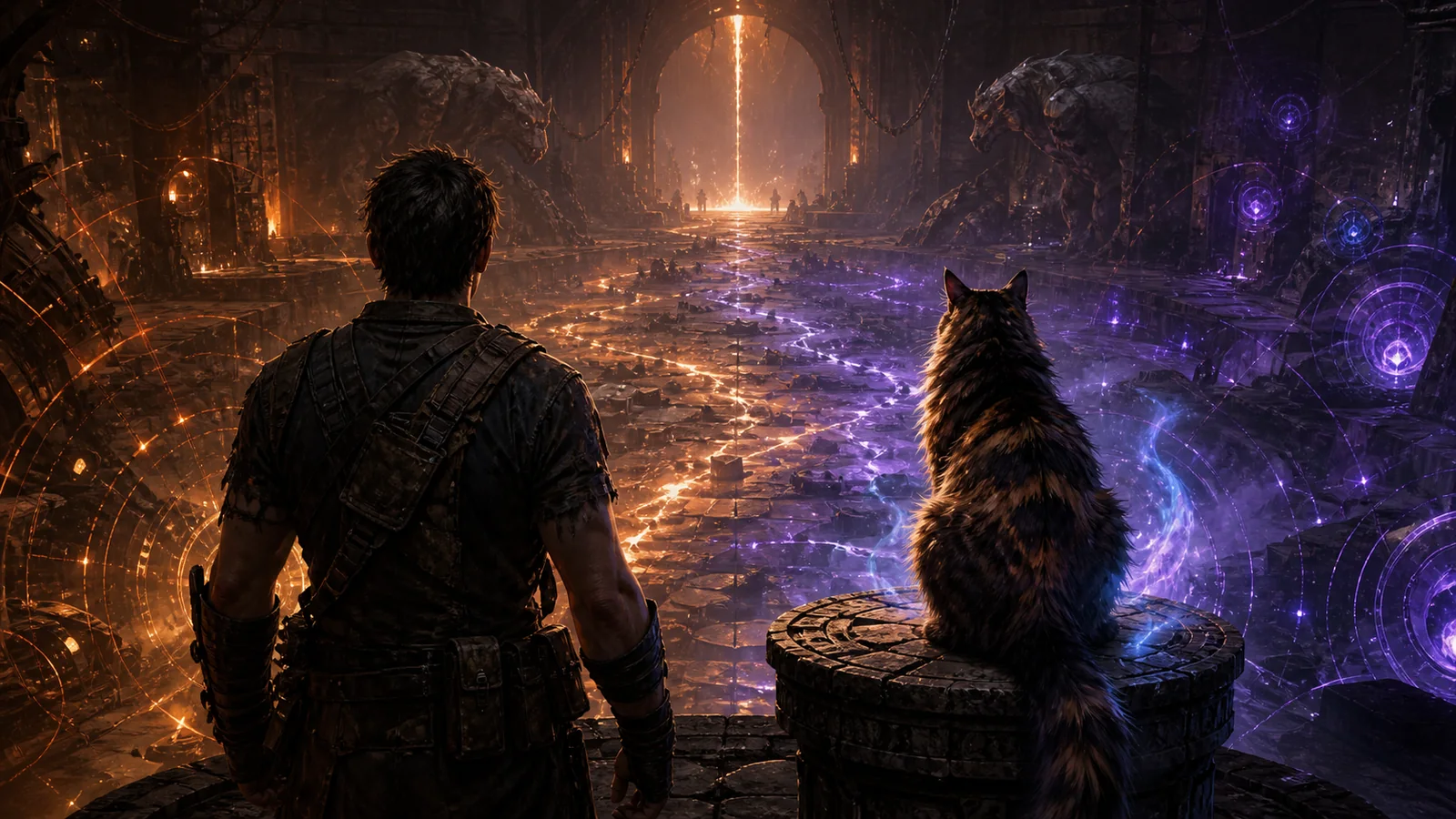
This article discusses major character development, relationship changes, public identities, and selected events through This Inevitable Ruin, Book 7 of Dungeon Crawler Carl. Dungeon Crawler Carl is narrated by Carl. The reader lives inside his observations, his anger, his tactical calculations, his memories, and his increasingly complicated relationship with the dungeon. That makes him the obvious central viewpoint character. But the series does not function like the story of one protagonist accompanied by an unusually entertaining pet. Princess Donut is not merely comic relief, a mascot, or a sidekick. Once she becomes sapient, she begins occupying narrative territory Carl cannot. She can command a room he would rather leave. She understands performance instinctively. She notices social status and humiliation in ways Carl dismisses until they matter. She becomes a ranged magical specialist while Carl becomes an increasingly physical, technical, and improvisational fighter. She can be vain, theatrical, impulsive, and emotionally transparent where Carl is guarded, grim, suspicious, and self-denying. More importantly, Donut has needs, fears, loyalties, wounds, ambitions, and choices that are not extensions of Carl's. Carl and Donut share one story because they choose each other, not because one exists to complete a job assigned by the other. That is what makes them work as dual protagonists. Carl supplies the reader's primary point of view, but Donut supplies a second center of gravity. She changes how the party operates, how the audience sees them, how allies relate to them, and how Carl understands himself. Carl does the same for her. Their partnership becomes the emotional bridge between the intimate story of two survivors and the enormous political, military, and media machinery surrounding the crawl. Neither is a mirror of the other. They are more useful than mirrors. They are pressures, anchors, translators, irritants, protectors, and witnesses to one another. The series works because their differences never disappear. They become more valuable. Carl and Donut do not begin the series as heroic partners. In Book 1, Chapter 1, Carl is a twenty-seven-year-old former Coast Guard member and marine technician standing outside in freezing Seattle weather while holding Princess Donut the Queen Anne Chonk, Beatrice's prize-winning tortoiseshell Persian cat.[1] He is outside because Donut escaped while he was trying to recover her. The circumstances that put them together are accidental. Carl makes clear that Donut is not even his cat in the formal sense. She belongs to Beatrice's cat-show world, a social environment Carl has intentionally avoided. Yet he also admits that he likes her. He respects that she behaves as if nobody owns her and that she chooses when she wants to sit with him. That small pre-dungeon detail matters. Their eventual partnership does not come from instant sentimental attachment. It grows out of an existing, slightly antagonistic familiarity. Carl already knows Donut's personality well enough to be annoyed by her. Donut already knows Carl well enough to seek him out when she wants comfort or attention. Then the world ends. Their domestic relationship is stripped of Beatrice, their apartment, the cat-show circuit, and every ordinary rule that defined who was responsible for whom. Carl becomes the only familiar human presence in Donut's life. Donut becomes one of the only surviving pieces of Carl's former home. That makes the bond emotionally important before either character has language for what it has become. When Donut is transformed and becomes capable of speech in Book 1, Chapter 7, the balance changes again. Her statistics are startlingly high. Her Charisma is exceptional, and her combined stat total is high enough that the system designates her party leader. Donut immediately names the party the Royal Court of Princess Donut, appoints Carl her Royal Bodyguard, and treats the whole development as confirmation of a status she already assumed she deserved.[2] The moment is funny because Carl has spent the opening chapters physically protecting an ordinary cat, only to discover that the newly sapient Donut is, on paper, stronger, smarter, more charismatic, and technically in charge. The joke also establishes the central pattern of the relationship: Carl appears to be the protector. Donut repeatedly proves that protection runs both ways. Carl and Donut work because their differences are not decorative personality traits. Their differences generate decisions. Carl is cautious about attention. Donut enjoys it. Carl's instinct is to distrust institutions. Donut is more willing to engage with the social systems around them, especially when she believes she can control the presentation. Carl tends to compress emotion into action. Donut tends to turn emotion into speech, outrage, performance, or dramatic declaration. Carl is often embarrassed by spectacle. Donut has spent her entire pre-dungeon life being judged in public. The contrast becomes explicit during their first serious media preparation in Book 1, Chapter 28. When Carl questions whether Donut understands how to handle an interview, she reminds him that cat shows were effectively interviews and that she has been doing this her entire life. Her argument is essentially that combat is Carl's environment and public presentation is hers.[3] That division of labor becomes one of the most productive parts of their partnership. Carl understands traps, physical systems, engineering, improvised weapons, and the practical consequences of bad plans. Donut understands rooms. She understands audiences. She understands status. She understands the emotional effect of a phrase, costume, insult, title, or public reaction. Neither skill set is sufficient for Dungeon Crawler World because Dungeon Crawler World is both a death game and a television program. Carl can survive an explosion. Donut can survive an interview. The series repeatedly requires both. Carl's public image initially grows out of qualities he would not have chosen as branding. He is angry. He is sarcastic. He resists authority. He is visibly uncomfortable with the entertainment machinery around him. He keeps getting pushed into situations where his refusal to cooperate becomes more compelling than cooperation would have been. That makes him useful television. Carl's appeal is not polished charisma in the traditional sense. It is friction. He gives the audience the sensation that they are watching someone who does not want to become a character in the show. Every time the producers, hosts, sponsors, or other outside actors attempt to frame him, Carl's resistance becomes part of the frame. The irony is that refusing the role helps create the role. By Book 1, the numbers attached to Carl and Donut begin climbing at extraordinary speed. Their battles, television appearances, controversy, and chemistry generate attention. In Chapter 42, a host describes Carl and Donut as having broken a record for the most-watched Second Floor battle in the history of Dungeon Crawler World.[4] The public does not experience Carl alone. It experiences Carl and Donut. That shared billing is important. Carl's hostility gives the pair danger. Donut gives it color. Carl makes the audience believe something may go wrong. Donut makes sure they keep watching when it does. Donut's public instincts are often mistaken for superficiality by characters who do not understand what those instincts accomplish. She likes titles. She likes admiration. She dislikes looking foolish. She notices clothing, presentation, etiquette, and perceived status. She can become obsessed with slights that Carl considers irrelevant. She can also walk into a studio, turn on a persona, and understand the social game almost immediately. That is not a trivial skill in a universe where ratings affect sponsorship, fan rewards, interview opportunities, legal leverage, and how outside civilizations understand the crawlers. Donut does not merely enjoy attention. She knows how to operate inside attention. Book 1, Chapter 28 is the clearest early statement. Donut tells Carl that the interview environment is her territory and that she has effectively trained for this through a lifetime of cat shows.[3] Later, Zev repeatedly treats the pair as media properties that must maintain audience interest. Book 1, Chapter 44 shows the scale of the attention they are attracting, while Zev discusses what storylines are trending and warns that the pair will need compelling material as they descend.[5] Donut's instincts become survival assets because she can participate in that system without the same instinctive rejection Carl feels. This does not mean Donut is controlled by fame. It means she understands that performance can be used. Carl learns to weaponize mechanics. Donut learns to weaponize image. The partnership also works at the mechanical level. Carl increasingly becomes a close-range fighter, trap builder, explosive specialist, technical improviser, and problem solver. He is good at seeing physical systems and asking how they can be broken. Donut becomes a magical ranged combatant with unusually high Charisma and Intelligence, later developing classes and abilities that reward her very different strengths. Book 1 already establishes the contrast. Donut's Intelligence makes her much more effective with some magic and scroll effects than Carl would be. Her early Magic Missile capability gives the party reliable ranged offense while Carl is still developing his own combat identity.[6] By Book 2, Donut selects the Former Child Actor class, a choice that fits her peculiar combination of performance history, social presence, and magical growth. Zev reports that viewers generally approve of both Carl and Donut's class and race decisions and notes that each has selected a unique class.[7] Their builds are moving apart in a way that makes the party stronger. That is important. The story does not make Donut a smaller version of Carl. It does not make Carl the real fighter while Donut provides commentary. They solve different categories of problem. Carl can look at a room and ask how to destroy it. Donut can look at the same room and identify who needs to be convinced, distracted, insulted, charmed, or publicly embarrassed. In later books, those categories begin overlapping. Donut's magic becomes strategically devastating at long range. Carl's leadership becomes increasingly social and political. But the original contrast remains visible. Their strengths expand toward each other without becoming identical. Carl and Donut argue constantly. That is one reason the relationship feels alive. A weaker version of the partnership would turn their loyalty into permanent agreement. Instead, the books allow them to irritate one another. Donut thinks Carl is crude, badly dressed, unnecessarily stubborn, and frequently insensitive to obvious social realities. Carl thinks Donut is dramatic, vain, distractible, and capable of turning any situation into an argument about something irrelevant. Both are often right. Their arguments provide comedy, but they also demonstrate security. Donut can insult Carl because she assumes the relationship will survive the insult. Carl can tell Donut to focus because he assumes she will still be beside him ten seconds later. The bickering becomes a form of intimacy. This is especially effective because so many other relationships in Dungeon Crawler World are unstable. Parties split. Sponsors manipulate. NPCs are reset or repurposed. Guides have hidden histories. Alliances may last one floor. Audience affection can vanish. Carl and Donut's ability to argue without treating disagreement as abandonment becomes increasingly important. For Donut, that security is something she desperately needs. For Carl, it is something he does not know how to ask for. Donut loves attention. But attention is not her deepest need. Book 5 makes that distinction explicit. In Chapter 12, Donut panics after Mongo runs off. Carl initially treats the episode as an immediate practical problem because Donut becomes dangerous when overwhelmed. He sits with her and waits. Eventually she admits what is actually frightening her. She believes everybody leaves. Katia has left the party. Carl is taking increasingly dangerous risks. Mongo may eventually leave her. She asks whether something about her is so awful that people keep going away.[8] That scene is one of the most important pieces of Donut's characterization in the series because it reorganizes many traits that can otherwise look like simple vanity. Donut wants to be admired, but admiration does not guarantee permanence. She wants to be chosen. She wants to know the people she loves will still be there. Her pre-dungeon identity was built around Beatrice, cat shows, judges, ribbons, breeding expectations, and a household she assumed was permanent. Carl knows something Donut has been avoiding: Beatrice had been preparing to give her away. Donut eventually admits that she already knew. That is the emotional wound underneath the princess persona. If Donut can be the best cat, the funniest crawler, the most beloved personality, the party leader, the star, the queen, the princess, perhaps people will keep choosing her. The dungeon rewards that instinct with followers. Carl answers it with something more important. He stays. Carl presents himself as self-reliant. He solves problems. He protects others. He absorbs responsibility. He keeps moving. The books gradually reveal how dangerous that pattern can become. Carl's protective instinct often becomes self-erasure. If a plan requires someone to take the greatest risk, Carl is likely to place himself in that position. If an ally is threatened, his first impulse is to make the threat his own problem. He is capable of treating his continued existence as less important than the survival of the people around him. That makes him heroic. It also makes him dangerous to himself. Donut sees this increasingly clearly. Book 5, Chapter 12 makes the conflict explicit when Donut tells Carl that his increasingly dangerous behavior frightens her because he acts as if what happens to him does not matter to the people who will be left behind.[8] Her complaint attacks one of Carl's most persistent blind spots. Carl believes sacrifice proves loyalty. Donut reminds him that unnecessary sacrifice can also be abandonment. That is why she is essential to his story. Other characters can tell Carl a plan is stupid. Donut can tell him the emotional cost of dying. Those are not the same argument. The return of Beatrice in Book 5 is one of the clearest demonstrations that Carl and Donut are no longer linked only by shared survival. When Odette reveals that Beatrice survived, Donut reacts physically. Her lower jaw trembles. She jumps to Carl's shoulder. Carl reaches up, and Donut leans into his hand for support.[9] The gesture is small. Its meaning is enormous. Beatrice was Donut's original person. Carl knows Donut once loved Beatrice more than she loved him. Donut said so directly in Book 1, Chapter 34, during what she believed might be a final battle.[10] By Book 5, the hierarchy is no longer simple. The interview with Beatrice in Chapter 19 makes Donut's emotional position even clearer. Before Beatrice appears, Donut tells Carl that Beatrice had been everything to her and that she had spent a long time pretending not to know she was going to be abandoned. Carl prepares Donut for the encounter, and Donut performs composure once the cameras are active.[11] That sequence could have been written as a reunion between pet and owner. Instead, it becomes proof that Donut's home has changed. Beatrice belongs to Donut's origin. Carl belongs to Donut's present. The distinction is central to the dual-protagonist structure because Carl is not replacing Beatrice in the simple sense of becoming Donut's new owner. Their relationship is no longer owner and pet. It is partnership. Donut can reject Carl's decisions. Carl can be overruled by Donut. They can hurt one another. They can reconcile. They can choose one another repeatedly. That is much more narratively powerful than ownership. One reason the relationship works is that Carl's protectiveness does not require Donut to remain helpless. He frequently worries about her safety. He also learns to trust her power. That distinction matters. The early Carl physically carries Donut through danger because she is an ordinary cat. The later Carl coordinates with a high-level magical combatant, party leader, settlement leader, public celebrity, political symbol, and eventual warlord. If Carl continued treating Donut like a fragile pet, the relationship would become unbearable. Instead, the books let his protective instinct evolve. He still worries. He still wants to keep her alive. But he increasingly protects Donut by respecting her agency, using her strengths, giving her information, and allowing her to take responsibility. Book 5's emotional conversation includes Carl promising to consult Donut more about the dangerous things he is doing.[8] That is a significant shift. He does not promise to stop being Carl. He acknowledges that Donut has standing in decisions that may take him away from her. That is the difference between protection and partnership. Donut does not require Carl to become verbally expressive in the way she is. This is another reason the partnership feels durable. Carl can be emotionally inarticulate. Donut can be emotionally overwhelming. They meet in behavior. Carl strokes Donut when she is panicking. Donut stays on Carl's shoulder when he is furious. Carl builds plans that account for Donut's strengths. Donut watches Carl's mental state even while insulting his clothes. Carl does not need to deliver long declarations of affection every time their bond deepens. Donut often delivers enough declarations for both of them. Their language of care is practical. It is staying. It is checking. It is arguing. It is adjusting plans. It is knowing when the other person is lying about being fine. That last skill becomes increasingly important as the series becomes darker. The media system encourages viewers to see simplified versions of Carl and Donut. Carl becomes the dangerous, stubborn human crawler. Donut becomes the charismatic princess. The Royal Court name makes the structure even easier to package. Donut is the sovereign. Carl is the bodyguard. Mongo becomes part of the visual identity. Their public appearances reinforce recognizable roles. Those roles are useful because viewers understand them instantly. They are also incomplete. The real relationship is much messier. Donut may technically lead the party menu, but Carl often leads tactical planning. Carl may be called the bodyguard, but Donut frequently saves him. Donut may look like the comic member of the pair, but she carries some of the more direct expressions of grief and abandonment. Carl may look emotionally hard, but his entire strategy increasingly revolves around protecting a widening circle of people. The public image works because it simplifies them. The story works because the reader knows the simplification is false. That creates a productive tension between brand and self. Zev and the larger media economy need Carl and Donut to remain legible to viewers. The books keep making them more complicated. The Royal Court of Princess Donut begins as a joke and a system label. Over time, the pair attracts other people. Katia joins. Mongo becomes family. Mordecai becomes far more than a guide. Imani, Elle, Louis, Bautista, Florin, Li Na, Li Jun, and many others move through increasingly important alliances and group structures. Eventually, the Princess Posse becomes a political and military identity. This expansion is important because Carl and Donut provide two different pathways into community. Carl tends to attract people through reliability. He solves problems, keeps promises, takes risks for others, and inspires trust through action. Donut attracts people through presence. She creates identity, names things, communicates, performs confidence, and gives groups a symbolic center. Carl helps make a group functional. Donut helps make it feel like a group. The Princess Posse is therefore an extension of their duality. It needs Carl's systems thinking. It also needs Donut's banner. The strength of the dual-protagonist design becomes even clearer when other characters enter. Mordecai often shares Carl's analytical focus, but he does not replace Donut's emotional role. He can explain why Carl's plan is mechanically reckless. Donut can explain why Carl's recklessness hurts the people who love him. Katia complicates the original pair by becoming genuinely close to both. Her arrival proves Carl and Donut's relationship is not closed. They can form a larger family without losing their central bond. Her departure from their party also exposes Donut's abandonment fear in Book 5.[8] Zev understands Donut's media value more intuitively than Carl does. She also helps turn the pair into a public product. That gives Donut an external relationship based on performance and lets Carl see how useful Donut's instincts can be. Mongo changes Donut from someone who fears abandonment into someone responsible for another creature. He also gives Carl and Donut something resembling a shared dependent. The resulting dynamic is frequently comic, but it reinforces the family structure. Later companions force Carl and Donut to become leaders rather than simply partners. Their private relationship becomes infrastructure for a larger community. A large percentage of the series' humor comes from the fact that Carl and Donut can witness the same event and assign it completely different significance. Carl may be thinking about death, structural weakness, ammunition, escape routes, or political consequences. Donut may be thinking about an insult, an outfit, a title, a social-media comment, a dog breed, or whether Mongo has been embarrassed. The comedy works because Donut's concerns are not always actually trivial. Sometimes Carl is right that the immediate issue is survival. Sometimes Donut is right that the social issue will create consequences Carl cannot see. Their conversations constantly shift the scale of a scene. A horrifying moment can become absurd. A ridiculous moment can reveal something painful. That tonal elasticity is one of the series' greatest strengths. Without Donut, Carl's viewpoint could become oppressively grim. Without Carl, Donut's theatricality could lose the hard surface it needs to create contrast. Together, they allow the books to move between violence, satire, grief, and comedy without becoming four different stories. Book 1 creates the essential structure. Carl saves Donut from the freezing outside world and enters the dungeon with her.[1] Donut becomes sapient and immediately disrupts the assumption that Carl is simply in charge.[2] Their builds begin differentiating. Donut discovers magic. Carl begins developing the physical and technical skills that will define him. They learn media performance, with Donut explicitly claiming that environment as her own expertise.[3] They survive battles that become audience events.[4] They begin acquiring a public identity as the Royal Court of Princess Donut. And beneath the comedy, their emotional relationship changes. In Chapter 34, when Donut believes they may die, she tells Carl she loves him, even while placing Beatrice and Ferdinand ahead of him in her existing emotional hierarchy.[10] Carl is hurt. He also knows something Donut does not want to confront. Beatrice had been preparing to give her away. The entire future relationship is contained in that moment. Donut still thinks home is behind her. Carl already knows home is gone. Their story will become the process of realizing they are building another one. Book 2 makes the pair mechanically distinct. Race and class selection transform crawler identity from improvised survival into longer-term specialization. Donut chooses Former Child Actor, a class that makes sense both mechanically and thematically. It connects her public history to her dungeon identity. Zev reports that audience response to both Carl and Donut's class choices is largely positive and that both have selected unique classes.[7] Carl's own path demands rigorous development in a different direction. The pair's differences are no longer just personality. They are now encoded into progression. This is important for dual protagonists because it prevents later power growth from collapsing them into interchangeable high-level characters. The stronger they become, the more differently they operate. Book 3 gives the Royal Court a major new relationship through Katia. Katia's presence is important because it tests whether Carl and Donut are a closed duo or the foundation of a party. They become the latter. At the same time, outside media pressure begins treating party composition as content strategy. Zev links audience interest to rewards and argues that Katia can be a ratings problem.[12] That forces Carl and Donut to confront the difference between what is good for the show and what is good for a person they care about. The pair becomes more morally coherent because they begin making decisions for a family larger than themselves. By Book 4, the crawl is operating at a larger scale. Group quests, settlements, sponsors, NPC populations, and competing objectives place Carl and Donut in positions where their choices affect far more people. Donut increasingly exercises social and symbolic leadership. Carl increasingly exercises strategic leadership. The division is not absolute, but it becomes visible. The story also makes clear that public identity can create real power. Titles, sponsorships, audience attention, and group reputation are becoming part of the same survival environment as spells and explosives. Carl and Donut are uniquely equipped for that environment because they cover both halves. Book 5 is one of the most important books for understanding the relationship. Donut's breakdown in Chapter 12 exposes abandonment as one of her central fears.[8] Carl's response establishes that his dangerous choices are not solely his to make if those choices threaten to leave her alone. Then Beatrice returns. The revelation in Chapter 18 and the interview in Chapter 19 force Donut to confront the person who defined her old life.[9][11] Carl does not solve the encounter for her. He helps her endure it. That is the emotional maturity of the partnership. Carl cannot erase what Beatrice meant. Donut does not need him to. He simply has to remain beside her while she decides what Beatrice means now. By Book 6, Carl and Donut are no longer merely surviving the dungeon's scenarios. They are shaping group strategy within them. The Eighth Floor's card-based rules force different kinds of coordination, and the pair increasingly operates in a wider network of allies, NPCs, quest obligations, and political interests. Donut's public and magical capabilities continue expanding. Carl's tactics become increasingly system-level. The personal relationship remains the stabilizing core beneath that growth. This matters because leadership can separate protagonists from ordinary relationships. The more important Carl and Donut become to everyone else, the easier it would be for the story to let their private bond become symbolic rather than lived. Instead, they continue arguing, messaging, worrying, and checking on one another. The huge story remains attached to the small relationship. Faction Wars changes the scale again. Carl and Donut are now operating inside military structures. The Princess Posse is no longer simply a charming party name. It is an army identity. Donut is explicitly a warlord. Her magical capability, public symbolism, and authority continue increasing, culminating in major system-recognized changes later in the book.[13] But the most important evidence for the dual-protagonist structure is not a title. It is Book 7, Chapter 26. Carl confronts Empress D'Nadia while overwhelmed by rage. His internal state is deteriorating. He wants to take the final violent action himself. Donut refuses. She tells him to step back. She tells him to calm down. She tells him she can handle it. Carl reaches a moment where he recognizes the psychological edge he is standing on. Then he listens to her.[14] This is the reversal promised by Book 1. Carl began the series carrying Donut because she could not survive the cold. By Book 7, Donut is one of the people capable of carrying Carl through a moment he may not survive emotionally. That is not sidekick behavior. That is co-protagonist behavior. Remove Donut and Carl is still an interesting character. He is resourceful, angry, technically creative, suspicious of authority, and increasingly committed to destroying the institutions that exploit him. But the story changes dramatically. Without Donut, Carl has less immediate emotional accountability. His self-sacrificing instincts have fewer consequences inside the primary relationship. His media discomfort has no equally central counterpoint. His public image becomes darker and less flexible. The comedy loses its most reliable source of tonal collision. Most importantly, Carl loses the person who knew him before he became Crawler Carl and who remains beside him through every transformation afterward. Donut remembers the apartment. She remembers Beatrice. She remembers the pre-dungeon world from the same domestic space Carl inhabited. That shared memory gives Carl continuity. Without her, it would be easier for the dungeon to replace Carl the person with Carl the role. Remove Carl and Donut also remains potentially compelling. She is charismatic, magically talented, status-conscious, funny, emotionally intense, and capable of attracting loyalty. But without Carl, her story becomes more vulnerable to the exact systems that want to define her. The audience loves Princess Donut. Sponsors can use Princess Donut. Media producers can package Princess Donut. The dungeon can reward Princess Donut. Carl is one of the few relationships in her life that does not depend on her remaining entertaining. That matters enormously. He liked Donut when she could not speak. He liked her before she had Charisma 25. He liked her before the audience. He protects her before she becomes valuable. That gives Donut something the dungeon cannot manufacture: evidence that she can be loved without performing. This is the answer to her abandonment fear. Not followers. Not favorites. Not sponsors. Not a crown. Carl. Carl and Donut allow Dungeon Crawler Carl to operate on two emotional frequencies simultaneously. Carl's story is about resistance, responsibility, anger, systems, and the danger of turning sacrifice into identity. Donut's story is about abandonment, recognition, performance, loyalty, and learning that being chosen is different from being admired. Their arcs intersect because each has something the other needs. Carl needs a person who makes his survival personal. Donut needs a person whose loyalty is not based on her performance. Carl teaches Donut that love can be durable without being glamorous. Donut teaches Carl that survival is not selfish when someone needs him to survive. Those lessons are not delivered as lectures. They emerge through hundreds of decisions. That is why the relationship feels structural rather than ornamental.
| Dimension | Carl | Princess Donut | What the story gains from both |
|---|---|---|---|
| Core temperament | Guarded, pragmatic, suspicious | Dramatic, expressive, socially alert | Constant friction and tonal range |
| Public instinct | Resists being packaged | Understands performance instinctively | A believable response to the dungeon's media economy |
| Combat identity | Physical, technical, explosive, improvisational | Magical, ranged, high-Charisma, increasingly strategic | Complementary combat rather than redundant power |
| Emotional defense | Action, anger, self-sacrifice | Performance, outrage, status, denial | Two different ways of hiding vulnerability |
| Central fear | Failing to protect others and losing control | Being abandoned or no longer chosen | Mutual accountability |
| Leadership style | Functional trust, plans, systems, risk-taking | Symbolic identity, morale, communication, presence | The foundation of the Princess Posse |
| Relationship need | Permission to depend on others | Proof that love does not depend on performance | A bond neither can replace with audience approval |
| Narrative function | Viewpoint, resistance, tactical engine | Second emotional center, public engine, social counterpoint | A story that can be intimate and enormous at once |
Carl and Donut see each other in ways the audience cannot. The audience sees highlights. Sponsors see value. Zev sees a media property. Enemies see targets. Allies often see leaders. The System sees statistics, achievements, classes, quests, and entertainment opportunities. Carl and Donut remember the person underneath all of that. Carl remembers the cat who sat on his lap before she could speak. Donut remembers the man in the apartment before billions of people knew his name. That makes them witnesses to identities the dungeon is constantly trying to overwrite. This may be the deepest reason the partnership works. They do not simply help each other survive physically. They help each other remain continuous people. Carl and Princess Donut work as dual protagonists because they do not complete one another by becoming less themselves. Carl remains stubborn, guarded, angry, technical, and willing to do frightening things. Donut remains dramatic, vain, funny, status-conscious, emotionally intense, and delighted by attention. The relationship works because the series allows those traits to collide rather than smoothing them away. Carl brings Donut stability without turning her back into a pet. Donut brings Carl connection without requiring him to become emotionally fluent overnight. Carl gives Donut proof that someone can choose her without an audience. Donut gives Carl proof that staying alive can be an act of loyalty. Together they become something neither public image fully captures. Not man and pet. Not bodyguard and princess. Not fighter and mascot. Not even simply best friends. They are the emotional mechanism that lets Dungeon Crawler Carl remain a story about people while its scale expands into gods, corporations, armies, and interstellar politics. The dungeon keeps trying to turn them into content. Their partnership keeps turning the content back into a life. Carl is the primary viewpoint protagonist because the novels are narrated through him. Donut nevertheless functions as a co-protagonist in narrative terms because she has an independent character arc, distinct goals and fears, major mechanical and social power, and a central role in determining the direction and emotional meaning of the story. Donut drives combat, media strategy, party identity, leadership, emotional conflict, and later political events. Her fear of abandonment, relationship to Beatrice, responsibility for Mongo, and evolving public identity give her a character arc that exists independently of Carl's jokes about her behavior. Carl provides continuity and unconditional loyalty. He knew and cared about Donut before she was sapient, famous, magically powerful, or useful to sponsors. That makes his presence fundamentally different from the attention Donut receives from the audience. Donut gives Carl emotional accountability. She is one of the few people who can tell him that his self-sacrificing behavior hurts others and later becomes one of the people capable of stopping him when anger and trauma push him toward destructive choices. Dungeon Crawler World is a media product as well as a survival game. Carl's reluctant anti-authority image and Donut's polished princess persona attract different kinds of audience attention. Together they create a public package that is much more compelling than either persona would be alone. Carl develops around physical combat, explosives, traps, engineering, and tactical improvisation. Donut develops powerful ranged magic, high Charisma, strong Intelligence, pet and class synergies, and later battlefield-scale capabilities. Their skills overlap enough for teamwork but remain distinct enough that each solves problems the other cannot solve as efficiently. Book 5 makes her fear of abandonment explicit. She worries that Katia has left, Mongo may leave, and Carl's recklessness will eventually kill him. Her public confidence and love of attention exist alongside a deep need to know that the people she loves will continue choosing her. He begins the series with habits formed when she was an ordinary cat, but the relationship changes quickly after her transformation. One of Carl's major adjustments is learning to treat Donut as an autonomous partner whose opinions and decisions have legitimate weight. Faction Wars makes Donut a military and political leader in her own right. More importantly, Book 7 includes a reversal of their original protector dynamic when Donut recognizes Carl's dangerous mental state and successfully gets him to step back from an act he wants to commit in anger. Without Donut, Carl's story would become more isolated, darker, and less emotionally accountable. Without Carl, Donut's story would lose the relationship that proves she is valued independently of fame, status, performance, or usefulness. The series needs both perspectives to balance survival, satire, comedy, trauma, and found family. 1. Dungeon Crawler Carl, Book 1, Chapter 1. Carl introduces Donut as Beatrice's prize-winning tortoiseshell Persian cat and establishes their pre-dungeon familiarity. 2. Dungeon Crawler Carl, Book 1, Chapter 7. Donut becomes sapient, displays unusually high statistics, becomes party leader by combined stat total, names the Royal Court of Princess Donut, and appoints Carl Royal Bodyguard. 3. Dungeon Crawler Carl, Book 1, Chapter 28. Donut argues that interviews are her environment because she has spent her life in cat shows and understands public presentation. 4. Dungeon Crawler Carl, Book 1, Chapter 42. Carl and Donut are introduced on air as having broken the record for the most-watched Second Floor battle. 5. Dungeon Crawler Carl, Book 1, Chapter 44. Their views, followers, and favorites have surged, and Zev discusses trending stories and the need to remain compelling. 6. Dungeon Crawler Carl, Book 1, early magic and training sequences, including Mordecai's explanation that Donut's higher Intelligence improves certain spell and scroll effects. 7. Carl's Doomsday Scenario, Book 2, Chapter 4. Zev reports generally positive audience response to their race and class choices and identifies Donut's Former Child Actor class as unique. 8. The Butcher's Masquerade, Book 5, Chapter 12. Donut tells Carl she feels as if everyone leaves her and explicitly connects that fear to Katia's departure, Mongo, and Carl's increasingly dangerous behavior. 9. The Butcher's Masquerade, Book 5, Chapter 18. Odette reveals Beatrice is alive; Donut physically leans into Carl's touch for support. 10. Dungeon Crawler Carl, Book 1, Chapter 34. Donut tells Carl she loves him while still identifying Beatrice as her person, showing the earlier emotional hierarchy. 11. The Butcher's Masquerade, Book 5, Chapter 19. Donut confronts Beatrice during a controlled interview after privately admitting to Carl that she knew Beatrice intended to abandon her. 12. The Dungeon Anarchist's Cookbook, Book 3, early media-management and Katia sequences. Zev connects party presentation and audience response to the group's media and reward environment. 13. This Inevitable Ruin, Book 7, Chapter 76. Warlord Princess Donut receives additional system-recognized status and class changes during Faction Wars, demonstrating her independent rise as a political and military figure. 14. This Inevitable Ruin, Book 7, Chapter 26. During the confrontation with Empress D'Nadia, Donut recognizes Carl's destabilized mental state, tells him to step back, and successfully takes over the immediate action.