Spoiler notice
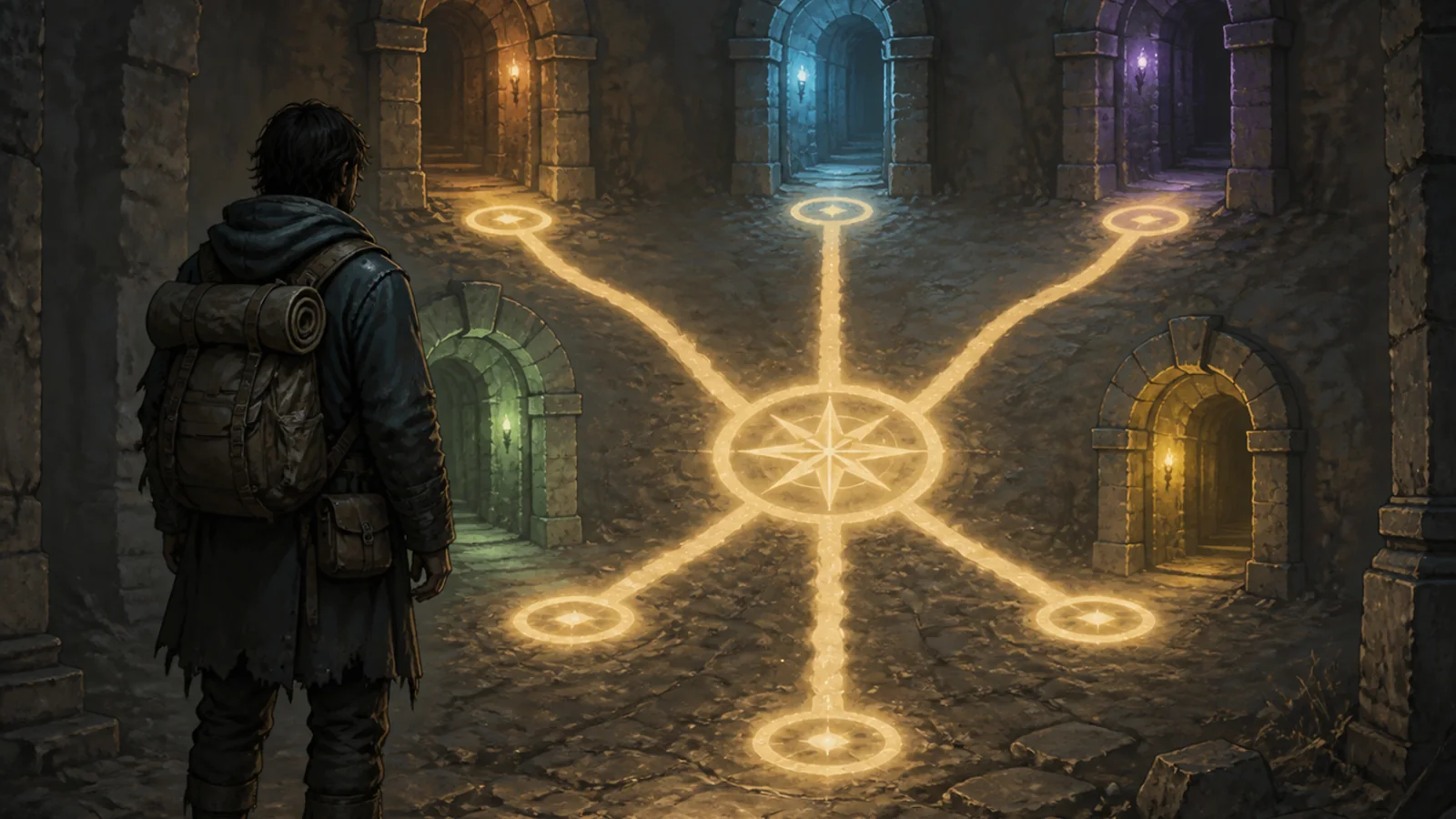
Spoilers for Dungeon Crawler Carl through Book 8 and the named source franchise may appear. This analysis uses the broadly established Jack Reacher archetype represented in the novels and Prime Video series: former military police investigator, highly observant, physically formidable, self-reliant, suspicious of corrupt institutions, and comfortable living with minimal possessions. The images contain no Reacher or actor likeness.
Jack Reacher looks like an ideal first-floor crawler.
He is large, physically capable, observant, disciplined under threat, comfortable with violence when necessary, and unusually good at recognizing when a local authority is lying.
Prime Video's official description of the series begins with Reacher as a retired military police officer arrested for a murder he did not commit, forced to uncover a conspiracy involving dirty police, business interests, and political corruption using his own judgment and investigative ability.
That background translates exceptionally well to early Dungeon Crawler World.
The first six floors reward many things Reacher already does naturally:
- read people
- investigate contradictions
- notice physical detail
- conserve resources
- keep moving
- distrust the obvious explanation
- act decisively under pressure
But DCC also contains systems that target precisely what Reacher dislikes most: dependency, showmanship, bureaucracy, sponsor relationships, and rules created by authorities he does not respect.
The question is therefore not whether Reacher survives Floor 1.
He almost certainly does.
The real question is whether his minimalist independence remains an advantage once the crawl becomes a network game.
Why Reacher Starts Strong
This floor analysis uses Safe Rooms: Strategy, Recovery, and Emotional Reset, Rules as Character Pressure, and System AI: Interface, Character, and Environment.
Reacher does not need much.
That is enormously valuable.
Many crossover characters lose their power base when removed from familiar equipment. Reacher's identity is already portable. He is accustomed to moving light, improvising from local conditions, and building understanding from whatever is in front of him.
Dungeon Crawler World strips away normal social infrastructure.
That hurts characters who depend on institutions.
It helps characters who are already comfortable outside them.
Reacher would not waste time mourning the loss of a headquarters, bank account, vehicle fleet, or communications network.
He would ask what works now.
Investigation Before Combat
The crawl's biggest mistake with Reacher would be assuming his value is primarily physical.
His real advantage is investigative thinking.
He notices inconsistencies.
He tests stories against evidence.
He reads spatial relationships.
He is skeptical of authority claims.
That is exactly how Carl becomes effective at exploiting the dungeon.
Reacher would treat System notifications as statements requiring verification rather than sacred instructions. If the interface says a room is safe, he would still inspect exits. If an NPC gives a quest, he would ask who benefits. If a floor rule sounds oddly specific, he would assume the specificity exists for a reason.
This approach is almost perfect for the early books.
Floor 1: The Dungeon Opens
The First Floor is mostly about surviving shock, learning basic mechanics, and getting to shelter.
Reacher's strengths align perfectly.
He is unlikely to panic.
He can fight unarmed.
He can assess a hostile environment without needing emotional reassurance from the authority controlling it.
His main weakness would be lack of DCC mechanical knowledge. He might underestimate stats, inventory, magical effects, or achievement logic because they violate normal experience.
But he learns fast.
Once he sees one impossible mechanic work consistently, he would incorporate it.
He would not waste time arguing with reality.
Floor 2: The Value of Minimalism
The Second Floor begins to reward players who can manage items, routes, and tactical choices without drowning in options.
Reacher's minimalist habits become useful here.
He would not hoard twenty mediocre items just because the interface says they are valuable.
He would want simple, reliable equipment.
Good footwear.
A durable weapon.
Armor that does not interfere with movement.
Basic healing.
Information.
This is not always optimal in a LitRPG system, where stacking synergies can produce enormous gains, but it protects him from one common failure mode: inventory complexity becoming indecision.
The Audience Problem Begins Early
Reacher's personality is not naturally audience-facing.
He does not need approval.
He does not perform warmth on demand.
He does not enjoy explaining himself to authorities.
This could hurt him in DCC's ratings economy.
At the same time, authenticity itself can become highly marketable. A quiet, physically imposing investigator who refuses to play for the camera would create its own compelling audience persona.
The problem is that Reacher would hate that this is true.
He would see popularity as surveillance before seeing it as opportunity.
That caution is wise.
It is also economically expensive.
Floor 3: Race and Class Selection
The Third Floor forces a more serious adaptation because race and class selection create long-term build consequences.
Reacher would hate being asked to choose from fantasy labels with hidden implications.
He would spend far too long reading every description.
Mordecai would probably appreciate the caution.
The safest Reacher build would preserve:
- human-scale physicality
- perception
- investigation
- endurance
- close combat
- mobility
He would avoid a transformation that gives spectacular power but introduces dependency or social weirdness he cannot predict.
This conservative approach may sacrifice raw ceiling for stability.
That is very Reacher.
Combat Instincts
Reacher would excel against humanoid opponents and physically interpretable threats.
He understands leverage, distance, positioning, surprise, and the psychological effect of decisive action.
DCC complicates this because many monsters do not obey normal anatomy.
A creature may be immune to blunt trauma.
A magical construct may not care about pain.
A boss may have scripted phase behavior.
The solution is investigation again.
Reacher would test.
Observe.
Adjust.
His physical confidence would help, but his willingness to revise a model matters more.
Floor 4: The Iron Tangle
The Iron Tangle may be Reacher's best floor.
The environment is a massive investigation disguised as transit chaos.
Routes matter.
Timing matters.
People provide partial information.
Systems repeat patterns without explaining them.
Reacher's brain is built for exactly this kind of problem.
He would map train movement, compare station behavior, identify inconsistent testimony, and search for the logistical logic underneath the apparent confusion.
His independence becomes an advantage because he does not need constant group validation to follow an investigative lead.
It also becomes a risk because the Iron Tangle rewards information sharing.
A brilliant answer held by one person is less useful than a decent answer distributed through a network.
Cooperation Problem
This is the central Reacher weakness in DCC.
He cooperates when necessary, but he is comfortable operating alone and often prefers it.
Dungeon Crawler World becomes increasingly hostile to isolated competence.
Group quests appear.
Large populations matter.
Safe-room networks matter.
Specialized magic matters.
One person cannot carry every required skill.
Reacher would need to accept a durable party rather than merely temporary collaborators.
That is harder for him than fighting.
Sponsor Relationships
Sponsors are almost perfectly designed to irritate Reacher.
They are external power centers offering useful resources while expecting some combination of visibility, access, influence, or brand association.
Reacher's first instinct would be suspicion.
That instinct is correct.
The problem is that refusing every sponsor on principle can become irresponsible once sponsor gear materially improves survival odds for allies.
Reacher would likely treat sponsorship like informant handling:
- understand motive
- take useful information or resources cautiously
- never confuse cooperation with trust
- maintain an exit plan
This could work very well.
It would not make sponsors like him.
Showrunners and Authority
The showrunner problem is worse.
Reacher is highly resistant to authority without legitimacy.
Dungeon Crawler World is full of it.
The system says a rule exists because the system says so.
The production layer treats suffering as content.
The legal layer may be formally real while practically corrupt.
Reacher would become adversarial quickly.
Unlike Carl, however, he may not initially understand the strategic value of performing compliance while planning resistance.
He tends to confront corruption directly once evidence is sufficient.
DCC sometimes requires a longer con.
Floor 5: NPC Populations and Moral Complexity
The Fifth Floor becomes harder because Reacher's investigation is now mixed with large-scale responsibility.
NPC populations, settlements, group objectives, gods, and long-term consequences create decisions that cannot be solved by identifying one corrupt person.
Reacher is strong when he can isolate a conspiracy.
The Fifth Floor reveals a system where exploitation is structural.
That requires coalition thinking.
He would adapt, but this is where the crawl starts forcing him into roles he dislikes: organizer, negotiator, visible leader.
Floor 6: The Hunters
The Sixth Floor is where Reacher's physical strengths become useful again and his moral/political difficulties intensify.
The hunter premise is simple enough for him to understand immediately: armed outsiders have entered expecting to kill crawlers.
He would not romanticize them.
He would identify capabilities, supply routes, hierarchy, and weaknesses.
The problem is audience and political scale.
Killing hunters may be tactically straightforward and politically explosive.
Reacher is less interested in optics than Carl and Donut.
That could create unnecessary strategic cost.
Resource Use
Reacher would be one of the best resource managers among crossover entrants.
He values function.
He does not collect prestige objects for identity.
He can live with limited possessions.
He would sell or trade aggressively if an item does not solve a real problem.
This makes him resistant to one of the crawl's psychological traps: confusing accumulation with preparedness.
But he could underinvest in weird utility items whose value is not immediately obvious.
Carl's world rewards keeping strange tools because the right absurd item can become a later exploit.
Reacher would need to learn that not all seemingly useless objects are useless.
Magic Is the Hardest Adaptation
Reacher is comfortable with complexity when complexity has physical logic.
Magic complicates this.
The correct response would still be empirical: observe effect, test conditions, build rules.
He would eventually treat magic like any other system.
But the initial period would be dangerous because DCC magic often interacts with hidden classifications and item descriptions rather than intuitive physics.
A person who wants a coherent causal model may be frustrated by rules whose primary purpose is gameplay balance.
Reacher and the System AI
The AI would probably enjoy trying to provoke him.
Reacher is difficult to embarrass because he does not care much about public image.
That deprives the AI of one easy pressure tool.
But the AI can target stubbornness.
It can create needlessly complicated instructions.
It can give him a humiliating but mechanically excellent class option.
It can attach rewards to behavior he considers ridiculous.
Reacher's refusal to play along could become either admirable discipline or strategic stupidity depending on the circumstance.
How Far Does He Get?
Through Floor 4, his odds are excellent.
Floor 5 is a turning point because the game becomes more social and political.
Floor 6 is survivable physically but demands that he accept public consequence and coalition complexity.
So yes, Reacher can survive the first six floors.
The qualification is important: if he builds a team.
If he insists on remaining essentially alone, the crawl eventually presents a problem no amount of investigation can solve by one person.
Floor-by-Floor Rating
| Floor | Outlook | Main reason |
|---|---|---|
| 1 | Excellent | Physical competence and immediate adaptation |
| 2 | Excellent | Minimalist resource discipline |
| 3 | Strong | Careful race/class decision making |
| 4 | Exceptional | Investigation and pattern analysis |
| 5 | Moderate to strong | Needs coalition and NPC politics |
| 6 | Strong physically, risky politically | Hunter war and public consequences |
Final Verdict
Reacher survives the first six floors more convincingly than many crossover characters with far more exotic abilities.
Why?
Because the early crawl rewards something more important than flashy power: calm attention.
Reacher sees things.
He asks why they do not fit.
He does not trust status without evidence.
He uses resources carefully.
He can fight when the investigation ends.
Those traits translate beautifully.
The crawl's real challenge is social.
Reacher has to accept sponsors he does not trust, teammates he cannot fully control, and showrunners he would prefer to confront directly. He has to learn that refusing dependence is not the same as being free.
If he learns that distinction, he reaches Floor 6 and probably beyond.
If he does not, Dungeon Crawler World eventually defeats him through the one resource he hates needing:
other people.
Information Is the Resource He Values Most
Reacher's minimalist relationship with physical possessions can obscure the fact that he is an aggressive collector of information. In Dungeon Crawler World, that distinction would matter. He may carry little, but he would remember routes, faces, inconsistencies, injury patterns, supply locations, and behavioral tells.
That makes him a natural intelligence node. The problem is that intelligence becomes exponentially more valuable when shared. Early Reacher could survive by keeping his deductions private until they are needed. Later Reacher would have to learn to build information systems others can use without him present.
The Iron Tangle is the clearest example. One person can solve a route. A coalition needs a map, a protocol, and confidence that the map will be updated when assumptions change. Reacher can solve the first problem instinctively. DCC forces him to solve the second.
Why the Fifth Floor Is the Real Test
Floor 5 matters more than Floor 6 in evaluating Reacher because it changes the scale of responsibility. Before that point, most of his strengths can be applied to personal or small-group survival. The Fifth Floor asks him to think about settlements, NPCs, group quests, and consequences distributed across people he may not know.
That is a philosophical expansion. Reacher is excellent at helping individuals trapped inside corrupt systems. The Fifth Floor asks whether he can help communities trapped inside one. It requires delegation, coalition-building, and a willingness to make decisions whose effects cannot be personally observed.
If he adapts there, Floor 6 becomes much more manageable. If he does not, the Hunter War will expose the limits of a man who can solve a conspiracy but has not yet learned to govern a coalition.
Public Popularity Would Sneak Up on Him
Reacher would not cultivate a public persona, which is exactly why he could become popular. The crawl loves legible authenticity. A man who speaks plainly, refuses ornamental gear, does not beg for applause, and repeatedly exposes lies has a strong audience identity whether he wants one or not.
The strategic question is whether he recognizes popularity early enough to control the damage. Sponsors may begin offering equipment tailored to the "no-nonsense investigator" image. Shows may want interviews. Other crawlers may approach him because the audience has certified him as reliable. At that point, refusing to engage with fame does not make fame disappear.
Reacher would need to learn that publicity is another crime scene: note who benefits, who is steering the narrative, and what evidence the audience has not been shown.
Why He Probably Does Not Become Carl
The comparison with Carl is tempting because both are physically capable, skeptical of authority, and comfortable confronting corrupt systems. The difference is scale of imagination. Carl increasingly becomes willing to attack the architecture of the crawl itself. Reacher's instinct is more local and evidentiary: identify the bad actors, prove what they did, stop them.
Dungeon Crawler World would force him to broaden that model. The bad actor is often an institution. The institution may be nested inside another institution. The "crime scene" can be a floor, a legal code, or an audience economy.
Whether Reacher survives past the first six floors may depend on whether he accepts that there is no single person to arrest.
The Social Skill Reacher Does Have
Reacher is independent, but that should not be confused with social incompetence. He is very good at reading fear, confidence, deception, and power dynamics. Inside the crawl, those abilities would help him choose allies carefully and identify which NPCs or crawlers are hiding information. The issue is not whether he can understand people. The issue is whether he is willing to remain attached to them long enough for a durable network to form.
That distinction matters by Floors 5 and 6. A temporary ally can help solve a room. A durable ally can cover a different city, manage a settlement, relay information, or make a decision while Reacher is somewhere else. The later crawl rewards trust that has survived enough shared history to function without constant supervision.
Reacher could absolutely build that kind of trust. He simply would not seek it for emotional comfort. He would seek it because the evidence shows the problem is too large for one investigator. Once he accepts that conclusion, his apparent weakness becomes manageable. He does not need to become socially expansive. He needs a small number of people whose judgment he respects enough to delegate real authority.
That is probably the threshold between "survives six floors" and "becomes a serious later-floor contender."
Reacher would also benefit from one underrated trait: he does not need the world to be comfortable before he can think. Bad food, poor sleep, temporary shelter, and constant movement are exhausting, but they do not automatically destroy his decision-making. In the first six floors, that resilience matters almost as much as fighting. Many crawlers lose effectiveness because every new hardship consumes attention. Reacher is unusually good at keeping attention available for the problem in front of him.
FAQ
Would Reacher choose a flashy class?
Probably not. He would favor a stable build that preserves physical competence, perception, and investigative flexibility.
Which floor is best for him?
The Iron Tangle on Floor 4, because it rewards pattern recognition, route analysis, and investigation.
Would he accept sponsor support?
Reluctantly. He would treat sponsors as interested parties rather than allies.
What is his biggest weakness?
Long-term cooperation. DCC increasingly requires networks rather than isolated competence.
Can he survive Floor 6?
Yes, but the Hunter War introduces political and audience consequences that are harder for him than the physical combat itself.
Source and update note
The novels and Prime Video series provide the broad Reacher baseline of military-police investigation, observation, physical ability, minimalism, and institutional skepticism. The DCC side is a hypothetical synthesis of published-series mechanics through Book 8, including floors, classes, safe rooms, sponsors, and System AI. No shared canon is claimed.
Primary starting point: Prime Video: Reacher Season 1 synopsis. These materials establish the source-franchise baseline; the dungeon outcomes, ratings, and comparisons above are editorial interpretations, not an announced crossover.