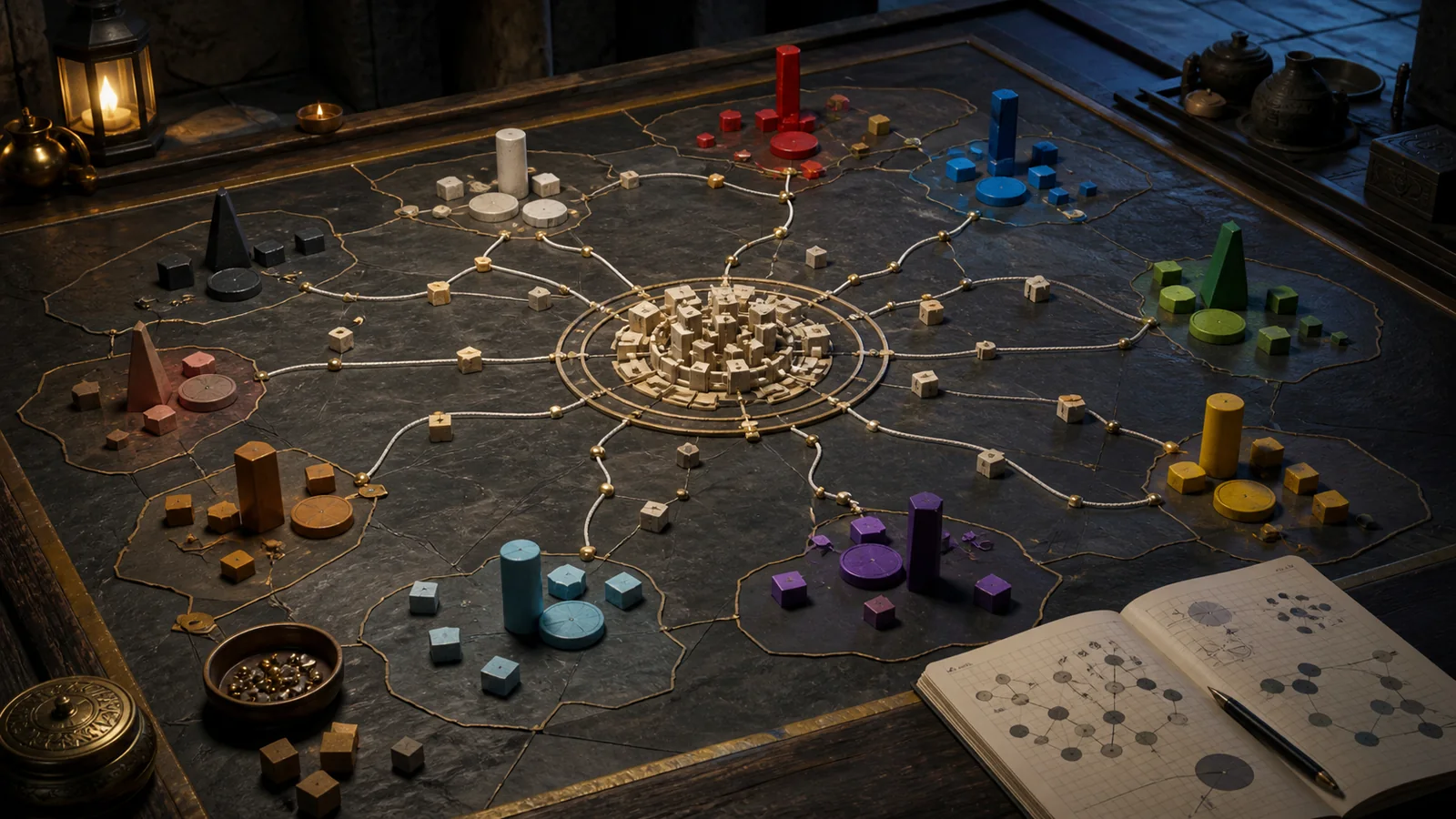
This route contains major Book 7 spoilers, including faction eliminations, the end of the Ninth Floor, and consequences that lead into later floors. Begin with Ninth Floor: Faction Wars and Book 7: This Inevitable Ruin. Use Faction War Battlefield thread for the battlefield spine, then follow Larracos, Princess Posse, and Tenth Floor: Don't Come in Last as the route advances. Faction Wars is one of the most difficult sections of Dungeon Crawler Carl to navigate as a reference topic because almost every page connects to several different kinds of information at once. A battle can be a geography event, a faction event, a crawler-team event, a political event, a rules event, and a character event simultaneously. The Ninth Floor begins with 32,429 crawlers entering an established war game whose participants include off-world political powers, dungeon-born NPC populations, mercenaries, former crawlers who have voluntarily returned to fight, awakened NPC leaders, external elites, sponsored deities, and the surviving crawler community itself.[1] Carl and Princess Donut are no longer merely party leaders moving through a scenario. They are warlords. The Princess Posse is no longer only a fan identity or expanding survivor community. It is a Faction Wars combatant with territory, troops, officers, aircraft, strongholds, alliances, secured locations, a flag room, logistical infrastructure, and multiple battle fronts. At the same time, the Ninth Floor remains a Dungeon Crawler World floor. The System AI still controls the rules. The audience still watches. Corporate and political actors still exert pressure from outside the battlefield. Adjudicators can rule on fouls. Gods can enter the field under specific conditions. Safe rooms and personal spaces remain important. The looming Celestial Ascendancy begins overlapping with the immediate war. The result is intentionally overwhelming. A reader trying to understand one battle can easily end up reading about a naga royal family, an alliance vote, a castle-capture rule, a god summon, an NPC uprising, a warlord chat argument, and a crawler battalion before returning to the original question. This reader route solves that problem by separating the Ninth Floor into seven threads: 1. Overview and rules 2. Battlefield geography 3. Crawler teams and command 4. Faction teams and alliances 5. Political institutions 6. Major events 7. Aftermath and consequences Read the route in order the first time. On a reread, jump directly to the thread you are trying to understand. The cleanest route through Faction Wars is: Faction Wars Overview → Ninth Floor Overview → Faction Wars Rules and Four Phases → Larracos and Plains of Larracos → Princess Posse and Team Retribution → Faction Directory and Alliance Map → Warlords, Adjutants, and FUPA Flag Room → Major Events Timeline → Operation Ruin → The Peeling of Larracos → Faction Wars Aftermath → Tenth Floor Transition That sequence prevents several common mistakes. It stops readers from confusing a faction team with a crawler party. It prevents the city of Larracos from being treated as if it were merely another faction stronghold. It separates the external political organizations represented by teams from the tactical battalions serving under Carl and Donut. It gives the war's four phases context before readers encounter phase-specific restrictions. And it leaves the aftermath until the reader understands why the transfer of Larracos and the defeat of Team Retribution matter. Earlier floors are easier to explain through a mostly linear sequence. Enter the floor. Learn the gimmick. Meet the threats. Complete the scenario. Find the stairs. Faction Wars is different. The floor behaves like a military strategy game layered over the normal dungeon. Book 7, Chapter 14 gives Carl a Faction Wars interface resembling an unwieldy city-building or strategy-game control system. From the Princess Posse flag room he can inspect troops, secured locations, other teams, officer information, faction messages, and the battlefield map.[2] The interface tells the reader something important. The Ninth Floor is not organized around Carl's physical location alone. The story can move among simultaneous fronts. Florin can be fighting in one sector. Boomer can command another. Donut can lead a third offensive. Louis can conduct air operations. Team Retribution can occupy enemy throne rooms. Rosetta can coordinate multiple operations from the command center. Carl may receive decisive war messages while personally fighting somewhere else. The reading route works best when it mirrors the war interface. Do not ask only, "What happened next?" Also ask: Where did it happen? Which team owned the territory? Which crawler command handled it? Which rule phase was active? Which political institution had authority over the event? Start with the premise before naming every faction. Book 7 opens with the System welcoming Carl to Faction Wars on the Ninth Floor. The level has a thirty-day collapse timer, or ends ninety hours after a winner is declared, whichever occurs sooner.[1] The surviving crawler population is immediately significant because Faction Wars turns the Ninth Floor into a collective human campaign rather than another Carl-and-Donut-only scenario. Six questions establish the board. A recurring Ninth Floor war game in which organized teams control territory, strongholds, troops, and external political identities. The Princess Posse enters as a crawler-led faction with a massive survivor force, allies, awakened NPCs, former crawlers, and a strategic goal that extends beyond merely surviving the scheduled game. The central funnel city around which the battlefield is arranged and whose political and physical fate becomes increasingly important as teams are eliminated. The season begins with ten principal Faction Wars teams or slots, including the Princess Posse and Team Retribution along with established off-world faction teams.[2][12] Faction Wars intersects with the Celestial Ascendancy, external faction politics, the growing autonomy of dungeon NPCs, the anti-dungeon resistance, Carl and Donut's wider plans, and the survival of thousands of people who would ordinarily be disposable participants in the game. Only after these questions are clear should the reader start clicking into individual factions. The war is divided into four major phases.[2] The floor begins under a ceasefire. This is not downtime in the ordinary sense. It is a preparation window. Warlords recruit. Troops move. Defenses are built. Intelligence is gathered. Alliances are negotiated. Infrastructure such as airports, saferoom links, and headquarters is organized. Scouts face special border rules. The Princess Posse uses this period to recruit crawlers and former crawlers and to learn a war system far more complicated than any previous floor. The Ramp-Up is scheduled for 180 hours after the ceasefire.[2] The phase introduces restricted hostilities. Among the key limitations explained to Carl are narrow border corridors for ordinary movement into enemy territory, suppression of offensive magic, and suppression of teleport-based magic or skills. The point is to create controlled escalation before unrestricted war. The Democratic Sortion's voluntary defeat changes the schedule. Chapter 19 triggers an acceleration rule, shortens the ceasefire, ends it early, and activates the Ramp-Up combat rules.[7] That event is the first major marker on the timeline because it changes the war clock for everyone. Once the Ramp-Up expires, borders lose much of their protective meaning. The war becomes substantially more mobile and dangerous. By Chapter 56 the Princess Posse has deliberately prepared Operation Ruin to begin when Open Hostilities starts.[12] This is where the reader should transition from "war preparation" pages into the large campaign pages. Chapter 68 shows the transition in real time. The defeat of the Madness satisfies the battlefield condition. The System announces that Larracos is no longer safe, the Peeling has begun, the city is open, and the first team to take the castle wins. It also explicitly warns that alliances do not matter in the end.[15] The Peeling is not simply another battle phase. It changes the meaning of the city. Until this point, much of the war is fought around Larracos. Now Larracos itself becomes the final board. Begin with the distinction between Larracos and the Plains of Larracos. Chapter 14 describes the land outside the city as the Plains of Larracos.[2] The battlefield is divided into nine pie-like territorial sectors arranged around the central city. The geography is not uniform. The northern area is mountainous. Other sectors contain rolling hills or flatter terrain. Waterways cross multiple faction boundaries. Sector ownership changes as teams are eliminated and assets transfer. A reader following only faction names will miss how dramatically those transfers alter the map. The Bone Clan of the Skull Empire begins in the first sector. Its stronghold, King's Point, is unusual because it is the only sector described as beginning with a pre-built castle. It sits on rocky, defensible high ground with volcanic features.[2] King's Point matters because the terrain reinforces the Bone Clan's strategic position and later becomes a major Operation Ruin target. The second sector begins as the Operatic Collective's area. It includes rolling hills and sits along the river route leading toward Larracos and Shanty Town.[2] After the Operatic Collective falls, the strategic meaning of the sector changes with asset transfers. The Princess Posse begins in sector three. The area is comparatively flat, with some hills and a small lake that Carl identifies as a major local water source.[2] This is the starting territorial frame for the crawler army. As factions fall, the Princess Posse eventually controls additional adjacent sectors. The Blood Sultanate occupies the neighboring fourth sector during the early war.[2] The naga faction's territory and stronghold become important during the middle campaign and the eventual seizure of its throne room. Larracos is not simply the tenth "sector." It is the central funnel city. The city has its own NPC population, infrastructure, saferoom access, temples, clubs, political history, and defensive systems. The city is initially defended by Team Retribution rather than being treated as ordinary exterior faction territory. That distinction is fundamental. Shanty Town forms the vulnerable ring around the opening of Larracos. By the lead-up to Open Hostilities, the Princess Posse and Team Retribution coordinate defense of this zone using Team Retribution troops, Larracos citizens, Semeru dwarves, and Princess Posse battalions.[12] Shanty Town should therefore have its own reader page rather than being a paragraph inside the Larracos entry. Faction strongholds are not merely scenery. Occupying a throne room can start a capture timer. Chapter 50 shows Princess Posse forces occupying the Blood Sultanate throne room, beginning a six-hour capture condition.[11] Chapter 61 shows Team Retribution simultaneously occupying the Bone Clan and Dream throne rooms, again triggering capture clocks.[14] Stronghold pages should therefore be linked to:
- the owning faction
- the territorial sector
- the warlord
- the capture event
- the resulting asset transfer
- Princess Posse
- guild leadership
- crawler recruitment
- Faction Wars logistics
- Larracos
- survivor community
- crawler biography
- vehicle
- air operations
- airports
- Operation Ruin
- Juice Box / Team Retribution
- war aftermath
- How did the crawler community become a military state?
- How does Carl's resistance strategy scale into war?
- How does Donut's public identity become warlord authority?
- How do former crawlers and NPC allies integrate into the army?
- What does Juice Box's leadership mean for awakened NPCs?
- How does Ferdinand function as co-warlord?
- Why is the Good Guys Alliance politically different from a temporary combat pact?
- What happens to Team Retribution after victory?
- Skull Empire
- Bone Clan
- Stalwart
- Maestro
- King's Point
- Operation Ruin
- War Mage Rebellion
- Blood Sultanate
- Madness
- Reavers
- Team Retribution
- Princess Posse
- Bone Clan
- Dream
- faction
- alliance
- start chapter
- end chapter
- reason for change
- source event
- command center
- information interface
- planning room
- political chamber
- warlord system access point
- Bone Clan controls spots 1 and 2
- Princess Posse controls spots 3 and 4
- Dream controls spots 5 and 6
- Madness controls spots 7 and 8
- Reavers control spot 9
- Team Retribution defends Larracos
- Florin against the Bone Clan
- Boomer against the Reavers
- Donut against the Dream
- Carl against the Madness
- Rosetta coordinating as Theater Commander
- Tipid defending the FUPA
- Louis conducting air support
Faction Wars also turns existing dungeon infrastructure into military logistics. Book 7, Chapter 6 explains that Imani can designate suitable personal-space locations as airports for Louis's aircraft operations.[3] Saferoom routes later become important for troop movement, return routes, and infiltration. Readers interested in battlefield logistics should therefore move from the geography route into Faction Wars Transportation and Logistics rather than trying to learn this from character biographies. The most useful command distinction is between a Faction Wars team and a crawler military unit. The Princess Posse is a Faction Wars team. Florin's 101st Crocodiles are a tactical unit inside that team. Those are different levels of organization. Carl and Donut operate as Princess Posse warlords. The title matters because it gives them access to team-level systems such as warlord chat, territory status, alliance messages, stronghold information, and rule actions. Individual biographies cannot carry the entire war without losing the command structure. Instead, they links to: Carl in Faction Wars and Princess Donut in Faction Wars as campaign-specific sections. Imani's leadership role is both crawler and institutional. Chapter 6 identifies her as guild leader and gives her authority to designate airports under the faction system.[3] Her reader route connects:
Florin becomes one of the Princess Posse's major field commanders. During Operation Ruin, his task is the offensive against the Bone Clan.[13] By Chapter 56, Florin's 101st Crocodiles hold the northern front in former Operatic territory and face the Skull Empire across the river.[12] His page is therefore best read after the Princess Posse overview but before Operation Ruin. Boomer commands major defensive and offensive operations and later handles the Reaver front during Operation Ruin.[13] Read his role through the battalion and military-command threads rather than treating him as only another named crawler. Louis holds the unique Army Air General rank and controls Party Planner, a faction-classified air asset.[3] His route crosses:
Katia remains a major Princess Posse military figure and is explicitly identified later as General Katia Grim.[11] Her Faction Wars story cannot be understood only through military command because the floor also intensifies the long-running Donut/Katia Crown of the Sepsis Whore problem. Her route should therefore branch between: Katia in the Princess Posse command structure and: Katia / Donut succession crisis Chapter 59 identifies Rosetta as the designated Theater Commander for Operation Ruin, coordinating the simultaneous offensives.[13] This is exactly the kind of role readers miss if they follow only the combat chapters. Rosetta belongs in the crawler-team route and in the Cookbook / former-crawler network route. Tipid remains at the FUPA during Operation Ruin to defend the command center while Rosetta coordinates the theater.[13] That makes his role primarily command and continuity support rather than frontline battle spectacle. Team Retribution deserves a separate section because it is not merely another enemy faction. It is the team defending Larracos and eventually forms the Good Guys Alliance with the Princess Posse.[10][12] Its co-warlords are Juice Box and Ferdinand. Its significance extends beyond military strength. Team Retribution represents awakened NPC autonomy inside a game originally designed to treat dungeon populations as disposable scenario components. The alliance between the crawler-led Princess Posse and NPC-led Team Retribution is therefore one of the central political developments of the Ninth Floor. Follow this route: Juice Box → Ferdinand → Team Retribution → Larracos NPCs → Good Guys Alliance → NPC Autonomy / Awakening → Faction Wars Endgame That path explains why defeating Team Retribution at the end is not treated like killing an ordinary enemy team. By the midpoint of the war, Chapter 56 gives a clean snapshot of the remaining and eliminated teams.[12] The campaign's principal teams can be organized as follows. Crawler-led faction. Core reader questions:
NPC-led faction defending Larracos. Core reader questions:
Orc faction associated with the Skull Empire. King's Point is its stronghold. Its political context extends back to the Maestro and earlier Skull Empire foreshadowing. The route includes:
The Operatic Collective begins in the second sector. Its defeat in Chapter 35 becomes an early major faction elimination and results in its assets being awarded to the Bone Clan.[9] Read it as both a faction page and a map-change event. The Blood Sultanate is a naga faction tied to an external royal family and a stylized recreation of its people's old imperial identity.[4] Its Ninth Floor role links back to earlier mentions in the series and forward to the Sepsis Whore bloodline crisis involving Donut and Katia. Its defeat in Chapter 55 transfers its assets into the Princess Posse arrangement.[11] The Prism faction is associated with Empress D'Nadia. Her death in Chapter 27 defeats the Prism team and transfers its assets to the Princess Posse.[8] Readers should reach this faction through D'Nadia's character page because the political relationship predates the Ninth Floor. Led by Commander Stockade. Its defeat is uniquely important because Chapter 19 treats the collapse as voluntary and uses a Faction Wars acceleration rule to shorten the ceasefire.[7] Its page belongs as much in the rules timeline as the faction directory. The Dream survives deep into the war. Its significance is military, economic, political, and corporate. The faction becomes entangled with long-range artillery, alliance shifts, the complicated status of Epitome Tagg, and larger external questions about the Dream as a galactic economic power. The Dream is defeated near the very end in Chapter 84.[19] Led by Architect Houston. The Madness is aligned with the Reavers through the Bloc during the middle campaign.[12] Carl's portion of Operation Ruin is explicitly aimed at defeating Houston and the Madness.[13] The faction's defeat in Chapter 68 triggers the conditions for the Peeling of Larracos.[15] That makes its elimination one of the most structurally important events on the floor. The Reavers are both a Faction Wars team and representatives of a much larger external power. Their troops, mercenaries, technology, and wider galactic identity create a direct bridge between battlefield events and the political economy outside the dungeon. Their defeat occurs in Chapter 80 after Warlord Fang is killed.[18] Faction membership and alliance membership change during the war. A dedicated alliance timeline makes that movement visible. Chapter 39 gives a useful alliance update after major upheaval:[10] The Bloc
The Good Guys Alliance
Unaffiliated
By Chapter 56, after several eliminations, the field is reorganized again.[12] The site should therefore contain an Alliance Timeline showing:
That prevents the common error of describing an alliance as if it remained permanent throughout Faction Wars. The Ninth Floor becomes much easier to understand once readers recognize the institutions that sit above or beside the armies. Warlords are not merely generals. They are the System-recognized political representatives of their teams. They can communicate through warlord channels, receive territory messages, propose certain actions, and trigger or respond to rules that ordinary combatants do not directly control. Baroness Victory serves as the Princess Posse adjutant. Chapter 14 makes the role explicit.[2] She can explain rules, advise strategy, identify fouls, and suggest ways to fit actions into the current ruleset. She also has limited movement privileges associated with the role. The adjutant system should have its own mechanics page because it is neither ordinary NPC assistance nor standard crawler leadership. The Princess Posse command room is a dedicated war interface. Carl can inspect troops, secured locations, other teams, messages, and detailed officer information from there.[2] The room also provides a limited information-security function because discussion inside the room during the pre-hostility period is delayed before reaching viewers. The FUPA is therefore:
Chapters 18 and 19 show that Faction Wars includes formal rulings when the rules become disputed.[7] This matters because war is still game administration. A battlefield action can become a legal question. A team defeat can activate a rule clause. A corporate actor's interference can lead to grievance procedures. Readers interested in the political structure should therefore route from Warlords to Adjudication rather than treating every ruling as an AI whim. Some teams represent organizations that exist beyond the dungeon. The Blood Sultanate's naga participants, Skull Empire orcs, Dream, Reavers, Prism Kingdom, and others carry real political identities into the staged war. This makes Faction Wars partly a game and partly a public extension of galactic politics. The Ninth Floor also shows that outside corporate ownership and media relationships can affect the war indirectly. The attempted manipulation surrounding Sensation Entertainment and the Dream is treated as a rules problem rather than merely personal drama.[5] That belongs on a Corporate Interference in Faction Wars page rather than being buried in a character biography. Team Retribution is the clearest expression of a larger institutional crisis. Dungeon NPCs increasingly understand that their roles are constructed. Some reject those roles. Some organize. Some become warlords. Faction Wars gives that political awakening territory, armed forces, and an alliance. The war also increasingly intersects with deity politics. Chapter 61 contains a rule action altering how sponsored deities appear when summoned during Faction Wars.[14] By the end of the floor, Larracos and its NPC population are being transferred into the Twelfth Floor's Court of the Ascendancy.[20] Readers should therefore treat the Celestial Ascendancy as part of the Ninth Floor aftermath, not as unrelated future lore. The event route is chronological and selective. Do not try to turn every skirmish into an equal-weight event. The following events change the board. Book 7, Chapter 1 Carl enters Faction Wars. The thirty-day level timer and crawler population establish the scale.[1] Chapters 6-14 The Princess Posse develops air infrastructure, recruits crawlers, moves through Larracos, learns the command system, and examines the battlefield.[3][4][5][6] Chapter 14 The Ceasefire, Ramp-Up, Open Hostilities, and Peeling of Larracos are formally laid out.[2] Chapter 19 Commander Stockade dies. The Democratic Sortion falls. The voluntary-defeat rules award assets to the Madness. The ceasefire is shortened and ends early, triggering the Ramp-Up.[7] This is the first event that changes the war schedule itself. Chapter 27 D'Nadia dies. The Prism team is defeated. Its assets transfer to the Princess Posse.[8] The Princess Posse now owns non-adjoining property, creating a new territorial problem. Chapter 35 The Operatic Collective is defeated. Its assets go to the Bone Clan.[9] The map changes again. Chapter 39 The Bloc and Good Guys Alliance are updated while the Bone Clan and Dream become unaffiliated.[10] This is the best point to insert an alliance-map checkpoint in the reader route. Chapters 50-55 Princess Posse forces occupy the Blood Sultanate throne room and begin the capture condition.[11] The Sepsis Whore falls. The Blood Sultanate is defeated. Its assets ultimately become part of the Princess Posse war position.[11] Chapter 56 The remaining-team status becomes clear.[12] At this point:
The Princess Posse and Team Retribution are the Good Guys Alliance. Madness and Reavers form the Bloc. Bone Clan and Dream are unaffiliated. Begins Chapter 59 Operation Ruin is the Princess Posse attempt to win the war through simultaneous offensives.[13] The core assignments are:
Operation Ruin is one of the largest events in the Faction Wars route. Chapters 61-62 Team Retribution occupies the Bone Clan throne room. Stalwart is killed with credit involving the War Mage Rebellion.[14] The throne-room and asset rules become entangled with the rebellion. Chapter 68 Architect Houston dies. The Madness is defeated. Its assets transfer to the Princess Posse. The battlefield condition triggers the Peeling of Larracos.[15] This is the single cleanest division between the main war and the final endgame. Chapters 68 onward Larracos becomes open. The final castle race begins. The System warns that only one team can win and alliances no longer protect the remaining participants.[15] The War Mage Rebellion becomes a nonstandard combatant force whose status does not fit neatly into the original team structure. Chapter 69 lists it among the remaining entities while noting the occupation of Team Retribution's castle.[16] By Chapter 78, Warlord Akuma leaves the realm and the System declares the War Mage Rebellion defeated.[17] The rebellion functions as both an event and an organization. Chapter 80 Warlord Fang dies. The Reavers are defeated. Their assets transfer to the Princess Posse.[18] Chapter 84 The Dream is defeated. Its assets transfer to the Princess Posse. The System announces that only two teams remain.[19] The final problem is no longer how to defeat a conventional enemy army. It is how to finish Faction Wars without destroying the allied NPC population and everything the alliance has been trying to save. Read this through the Team Retribution Endgame rather than as a normal "final boss" battle. Chapter 85 Juice Box and Ferdinand leave the realm under the carefully constructed endgame plan. Team Retribution is defeated. The Princess Posse wins Faction Wars.[20] The event is inseparable from the transfer of Larracos and its population. Do not end the Faction Wars hub at "Princess Posse wins." The aftermath contains some of the floor's most important consequences. Chapter 85 explains that Larracos and Shanty Town are combined and transferred to the Twelfth Floor, into the Court of the Ascendancy.[20] This preserves thousands of NPC lives while also moving them into another dangerous political environment. The city therefore needs two page states: Larracos on the Ninth Floor and: Larracos after transfer Juice Box and Ferdinand leave the realm as part of the plan. The System interprets the departure through Faction Wars rules and declares Team Retribution defeated.[20] That distinction matters. The faction loses the game. Its people are not simply exterminated. Chapter 85 notes that more than fifty thousand former crawlers came back to fight and only about twenty-eight thousand remain by the end.[20] The subject deserves separate attention: Former Crawlers in Faction Wars It is one of the clearest demonstrations of the anti-dungeon movement becoming direct military action. Book 7 reports that 32,500 crawlers made it from the Eighth to the Ninth Floor and 20,221 remain near the end of Faction Wars.[20] Carl recognizes the death toll as war while also noting that the number reaching the Tenth Floor represents an extraordinary survival record. Treat this as an aftermath statistic, not merely a number in Carl's biography. Different categories of mercenaries receive different outcomes when the city moves and the floor ends.[20] Some disappear back into dungeon systems. Some NPC groups move with Larracos. Outworlders are removed from the dungeon. Others remain with the crawlers. It belongs with the wider account of Faction Wars mercenaries and forces. Chapters 86 and 87 show crawlers moving into the Tenth Floor stairwells while Emberus prepares to destroy the Ninth Floor.[21] The Faction Wars route should therefore end with: Ninth Floor Collapse → Tenth Floor Overview rather than immediately jumping to unrelated Book 8 material. Different readers need different versions of this guide. 1. Faction Wars Overview 2. Four Phases 3. Larracos 4. Princess Posse 5. Team Retribution 6. Faction Directory 7. Major Events Timeline 8. Faction Wars Aftermath 1. Plains of Larracos 2. Sector Map 3. Strongholds 4. Shanty Town 5. Faction Wars Transportation 6. Operation Ruin 7. Peeling of Larracos 8. Final Castle Endgame 1. Carl in Faction Wars 2. Princess Donut in Faction Wars 3. Imani 4. Florin 5. Katia 6. Louis 7. Juice Box 8. Ferdinand 9. Baroness Victory 10. Rosetta 11. Major character losses 12. Aftermath 1. Faction Wars Overview 2. Faction Directory 3. Warlord System 4. Adjutants 5. Alliance Timeline 6. External Political Factions 7. NPC Autonomy 8. Corporate Interference 9. War Mage Rebellion 10. Celestial Ascendancy overlap 11. Larracos transfer 1. Midwar Board State 2. Princess Posse Command Structure 3. 101st Crocodiles 4. Reaver Front 5. Dream Front 6. Madness Front 7. Party Planner air operations 8. Bone Clan offensive 9. Operation Ruin 10. Peeling of Larracos Faction Wars is the Ninth Floor's organized territorial war game. Teams control territory, strongholds, troops, warlords, and political identities while fighting under phase-specific rules. The season's structure contains ten principal team positions when Team Retribution, which defends Larracos, is counted alongside the nine exterior territorial factions. The field includes the Princess Posse, Team Retribution, Bone Clan, Operatic Collective, Blood Sultanate, Prism Kingdom, Democratic Sortion, Dream, Madness, and Reavers. The Princess Posse is a full Faction Wars team and army. Individual crawler parties, battalions, and field units operate inside it. Carl and Donut function as warlords rather than merely party leaders. The phases are the Ceasefire, the Ramp-Up, Open Hostilities, and the Peeling of Larracos. Each phase changes movement, combat, or victory rules. The Democratic Sortion's voluntary defeat activates an acceleration rule that shortens the ceasefire and begins the Ramp-Up early. Larracos is the central funnel city around which the Ninth Floor battlefield is organized. It contains a large NPC population and is defended by Team Retribution before becoming the center of the final Peeling phase. Shanty Town surrounds the upper opening of Larracos and becomes a strategically important defensive zone linking the city to the exterior battlefield. The FUPA Flag Room is the Princess Posse's faction command room. It provides warlord-level interfaces for troop, territory, officer, team, and communication management. Operation Ruin is the Princess Posse's coordinated Open Hostilities campaign. Florin targets the Bone Clan, Boomer the Reavers, Donut the Dream, and Carl the Madness, while Rosetta coordinates as Theater Commander and Louis provides air support. The phase begins when the battlefield reaches four remaining teams. In the novel, the defeat of the Madness triggers the condition. The Princess Posse wins after Team Retribution's warlords leave the realm as part of the endgame plan. Larracos and Shanty Town are transferred to the Twelfth Floor's Court of the Ascendancy, allowing the surviving NPC population to escape the destruction of the Ninth Floor. Continue to the Faction Wars Aftermath page, the Larracos Transfer page, and then the Tenth Floor overview. Faction Wars is easiest to understand when the reader stops treating Book 7 as one long battle. It is a layered system. The geography tells you where power can move. The crawler command structure tells you who can act. The factions tell you whose political interests are represented. The institutions tell you which rules and external powers constrain the war. The event timeline tells you how the board changes. The aftermath tells you why the Ninth Floor matters after the fighting ends. Carl and Donut remain the emotional center. They are no longer the only center. That is the point of the floor. The Ninth Floor takes every system the series has been building toward, parties, followers, sponsors, NPC awakening, external factions, gods, safe rooms, media, politics, and crawler cooperation, and places them on one battlefield. A good Faction Wars archive should do the opposite. It should pull those systems apart long enough for readers to understand them. Then it should show how they fit back together.