Spoiler notice
This guide discusses the floor structures, central objectives, major reversals, and end states of Books 1 through 8. It includes the destruction of the Seventh Floor's Great Race, the Eighth Floor campaign, Faction Wars on the Ninth Floor, and the Tenth Floor's seven-heat race structure.
Overview
The floors of Dungeon Crawler World: Earth do not form a single dungeon whose enemies simply become stronger with depth. Each floor is a replacement gameboard. Its geography, victory conditions, social structure, permitted tactics, and intended television story are rebuilt around a new scenario. A skill set that dominates one floor may become secondary on the next. A route that looks like ordinary travel may turn out to be the central puzzle. A safe exit may depend on strangers in another biome, the defeat of off-world tourists, the construction of a temporary monster army, or the outcome of a formal war. This design has two related purposes. The first is elimination. Floor timers, scarce stairwells, environmental hazards, boss systems, and rule changes ensure that surviving one level does not produce a stable method for surviving the next. The second is spectacle. The dungeon continually changes genre so that the audience never watches the same contest for long. The early floors resemble a brutal role-playing tutorial. The Third Floor introduces races, classes, NPC law, cities, and large quest networks. The Fourth Floor converts the map into a transit puzzle. The Fifth Floor makes survival dependent on cross-biome cooperation. The Sixth Floor allows wealthy outsiders to enter the game as hunters. The Eighth Floor combines regional folklore, squad construction, card combat, and forced competition over keys. The Ninth Floor turns the survivors into officers, recruits, diplomats, conscripts, saboteurs, and warlords. The Tenth Floor continues the pattern after Faction Wars. Don't Come in Last compresses the surviving population into seven heats built around vehicles, mounts, garages, support crews, upgrades, and last-place elimination. A military coalition must suddenly function as small racing teams, demonstrating once again that success on one floor does not guarantee readiness for the next. The escalation is therefore not simply monster versus crawler. It develops through a series of broader conflicts: 1. Individual versus environment on the First Floor. 2. Party versus escalating local threats on the Second and Third Floors. 3. Networked teams versus a floor-wide system on the Fourth Floor. 4. Coalitions versus interdependent objectives on the Fifth Floor. 5. Crawlers versus armed outside participants on the Sixth Floor. 6. Crawlers versus the assumptions of the scenario itself on the Seventh Floor. 7. Squads versus other squads, decks, and scarcity rules on the Eighth Floor. 8. Armies versus armies, alliances, and governing institutions on the Ninth Floor. 9. Small teams versus engineered last-place elimination on the Tenth Floor.
At-a-Glance Floor Scenario Map
| Floor | Scenario and principal geography | Defining rule change | Primary threats | Survival strategy | Escalation function |
|---|---|---|---|---|---|
| First Floor | An enormous maze of corridors, neighborhoods, tutorial guilds, safe rooms, boss routes, and scattered stairwells | The basic interface, achievements, inventory, loot, skills, mobs, bosses, timers, and stairwells are introduced | Low-level mobs, neighborhood and borough bosses, traps, hostile crawlers, ignorance | Learn the system, secure a guide, conserve resources, identify safe rooms, and reach stairs before collapse | Reduces the apocalypse to immediate personal survival |
| Second Floor | Tighter arteries and quadrants with more complex neighborhoods and mobile boss threats | A shortened six-day timer, viewer follows and favorites, revised patronage, more elaborate status and crafting interactions | Disease effects, ranged mobs, bosses that can leave their rooms, hostile crawlers, time pressure | Protect a group, use recipes and environmental clues, manage public visibility, and avoid unnecessary fights | Turns isolated survival into team protection under broadcast pressure |
| Third Floor: The Over City | Sprawling artificial urban ruins, villages, guarded settlements, quest zones, and NPC populations | Race and class selection, permanent build commitments, citizen law, guard enforcement, sponsor courtship, major quest chains | Elites, city forces, large coordinated encounters, faction agendas, player killers | Build a coherent party, understand NPC law, choose quests selectively, and plan around class roles | Makes social systems and politics as important as combat |
| Fourth Floor: The Iron Tangle | A gigantic rail network of moving trains, stations, settlements, transfer points, and hidden route relationships | The map itself becomes the puzzle, with transit schedules and line connections controlling access | Mob-filled train cars, dangerous platforms, route errors, traps, separation, floor-scale confusion | Map collaboratively, control train cars, share discoveries, create defensible mobile positions, and solve the network | Moves the conflict from local tactics to operational coordination |
| Fifth Floor: The Bubble Level | 1,172 self-contained bubbles, each divided into Land, Sea, Air, and Subterranean quadrants with one castle per quadrant | All four castles in a bubble must fall before any stairwell in that bubble becomes usable | Environmental extremes, isolated crawler populations, castle defenses, quadrant bosses, travel limitations | Form a bubble-wide coalition, develop specialized transport, rescue weak groups, and sequence four sieges | Makes strangers mutually dependent and introduces coalition warfare |
| Sixth Floor: The Hunting Grounds | A jungle-overgrown version of the Third Floor layout, with towns, wilderness, ruins, the hunter city of Zockau, and hidden exits | Off-world hunters enter after a grace period to kill crawlers and take their equipment | High-level hunters, hunter pets and traps, ambushes, bounty pressure, city politics, the Butcher's Masquerade | Build guild intelligence, reverse the hunt, coordinate ambushes, share targets, and deny hunters safe control of the map | Converts the game into asymmetric war between contestants and privileged outsiders |
| Seventh Floor: The Great Race | Hundreds of kilometers of one-way tubes, branching nodes, pitstop safe rooms, puzzle paths, and limited zero-danger routes | No backtracking, path closures, starting-order pressure, and branch selection based on risk and distance | Route scarcity, irreversible choices, puzzles, path competition, engineered attrition | Intended strategy: optimize route selection and position. Actual strategy: exploit the scenario's structural flaw | Demonstrates that understanding and breaking the rules can supersede playing them |
| Eighth Floor: The Ghosts of Earth | Recorded regions of pre-collapse Earth followed by a second regional assault and a return to the original stairwell region | Three phases, fixed squads, T'Ghee totems and decks, key retrieval, and forced key conflict | Regional folklore monsters, uncontrollable allies, intelligent deckmasters, environmental memory traps, desperate crawlers | Recruit a balanced squad, construct a reliable deck, secure a key, coordinate with other crawlers, and defeat forced scarcity | Blends emotional warfare, operational campaigns, and organized crawler conflict |
| Ninth Floor: Faction Wars | Larracos at the center, nine attacking territories arranged around it, military strongholds, outer forests, and 293 stairwell chambers | Warlords, officers, recruitment, conscription, truces, declarations of war, base capture, throne control, and army elimination | Entire armies, political blocs, siege systems, intelligence warfare, internal betrayal, resource shortages | Govern an army, recruit quickly, maintain alliances, gather intelligence, coordinate combined arms, and win without sacrificing the crawler population | Completes the transformation from contestants into political and military actors |
| Tenth Floor: Don't Come in Last | Team garages and seven changing race courses travelled by mechanical or biological conveyance | Teams of no more than four compete in heats; the last-place containment fails, safe-room access closes during races, and upgrades occur between stages | Course hazards, vehicle failure, rival teams, time pressure, fatigue, and backstage interference | Build a balanced race team, maintain a vehicle or mount, use support crews, upgrade between heats, and manage alliances without losing speed | Shrinks army-scale leadership into an endurance contest where logistics and teamwork remain decisive |
The Design Logic Behind the Floors
Every floor changes the genre
The most important feature of floor design is discontinuity. The dungeon does not reward a survivor merely for becoming better at the last challenge. Instead, it repeatedly changes the kind of problem being solved. The First Floor rewards caution, observation, and rapid mastery of the interface. The Fourth Floor rewards mapping and transportation control. The Fifth Floor punishes parties that think only about their own quadrant. The Sixth Floor rewards counterintelligence and coordinated ambushes against opponents with superior preparation. The Eighth Floor forces combatants to become deck builders and squad commanders. The Ninth Floor requires diplomacy, governance, logistics, and military planning. The Tenth Floor strips those armies back into compact race teams whose survival depends on transport, maintenance, timing, and endurance. This changing genre prevents a single build or personality from becoming a complete answer. Carl's explosives are decisive in many fights, but explosives cannot by themselves explain the Iron Tangle, negotiate a truce, recruit an army, or determine which squad should receive an exit key. Donut's charisma is valuable from the beginning, but it becomes increasingly powerful as the floors add NPC societies, media influence, squad leadership, and warlord authority. Katia's adaptability first appears as a combat and transport advantage, then becomes part of larger strategic problems involving parties, factions, sponsorship, and future-floor conditions.
Geography becomes an active rule
Early maps contain threats. Later maps create threats. On the First Floor, a corridor is primarily a route between encounters. On the Iron Tangle, the route is the encounter. Train lines, station numbers, transfers, moving cars, and settlement locations determine what can be reached and whether a discovery can be used before time expires. On the Fifth Floor, the four-quadrant bubble structure creates compulsory cooperation because no party can open its stairwell by conquering only its own castle. On the Eighth Floor, geographic selection determines which folklore monsters, memories, infrastructure, and emotional provocations a squad encounters. On the Ninth Floor, territory is political power. Strongholds, roads, recruitment areas, defensive positions, and the central city all have military meaning. The floors increasingly punish incomplete maps. A party may win every fight it sees and still fail because it chose the wrong tube, reached the wrong station, misunderstood the relationship between quadrants, or allowed an enemy army to control the road to a strategic objective.
Information rises in value faster than raw power
Combat strength remains essential, but the value of information increases with every floor. The early advantage comes from knowing that safe rooms exist, that maps can be found, that a guide can explain the interface, and that stairwells are deliberately scarce. By the Third Floor, crawlers need information about classes, races, NPC law, settlement behavior, elite quests, and sponsor interest. The Iron Tangle requires a distributed knowledge network because no single party can efficiently discover the entire rail structure alone. The Hunting Grounds makes hunter identity, location, equipment, pets, alliances, and preferred tactics into life-or-death intelligence. Faction Wars expands this into formal reconnaissance, diplomatic channels, officer reporting, troop numbers, base defenses, and enemy intentions. The increasing importance of information changes what leadership means. A powerful fighter can save a room. A good operational leader can save a route. A trusted information network can save thousands of crawlers.
The dungeon increases social density
The First Floor scatters people. The later floors force them together. Carl and Donut begin as a two-person survival unit. Their relationship with Mordecai gives them a knowledge advantage, while their alliance with Team Meadow Lark creates a moral and logistical responsibility beyond themselves. The Third Floor makes settlement populations and quest factions unavoidable. The Fourth Floor physically mixes parties through shared trains and stations. The Fifth Floor assigns every crawler in a bubble to a common four-castle problem. The Sixth Floor encourages guild formation because a lone party cannot effectively monitor hundreds of hunters. The Eighth Floor fixes crawlers into squads and then manipulates key scarcity to turn those squads against one another. The Ninth Floor offers recruitment, conscription, officer positions, alliances, and warlord command. This progression is central to the series' political development. The crawlers do not become a movement because the dungeon invites them to form one. They become a movement because the floors repeatedly make coordination necessary while the showrunners attempt to control how that coordination is used.
The audience economy becomes part of survival
The broadcast storyline is present from the start, but it gains mechanical force on the Second Floor when follows, favorites, and patronage become visible parts of the contest. Popularity affects sponsorship interest, benefactor support, program appearances, and the value of a crawler as entertainment. This creates a second battlefield running above the physical dungeon. A crawler must survive the floor while also surviving the story being manufactured around them. Show appearances can create allies, increase patron support, reveal information, or expose vulnerabilities. Sponsors can provide crucial items but also pursue agendas tied to later floors. By Faction Wars, off-world political and financial interests are no longer background forces. They own teams, supply armies, manipulate rules, and respond to the possibility that crawlers might alter a game that was supposed to use them as expendable content.
Floor-by-Floor Analysis
First Floor: Survival as Forced Education
Geography and rules
The First Floor is enormous, with Mordecai describing it as nearly the size of Earth's surface, but its practical experience is local and fragmented. Crawlers encounter corridors, intersections, themed neighborhoods, tutorial guilds, safe rooms, boss routes, hidden maps, and scattered stairwells. The scale prevents anyone from treating the floor as a single conventional labyrinth. Most crawlers experience only a tiny portion of it before the timer forces them downward. The First Floor introduces nearly every foundational system: levels, statistics, skills, achievements, inventory storage, magical equipment, loot boxes, mobs, boss classifications, maps, safe zones, guides, party mechanics, and floor collapse. This is a tutorial only in the sense that the rules are being introduced. Failure remains fatal, and the tutorial is designed to remove people who do not learn quickly enough.
Threat structure
The principal danger is ignorance. Individual mobs and neighborhood bosses are deadly, but they are at least legible once a crawler understands the interface. More dangerous are mistakes caused by not knowing what an icon means, how a safe room works, why a boss chamber matters, or how rare the stairs are. Hostile crawlers also appear early, demonstrating that the human population is not automatically a unified faction. The floor's encounters remain mostly isolated. A group enters a neighborhood, identifies local enemies, fights a boss, loots the result, and moves toward another objective. Even the Ball of Swine crisis is a localized disaster with a clear defensive problem. The conflict is personal and tactical.
Survival strategy
The winning approach is to learn faster than the floor can punish. That means entering a tutorial guild, obtaining a reliable guide, reading item descriptions, establishing party communication, finding safe rooms, and preserving enough time to reach a stairwell. Carl and Donut's early advantage does not come from superior starting power. It comes from their willingness to test the system, question explanations, improvise with available materials, and use Mordecai's knowledge. Their decision to protect Team Meadow Lark is also strategically important. It creates burdens, but it establishes a pattern that later becomes the basis for guild organization and political leadership. The First Floor asks whether an individual can survive. Carl's answer begins to include whether other people can be brought through with him.
Second Floor: Time Pressure, Public Visibility, and Mobile Threats
Geography and rules
The Second Floor resembles the First Floor closely enough to preserve the basic survival loop, but it compresses time and increases uncertainty. The announcement gives the remaining crawlers only six days to find a staircase because the surviving population is below the organizers' projection. That decision reveals a core truth of floor design: the timer is not a neutral clock. It can be adjusted to meet production goals. The floor's main arteries are narrower, the ground is rougher, and its neighborhoods contain more layered environmental setups. More importantly, the social interface expands. Viewer follows and favorites become visible, and the revised patronage system ties future benefactor support to public attention and bidding. Crawlers are no longer merely trying to live. They are becoming marketable assets.
Threat structure
The Second Floor complicates encounters through status effects, ranged enemies, recipes, and bosses that do not respect the assumptions established above. The Krakaren encounter demonstrates this directly when a neighborhood boss reaches beyond its chamber, invalidating the expectation that dangerous enemies remain contained behind a boss-room threshold. The floor also emphasizes indirect preparation. A strange crafting setup, a recipe, a disease effect, or a floor-specific consumable may be the intended solution to a boss. Survivors who rely only on damage output can be defeated by debuffs, contamination, or a mechanic they failed to investigate.
Survival strategy
Successful parties need a wider division of labor. Fighters, healers, crafters, scouts, and vulnerable survivors must move together without creating a formation too slow to reach the stairs. Carl and Donut's relationship with Meadow Lark turns the floor into an escort and protection problem, not simply a leveling opportunity. The broadcast system also demands restraint. Popularity can attract support, but playing directly to the audience can distort judgment. The safest choice for the camera may not be the safest choice for the party. The Second Floor is therefore the point at which the crawl becomes visibly two games at once: the physical game of survival and the media game that determines how the universe values each survivor.
Third Floor: The Over City and the End of the Training Levels
Geography and rules
Mordecai explicitly describes the first two floors as training levels. The Third Floor begins the full game. Crawlers select races and classes, making permanent or long-term decisions about their bodies, abilities, roles, and future development. The floor itself is the Over City, a sprawling artificial urban ruin containing villages, pubs, shops, guilds, civic populations, guarded settlements, military units, elite quest locations, and large stretches of decayed city infrastructure under an artificial sky. This geography introduces a distinction between combatants and citizens. Non-combatant NPCs have legal and mechanical protections. City guards enforce order. Killing citizens provides no experience, and guards receive stronger statistics. The floor therefore places crawlers inside societies rather than among neutral scenery.
Threat structure
The Third Floor's most dangerous threats are organized. Elites carry storylines and obligations that can outlast the floor. Settlements have guards, rulers, political conflicts, and military forces. Quest chains can trigger battles far larger than ordinary neighborhood encounters. Other crawlers have completed race and class selection, meaning their capabilities are more specialized and less predictable. The permanent build decisions also create a strategic hazard. A race or class that looks powerful in isolation may conflict with a party's needs, future stat requirements, equipment, or later-floor objectives. The selection process is therefore part of the floor's scenario design, not a pause between scenarios.
Survival strategy
Survivors need coherent builds and coherent relationships. A party must understand who absorbs damage, who controls crowds, who heals, who scouts, who handles mobility, and who can negotiate with NPCs. It must also decide which quests are worth accepting. The floor encourages crawlers to follow dramatic storylines, but those storylines may serve sponsors, producers, elite families, or future game segments more than they serve the crawlers. The Over City is where political awareness becomes a survival trait. Carl begins to treat laws, media contracts, elite narratives, and settlement behavior as systems that can be manipulated. Combat remains central, but the ability to read a faction's incentives becomes equally valuable.
Fourth Floor: The Iron Tangle as a Logistics Puzzle
Geography and rules
The Iron Tangle replaces open exploration with a massive rail system. Crawlers appear inside moving train cars. Stations contain settlements, saferoom access, shops, and transfer opportunities. Different lines and train types intersect according to a structure that is deliberately difficult to understand. Station names, colors, numbers, schedules, transfer points, and hidden relationships produce a floor whose central enemy is disorientation. The floor still contains conventional mobs and bosses, but the trains turn every movement decision into a tactical commitment. A party may be carried far from its allies, pass a needed transfer, become trapped in a car, or reach a station without understanding how to return. The scarcity of stairwells means discovering one is not enough. Crawlers need a reproducible route to it.
Threat structure
Threats arrive from multiple directions. Train cars can contain hostile creatures. Exterior doors can open onto dangerous platforms. Passengers and mobs can board at stops. Moving between cars creates funnels and exposure. The transport network can separate parties and make rescue difficult. The greatest risk is wasted time caused by incomplete information. A crawler can win dozens of fights while moving in the wrong direction. This is a major shift from the early floors, where combat success usually produces local progress.
Survival strategy
The Iron Tangle rewards operational thinking. Carl's party develops formations for close-quarters train fighting, fabricates barriers to control doors and gangways, studies car layouts, and treats each train as a moving defensive position. On the floor-wide level, crawlers share station information and route discoveries. Mapping becomes a collective project. This floor is the first scenario where the surviving population's distributed knowledge is more important than any single party's observations. It teaches the crawlers to act like a network. That lesson becomes essential on every later floor.
Fifth Floor: Bubble Worlds and Compulsory Coalition
Geography and rules
The Fifth Floor is organized like a sheet of bubble wrap. It contains 1,172 separate bubbles, with roughly 150 crawlers assigned to each. Every bubble is divided into four quadrants: Land, Sea, Air, and Subterranean. Each quadrant contains a unique castle and a stairwell in its throne room. The decisive rule is that taking one castle is not enough. All four castles in a bubble must be conquered before any of the four stairwells becomes usable. A party that defeats its local boss but ignores the other quadrants remains trapped. Once one castle falls, crawlers may leave their quadrant to assist the others. Once all four fall, the bubble pops and its survivors can move outside the original enclosure, though they cannot enter an unpopped bubble.
Threat structure
The floor combines environmental specialization with uneven population strength. Air quadrants may require flight or improvised aircraft. Sea quadrants require boats, navigation, or water survival. Subterranean quadrants create different mobility and visibility problems. Land quadrants present their own fortified routes. Each castle has a different defensive design, so a solution cannot simply be copied four times. Random distribution creates another problem. A strong party may be placed with dozens of underpowered crawlers. The bubble's fate depends on the least prepared quadrant as much as the strongest one. Environmental items and reward patterns, such as the prevalence of water-breathing and antidote resources, function as advance warnings about the floor's hazards.
Survival strategy
The proper strategy is coalition management. Crawlers must identify the population of each quadrant, locate competent leaders, share equipment, build transport, and decide the order in which castles should be attacked. Strong parties cannot merely race to their own stairs. They must rescue, organize, and sometimes carry weaker groups through objectives those groups could not complete alone. This is the floor where leadership expands from party command to community coordination. The dungeon makes altruism and self-interest temporarily identical. Helping strangers is not optional because their failure locks everyone in the bubble. The result is an early form of coalition warfare. The crawlers gather forces, assess fortifications, develop specialized vehicles, and conduct sequential sieges. Their enemy is no longer a single boss. It is a four-part campaign bound together by a shared failure condition.
Sixth Floor: The Hunting Grounds and Asymmetric War
Geography and rules
The Sixth Floor reuses the scale and broad layout of the Third Floor but transforms it through centuries of simulated overgrowth. The Over City ruins are buried beneath jungle, rain, trails, settlements, abandoned structures, and the fortified hunter city of Zockau. The floor contains 2,344 exits, including an unguarded exit in Zockau, exits near certain bosses, and others hidden across the wilderness. The defining rule is the Hunt. Crawlers receive a brief grace period before off-world participants are released. The initial hunter roster consists of hundreds of well-equipped outsiders raised to level 50 because the crawlers reached the floor earlier than expected. Hunters enter to kill crawlers and take their gear. Many have trained, planted minions, prepared traps, or returned across multiple seasons.
Threat structure
The Hunters are not ordinary mobs. They are voluntary participants with money, experience, equipment, social connections, and knowledge of the event. They can coordinate, retreat, use pets, exploit cities, and choose targets based on bounties or prestige. Their presence makes the floor structurally unequal. The crawlers are prisoners trying to survive, while the hunters are customers seeking entertainment. The Butcher's Masquerade adds another thread. The event gathers elite crawlers and hunters into a produced social space where competitions, vendettas, political schemes, and major quest lines converge. The distinction between battle, party, media event, and diplomatic trap becomes increasingly unstable.
Survival strategy
The expected crawler response is fear and dispersal. The more effective response is counter-hunting. Guilds share hunter identities, locations, pets, tactics, and vulnerabilities. Parties coordinate ambushes and rescue operations. Hunters who rely on isolated targets discover that the crawlers can mass information and force. The Sixth Floor therefore marks the transition from coalition to insurgency. The crawlers operate as a population resisting an occupying class with better resources and institutional permission to kill them. They use terrain, intelligence, deception, traps, and synchronized action to reverse the intended power relationship. This shift has direct political consequences. By the end of the floor, Carl and Donut are no longer merely popular contestants. They have acquired a place in the coming Faction Wars and transferred an army into the Ninth Floor. The scenario designed to let wealthy outsiders hunt humans helps produce a crawler military faction.
Seventh Floor: The Great Race and the Destruction of the Gameboard
Intended geography and rules
The Seventh Floor, called the Great Race, is designed as a vast one-way maze. Crawlers begin in glass pods arranged around portals leading to the Eighth Floor. When released, they are supposed to be pulled into hundreds of kilometers of branching tubes. Every path leads toward the exit, but each route passes through nodes that offer many branches with different danger levels, distances, monsters, mathematical problems, or puzzles. Backtracking is prohibited. Paths close temporarily after a party or a set number of crawlers passes through them. Major nodes may contain a zero tube with no danger, but each zero tube can be used only once. Starting position therefore matters. Crawlers near the front gain first access to safer routes, while crawlers in the rear face depleted choices and higher risk.
Threat structure
The Great Race is intended to weaponize irreversible decisions. It turns route selection into a competitive resource. A safe path used by one party becomes unavailable to another. The crawl's remaining population would be spread across separate tubes, reducing communication and making collective rescue more difficult. The scenario also demonstrates the show's tendency to present a formally fair rule that produces predictable inequality. Every path may be technically passable, but parties with worse starting positions, weaker puzzle skills, or less complete information face a far more dangerous floor.
Actual survival strategy and outcome
The floor lasts only minutes. Prepotente recognizes that its structure reproduces a well-known story and behaves like a giant Prince Rupert's drop. With items supplied through aligned sponsors, he creates a crack at the correct point and shatters the entire level. The maze disintegrates, and the crawlers are pulled directly into the Eighth Floor portals. This is a decisive development in the floor design arc. Earlier floors are solved. The Seventh Floor is invalidated. Prepotente does not choose a superior route through the scenario. He attacks the premise that the route must be traveled at all. The collapse proves three things. First, the dungeon's designers can build fatal flaws into a floor. Second, sponsors and outside factions can cooperate to exploit those flaws for political and financial reasons. Third, crawlers who understand the system deeply enough can change the gameboard before the game begins. From this point forward, the contest is increasingly about who controls the rules, not only who survives them.
Eighth Floor: The Ghosts of Earth and the Three-Phase Campaign
Phase One: Memory regions and squad construction
The Eighth Floor uses 293 geographic regions, of which the surviving crawlers occupy 205. Each starting area is a precise recorded version of part of Earth shortly before the collapse. Buildings, roads, vehicles, objects, and terrain are physically present. People and animals appear as noncorporeal ghosts who continue their recorded actions and generally cannot perceive the crawlers. The distinction between ghostly biology and tangible objects creates an unusual environmental system. A vehicle can remain dangerous. A building can be entered or destroyed. An object can be taken from a ghost's hand. Machines may work depending on their complexity and condition. Any ordinary Earth material taken from the memory will turn to dust when the floor collapses, preventing the crawlers from carrying an arsenal of Earth weapons into Faction Wars. Each region is populated by monsters drawn from local folklore. Difficulty increases with distance from the starting point. The regional choice therefore controls both the monster pool and the emotional content of the memory. The recorded Earth environment allows the showrunners to place survivors near scenes from their former lives, turning geography into psychological pressure. Crawlers are assigned to fixed squads of no more than five crawler members, with six additional spaces reserved for recruited creatures. Squad leaders receive flags that can transform a nearly defeated entity into a T'Ghee totem. The captured creature joins the squad when summoned, but stronger creatures may be less obedient. Squads can collect, trade, steal, dismiss, and select totems, creating a recruitment game that rewards power without making maximum power automatically safe.
Phase Two: Regional assault and key retrieval
At the end of the first fourteen days, every squad moves to a different Earth-memory region. Only the six active totems remain in the deck. The new area contains intelligent enemies carrying their own decks. Squads have forty-eight hours to travel approximately ten to fifteen kilometers, defeat a chain of deckmasters, and retrieve a key. Card combat changes the meaning of party roles. The deckmaster controls totem deployment, support cards, timing, and special combinations. Totems can absorb attention and produce enormous battlefield effects, but they may also resist orders, damage allies, or create problems beyond the card battle. Ordinary combatants remain vulnerable even when the deckmaster receives special protections.
Phase Three: Key scarcity and forced crawler conflict
Keyholders return to random locations in their original region and must reach their stairwell. Squads without keys are transferred to the doorway of a stairwell belonging to a keyholder. The rules prevent voluntary key transfer. A keyholder can surrender a key only through the Flee card during a card battle, and the key passes automatically to an opponent. The floor is therefore designed to produce crawler-on-crawler battles among survivors who may have cooperated for months. Scarcity is manufactured even though the population has already fallen dramatically. The rule system attempts to make desperate people kill one another while presenting the conflict as an unavoidable consequence of key ownership.
Survival strategy
The best strategy changes in each phase. Phase One rewards recruitment, regional research, controlled experimentation, and the creation of a balanced deck. Phase Two rewards route speed, deck mastery, fast elimination of enemy deckmasters, and the ability to keep powerful totems from destabilizing the party. Phase Three rewards diplomacy and rule exploitation because direct victory can save one squad while destroying another. Carl's broader response is to reject the intended scarcity. He works with other crawlers to create alternatives to key theft and to reduce the number of forced battles. This is the political lesson of the Eighth Floor: a rule can be mechanically valid and morally illegitimate. Survival leadership requires finding a way around both the monster and the false choice.
Ninth Floor: Faction Wars and Total Conflict
Geography and political structure
The Ninth Floor is a military theater. Larracos occupies the center. Nine attacking teams are distributed around it like sections of a pie, while Team Retribution, the NPC faction, defends the city. Each attacking faction has a stronghold and a warlord structure. The playing field extends through plains, roads, forests, bases, settlements, and 293 stairwell chambers. The floor begins with a ceasefire. During that period, armies recruit, appoint officers, negotiate truces, inspect defenses, organize logistics, and prepare territorial plans. Crawlers may volunteer for a faction or attempt to remain unaffiliated, but armies can hunt down and conscript them once the fighting begins. Carl and Donut enter as warlords of the Princess Posse, which makes them direct participants in the governing thread of the game.
Victory conditions
Faction Wars contains ten teams: nine attackers and one defender. The attacking teams seek to capture the central castle. The city remains closed during the early war. Once only four teams remain, the Peeling of Larracos begins and the city becomes the final battlefield. The stairwells do not open until Faction Wars is won or only thirty hours remain before floor collapse. The entire crawler population is therefore tied to the outcome of a war that many did not choose to join.
Threat structure
The Ninth Floor combines every earlier threat category. It contains powerful monsters and environmental hazards, but also armies, commanders, military engineers, spies, assassins, diplomats, sponsors, political blocs, supply systems, and fortified territory. The early declaration by the Bloc against both the Princess Posse and Team Retribution shows that alliances can immediately reshape the strategic map. Individual combat remains dangerous, but battles are decided by concentration of force, logistics, intelligence, command structure, mobility, morale, and political legitimacy. Killing an enemy unit may matter less than convincing a faction to withdraw, breaking a truce, protecting a supply route, recruiting unaffiliated crawlers, or denying an opponent access to a defensive system.
Survival strategy
The required strategy is full-spectrum leadership. Warlords must appoint competent officers, create a chain of command, organize recruitment, protect noncombatants, control information, coordinate specialists, and decide which alliances can be trusted. The Princess Posse must also reconcile two goals that the formal game treats as incompatible: winning the war and preserving as many crawlers and NPCs as possible. This is where the cumulative lessons of the previous floors become military doctrine:
- First Floor improvisation becomes engineering and field adaptation.
- Second Floor escort work becomes protection of vulnerable populations.
- Third Floor political awareness becomes negotiation with factions and NPC governments.
- Fourth Floor mapping becomes operational movement and route control.
- Fifth Floor coalition building becomes alliance management.
- Sixth Floor counter-hunting becomes intelligence-led warfare.
- Seventh Floor rule-breaking becomes strategic sabotage.
- Eighth Floor squad command becomes army command.
Faction Wars is not an abrupt genre change. It is the point at which every prior floor's survival skill is required at the same time.
Tenth Floor: Don't Come in Last and Team-Scale Endurance
Geography and race structure
The Tenth Floor changes scale again. Rather than preserve Faction Wars' mass armies, Don't Come in Last divides the remaining crawlers into teams of no more than four and sends them through seven heats. Each team receives a garage, support staff, and a mechanical or biological conveyance. The courses change from heat to heat, while garages provide the narrow window for repairs, upgrades, and planning between races. The objective sounds simple: travel from one end of a course to the other without finishing last. The surrounding rules make that simplicity deceptive. Safe-room access closes during a heat, vehicle condition becomes a survival concern, and the danger follows the team even when its members are not directly fighting. Position, reliability, and the ability to keep moving matter as much as raw damage.
Threat structure
Each course combines route hazards with competition between teams. A crawler may have enough power to defeat a local enemy and still lose because a mount is injured, a vehicle breaks down, a detour costs too much time, or another team handles the same obstacle more efficiently. The floor therefore ties survival to a shared machine and to the judgments of a very small crew. The social spaces around the races also matter. Garages, vendors, support staff, and the Pineapple Cabaret thread create a backstage thread where information, modifications, favors, and interference can change what happens on the course. As on earlier floors, the visible contest is only one part of the scenario.
Survival strategy
Successful teams need complementary roles: navigation, defense, repair, resource management, and rapid decision-making under a clock. They must choose upgrades that solve immediate weaknesses without making the vehicle too specialized for the next unknown course. They also need a support network that extends beyond the four crawlers formally entered in a heat. The Tenth Floor is a deliberate contrast with the Seventh. The Great Race is a branching tube maze that Prepotente destroys before normal traversal. Don't Come in Last is a distinct seven-heat endurance format that the survivors must actually race. Both scenarios use movement as pressure, but they test entirely different forms of adaptation.
How the Threats Escalate
From monsters to institutions
The early dungeon presents enemies as visible bodies with levels, descriptions, and health bars. Later enemies may be institutions whose power is expressed through rules, money, armies, contracts, and information control. Borant can shorten a timer. Sponsors can shape equipment and future obligations. Hunters can purchase entry into a killing ground. Faction owners can supply armies. The Syndicate can define citizenship, deals, and legal status. This does not make monsters irrelevant. It places them inside a larger system. A monster may guard a room. An institution decides why the room exists, who is placed inside it, how long the door remains open, and whether the audience sees the death as tragedy or entertainment.
From clear objectives to layered objectives
The First Floor objective is direct: find stairs before collapse. Later floors preserve that ultimate goal but place multiple systems in front of it. The Fifth Floor requires four castles. The Sixth Floor offers many exits but surrounds them with hunters, bounties, and event obligations. The Eighth Floor requires squad construction, deck development, a regional assault, key acquisition, and a return through contested territory. The Ninth Floor delays all stairs until a war reaches its required end state. Layered objectives create opportunities for manipulation. A crawler may complete the obvious quest and still advance an enemy's political goal. The deeper floors reward survivors who ask not only, "What does the system say to do?" but also, "Who benefits if we do it this way?"
From personal failure to collective failure
The cost of a mistake expands with depth. On the First Floor, a bad decision may kill one party. On the Iron Tangle, bad information can misroute many parties. On the Fifth Floor, one unconquered quadrant can doom an entire bubble. On the Eighth Floor, a failed key campaign can force allies into lethal competition. On the Ninth Floor, a warlord's decision can kill an army or close an escape route for thousands. This expansion explains why leadership becomes one of the dungeon's most dangerous roles. Greater authority provides more power to save people, but it also multiplies the consequences of error.
How Survival Strategy Evolves
Stage One: Learn and improvise
The first requirement is mechanical literacy. Crawlers must understand stats, skills, items, safe rooms, bosses, maps, and timers. Improvisation is decisive because nobody enters with dungeon training.
Stage Two: Build a dependable party
Permanent race and class choices make role coordination necessary. Parties that duplicate strengths while ignoring healing, mobility, information, or crowd control become fragile. Trust becomes a resource because a powerful teammate who cannot be trusted may be more dangerous than a weak one.
Stage Three: Share information across parties
The Iron Tangle and Hunting Grounds show that no party can gather enough information alone. Chat networks, guilds, maps, reports, and common naming systems become essential infrastructure. The crawler population begins behaving like an intelligence network.
Stage Four: Form coalitions and resist engineered scarcity
The bubble floor and Eighth Floor force strangers into shared objectives. The dungeon repeatedly tries to control those coalitions by dividing resources, isolating groups, and creating unequal access to exits. Successful leaders distinguish real scarcity from rules designed to manufacture conflict.
Stage Five: Govern and wage war
Faction Wars requires institutions of the crawlers' own. An army needs command, logistics, discipline, medical support, engineering, reconnaissance, diplomacy, and a legitimate reason for people to follow orders. The deepest strategic question is no longer how to win a fight. It is what kind of political community can survive winning it.
Known Later-Floor Design Signals
Novel continuity through Book 8 provides only limited information about floors below the Tenth. Those references establish broad pressures, but they do not support a complete map of every deeper level.
Eleventh Floor
The available references establish that crawlers can reach Outreach Guilds upon entry and that the floor remains part of the deal-making zone before the Twelfth. The known material does not support a complete geography or scenario map.
Twelfth Floor
The Twelfth Floor hosts the Celestial Ascendancy. Gods lose their ordinary invulnerability there, and the contest for the Celestial Throne becomes active when crawlers reach the floor or the crawler population is eliminated. This suggests a major shift from faction warfare among armies to political and combat intervention in a divine succession conflict.
Fifteenth and Eighteenth Floors
The Fifteenth Floor is confirmed to contain extremely dangerous celestial-blooded creatures, but its complete scenario is not yet described in the novels. The Eighteenth Floor is both the final reclamation floor and an established luxury destination for the universe's wealthy elite. The contradiction is deliberate: the last floor is simultaneously the endpoint of the crawl and a privileged off-world space already being used for entertainment, gambling, and indulgence.
Design Principles Revealed by the Map
The dungeon attacks specialization
Every floor reduces the reliability of the previous floor's dominant solution. A party that survives by explosives encounters puzzles, diplomacy, water, transportation, or legal restrictions. A party that depends on a single powerful creature may face squad limits, deck rules, or obedience problems. A political coalition may be split by geography or key scarcity. The most durable build is therefore not the strongest isolated build. It is a flexible party with overlapping capabilities, reliable communication, and the willingness to change plans quickly.
The dungeon turns morality into a mechanic
Many floors place crawlers in situations where helping others is either necessary or punished. The Fifth Floor requires cooperation, while the Eighth Floor later attempts to reverse that cooperation by forcing key conflict. The showrunners repeatedly create rules that make cruelty appear rational and solidarity appear expensive. Carl's growing opposition to the crawl comes from recognizing that these are design choices. The system is not merely recording what desperate people do. It is arranging the conditions that make betrayal more likely and then selling the result as entertainment.
The floors train the survivors to become a political force
The organizers intend each floor to eliminate crawlers and create stories. The cumulative effect is different. Survivors learn combat, engineering, logistics, media strategy, negotiation, intelligence sharing, coalition building, and military command. By the Ninth Floor, the remaining crawlers possess the skills required to challenge not only enemy factions but the institutions that operate the crawl. This is the central irony of the floor progression. The dungeon keeps changing the rules so no one can become comfortable. In doing so, it trains its most adaptable victims to understand every thread of the system.
Floor Design as Narrative Escalation
The floor sequence is also the structural backbone of the series. Each new map widens the meaning of survival. The First Floor asks whether Carl and Donut can stay alive. The Second asks whether they can protect a vulnerable group while becoming public figures. The Third asks what identities and alliances they will choose. The Fourth asks whether scattered crawlers can solve a common system. The Fifth asks whether entire local populations can cooperate. The Sixth asks whether the prey can organize against the hunters. The Seventh asks whether the gameboard itself can be broken. The Eighth asks whether crawlers can reject a scarcity system designed to make them kill allies. The Ninth asks whether they can build and command a political community in open war. The Tenth asks whether exhausted military leaders can become small, fast, technically disciplined race teams before the next course begins. The escalation from isolated encounters to military conflict is therefore not only a rise in spectacle. It is a rise in responsibility. Carl and Donut begin with responsibility for each other. They acquire responsibility for a party, then a network, then a bubble, then a guild, then squads and an army. Every expansion gives them more capacity to resist the crawl, while also giving the crawl more people it can threaten through them.
Conclusion
The Floor Scenario Design Map shows that the World Dungeon is an adaptive sequence of social experiments disguised as a fantasy game. Each floor changes four things at once: the rules, the geography, the threat model, and the scale of the survivor's required strategy. The first floors teach people how to fight. The middle floors teach them how to map, specialize, communicate, and form coalitions. The Hunting Grounds teaches them to resist a privileged occupying force. The Great Race teaches them that a floor can be destroyed. The Ghosts of Earth teaches them to command constructed squads while rejecting forced scarcity. Faction Wars requires them to govern territory and wage organized war. Don't Come in Last turns that accumulated experience into a test of small-team logistics and endurance. The deeper lesson is that the dungeon's difficulty does not rise in a straight line. It expands outward and then contracts without becoming simpler. A room becomes a neighborhood. A neighborhood becomes a city. A city becomes a transportation network. A network becomes a coalition of biomes. A hunt becomes an insurgency. A squad becomes an army, and that army's surviving leaders are forced back into small teams carrying all of those earlier obligations with them. Survival is no longer an individual act. It is a political project performed at changing scales.
Frequently Asked Questions
How many floors are in Dungeon Crawler Carl?
The World Dungeon contains eighteen floors. Novels through Book 8 directly depict the crawl through the Tenth Floor, although the Seventh Floor is destroyed almost immediately. Only limited confirmed information is available about the deeper floors.
Which floor is the Iron Tangle?
The Iron Tangle is the Fourth Floor. Its trains, stations, transfer points and route relationships form a floor-wide logistics puzzle that requires shared mapping and coordinated travel.
Which floor is the Hunting Grounds?
The Hunting Grounds is the Sixth Floor. It reuses the broad scale of the Over City beneath heavy jungle growth and allows off-world hunters to enter after a grace period to hunt crawlers for their equipment.
What happened to the Seventh Floor?
The Seventh Floor was designed as the Great Race, a one-way maze of branching tubes. Prepotente recognized a structural weakness based on the scenario's source legend and shattered the entire level, sending the crawlers directly to the Eighth Floor.
What is the Ghosts of Earth scenario?
What is Faction Wars?
Faction Wars is the Ninth Floor scenario. Nine attacking factions surround the NPC defenders in Larracos, while crawlers can become recruits, conscripts, officers or warlords in a military contest governed by alliances, base capture, throne control and delayed stairwell access.
What is Don't Come in Last?
Don't Come in Last is the Tenth Floor's seven-heat race format. Teams of no more than four rely on vehicles or mounts, garages, support crews, repairs, and upgrades while trying to avoid the final position in each changing course.
See Also
- World Dungeon
- Dungeon Crawler World: Earth
- Floor Collapse Timer
- Floor Rules and Timers
- Stairwell to Floor Two
- Stairwell to Floor Three
- Safe Rooms
- First Floor
- Second Floor
- Race and Class Selection
- Party System
- Audience Mechanics
- Viewer Metrics
- Sponsors
- Patronage System
- Dungeon Announcements
- Crawler and Party Mechanics
References
1. Matt Dinniman, Dungeon Crawler Carl, Chapters 2 through 30. First Floor geography, tutorial systems, bosses, Team Meadow Lark alliance, and descent structure. 2. Matt Dinniman, Dungeon Crawler Carl, Chapters 31 through 47. Second Floor announcement, shortened timer, viewer metrics, patronage revisions, mobile boss behavior, and stairwell progression. 3. Matt Dinniman, Carl's Doomsday Scenario, Chapters 1 through 7 and subsequent Over City chapters. Third Floor race and class selection, NPC settlements, citizen rules, city guards, quests, and elite storylines. 4. Matt Dinniman, The Dungeon Anarchist's Cookbook, Chapter 1 and the Iron Tangle route-resolution chapters. Fourth Floor train geography, stations, moving-car combat, transfers, and network puzzle. 5. Matt Dinniman, The Gate of the Feral Gods, Chapter 1 and the four-castle campaign. Fifth Floor bubble count, quadrant structure, castle requirements, environmental specialization, and bubble cooperation. 6. Matt Dinniman, The Butcher's Masquerade, Chapter 1 and the Hunting Grounds campaign. Sixth Floor jungle geography, hunter release, Zockau, exits, guild coordination, and the Butcher's Masquerade. 7. Matt Dinniman, The Butcher's Masquerade, Chapter 75. Seventh Floor Great Race rules, one-way tube design, path closures, zero tubes, and Prepotente's destruction of the floor. 8. Matt Dinniman, The Eye of the Bedlam Bride, Chapter 1 and the Phase Two and Phase Three announcements. Eighth Floor Earth memories, squads, T'Ghee system, decks, key assault, and forced key battles. 9. Matt Dinniman, This Inevitable Ruin, Chapter 1 and opening Faction Wars chapters. Ninth Floor teams, Larracos, warlord rules, recruitment, conscription, elimination conditions, Peeling of Larracos, and stairwell timing. 10. Matt Dinniman, A Parade of Horribles, opening Tenth Floor chapters and race announcements. Team garages, vehicles and mounts, seven heats, last-place elimination, upgrades, support crews, and the transition from Faction Wars to Don't Come in Last. 11. Matt Dinniman, The Eye of the Bedlam Bride, prologue. Historical Tenth Floor information and the transition to the Eleventh Floor.
Source and update note
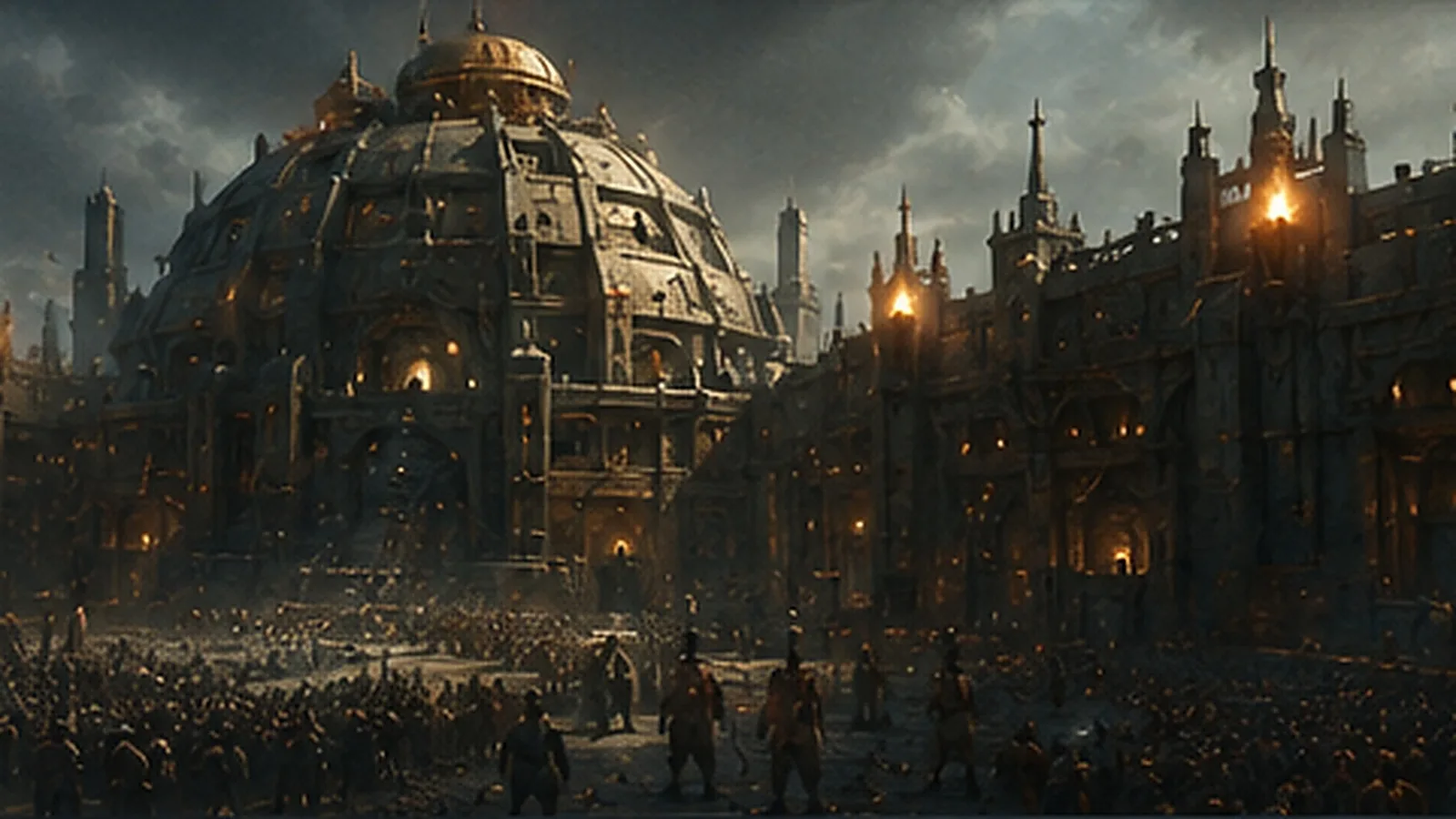
This guide follows novel continuity through A Parade of Horribles. It paraphrases the books, distinguishes confirmed mechanics from cross-book analysis, and limits later-floor notes to established details. The lead artwork is an original, non-canon conceptual rendering created for this fan reference.