Spoiler notice
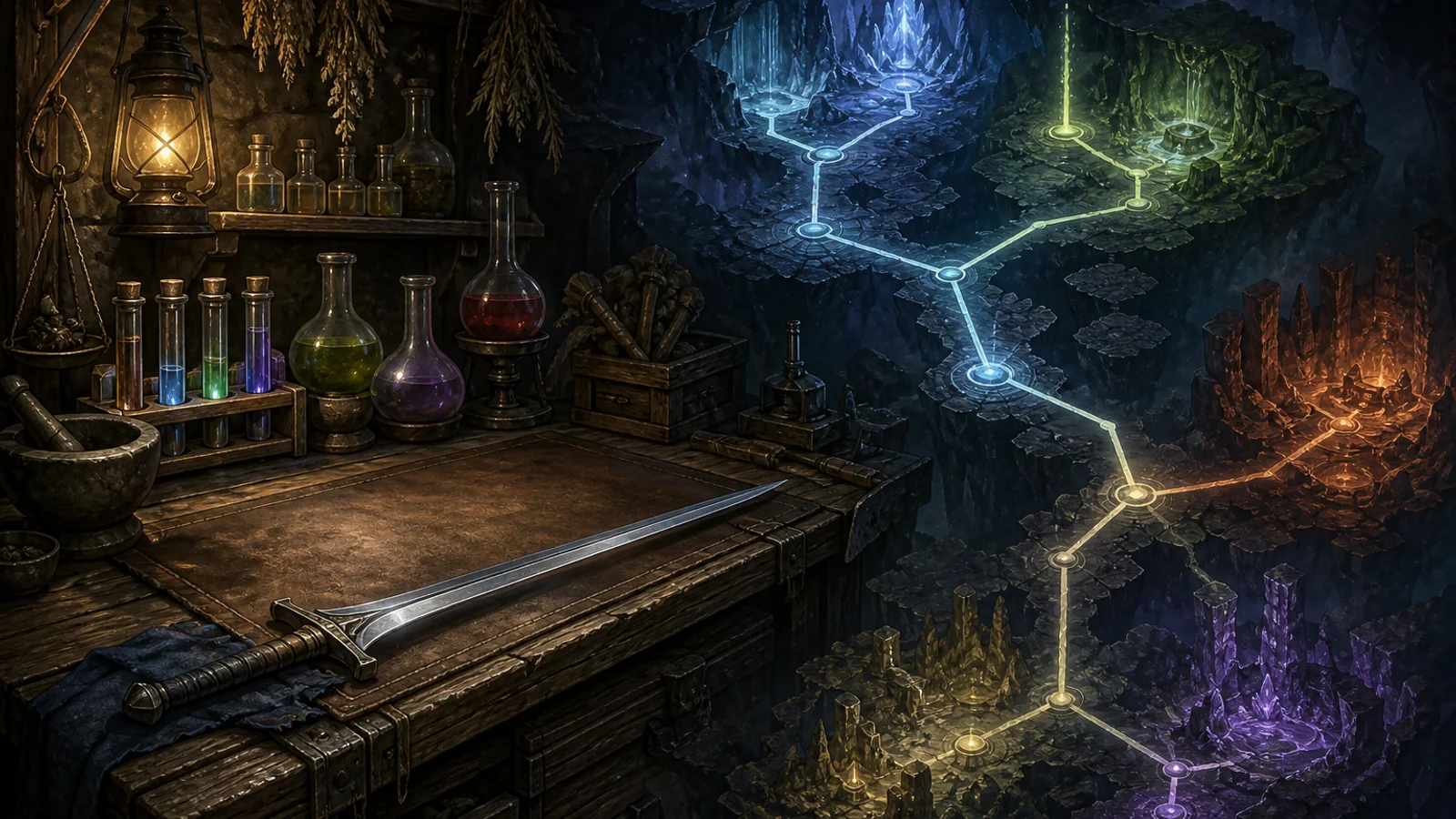
Spoilers for Dungeon Crawler Carl through Book 8 and the named source franchise may appear. This article uses broad, official Geralt/Witcher traits such as professional monster hunting, contracts, potions, signs, specialized materials, and moral skepticism. The imagery is environment/object-only and does not depict Geralt, an actor likeness, a white-haired witcher, franchise medallions, or copied costume/weapon designs.
Geralt of Rivia would understand one part of Dungeon Crawler World immediately.
Someone wants a monster dead.
There is a reward.
The description is probably incomplete.
The person offering the job may be lying.
That is familiar territory.
Netflix's official The Witcher description identifies Geralt as a mutated monster-hunter for hire moving through a world where people often prove more dangerous than beasts. Netflix's creature guide also emphasizes potions, rare materials, monster knowledge, and Witchers as specialized hunters shaped by mutation and training.
All of that transfers beautifully to DCC.
Then the System AI starts talking.
That is where the problems begin.
Geralt's entire profession depends on turning incomplete folklore into practical preparation. He studies monsters, chooses oils and potions, identifies environmental evidence, negotiates contracts, and decides whether the creature in front of him is actually the moral problem the client claims it is.
DCC looks like a perfect monster-hunter environment until one realizes the monsters are part of a designed entertainment system.
Geralt is used to corrupt clients.
He is not used to the quest interface itself being a corrupt client.
Monster Preparation
Geralt's preparation can be compared with Rules as Character Pressure, Safe Rooms: Strategy, Recovery, and Emotional Reset, and System AI: Interface, Character, and Environment.
Geralt's biggest advantage is preparation before contact.
He rarely treats a monster as a generic combat target.
He wants context.
What does it eat?
Where does it nest?
What signs does it leave?
What material harms it?
What story are the locals telling incorrectly?
That is exactly the mindset DCC rewards on any floor where enemies have hidden mechanics.
Geralt would take item descriptions and bestiary entries seriously without trusting them completely. He would compare the System's classification with physical evidence.
This is important because DCC loves comedy names, misleading genre assumptions, and monsters whose behavior depends on rules rather than folklore.
Geralt would become valuable not because he already knows the species.
He would become valuable because he knows how to learn a species.
The Bestiary Problem
The major complication is that Witcher knowledge does not transfer directly.
A DCC vampire may not be a Witcher vampire.
A ghoul may not follow expected anatomy.
A demon may be a generated entity using a game-specific status system.
The System might deliberately use familiar labels because it wants crawlers to assume the wrong thing.
Geralt's professional discipline protects him from this trap better than most characters.
He has long experience with folklore being unreliable.
He would test assumptions.
The danger is overconfidence when a familiar name appears.
One bad encounter would probably cure that quickly.
Potions and Alchemy
Geralt's potion practice maps well to DCC crafting and consumable systems.
He is accustomed to preparing before a fight rather than treating healing as something that only happens after damage.
That makes him well suited to:
- resistance potions
- toxin counters
- status preparation
- oils and coatings
- limited-duration buffs
- ingredient collection
The DCC problem is system formalization.
The dungeon may not recognize his existing alchemy exactly as he expects. Ingredients may be classified differently. Toxicity rules could interact strangely with stats. A potion that works in his world might receive altered behavior or become redundant next to a system item.
Geralt would adapt quickly because he already thinks experimentally.
Contracts Versus Quests
This is the strongest thematic comparison.
A Witcher contract is negotiated.
The client states a problem.
Geralt investigates.
He may discover that the client is wrong, dishonest, frightened, or morally compromised.
He can renegotiate.
He can sometimes walk away.
DCC quests look similar on the surface and are radically more coercive.
The System defines objectives.
Failure conditions may be hidden or punitive.
Rewards are mechanically assigned.
The entity giving the quest may not control the real consequences.
Geralt would immediately treat quests like hostile contracts.
He would read every condition.
Ask what is omitted.
Identify who benefits.
Search for alternative completion states.
This would make him extremely effective.
It would also make the System AI very irritated.
Moral Choices
Geralt is one of the best crossover characters for DCC because his source world already refuses simple monster/human morality.
The creature is not always evil.
The village is not always innocent.
The employer is not always honest.
Neutrality is often impossible even when he prefers not to become a political actor.
DCC takes those dilemmas and mechanizes them.
An NPC may be a person even when the System calls them content.
A god may be a political asset.
A monster may be sentient.
A sponsor may offer help for reasons that compromise the recipient.
Geralt would recognize this moral instability quickly.
His weakness is that he often prefers local judgment to ideological commitment.
DCC eventually makes local neutrality almost impossible.
Neutrality Under Broadcast Pressure
Geralt does not seek celebrity.
That is bad news in an audience economy.
At first he would likely underperform in viewer metrics relative to a more theatrical crawler.
Then the audience would discover the appeal of the reluctant professional.
A taciturn monster hunter who refuses hype, investigates before fighting, and occasionally tells the quest giver that the quest itself is wrong is extremely watchable.
Geralt could become popular precisely because he resists popularity.
That creates a familiar DCC paradox.
The more authentically he refuses performance, the more the refusal becomes a performance category.
Sponsor Appeal
Sponsors would want him for credibility.
Geralt has a strong professional identity.
A sponsor connected to weapons, alchemy, travel, or monster gear could benefit from association with someone who treats equipment seriously.
He would hate most overt branding.
He would accept useful support if the terms were clear enough.
The problem is that DCC sponsors often operate politically.
Geralt is wary of being drawn into larger causes.
The crawl keeps turning resources into causes.
That would pressure his preference for transactional clarity.
Social Popularity
Geralt's social game is uneven.
He is observant.
He understands people.
He can negotiate.
He is not naturally cheerful, reassuring, or crowd-pleasing.
DCC audiences might initially read him as cold.
Over time, his consistency would likely become an asset.
He says less than many crawlers.
That makes the words he does say more valuable.
This kind of audience identity can become powerful because it feels unmanufactured.
Resistance to System Manipulation
Geralt's greatest anti-system advantage is professional skepticism.
He does not assume the person offering a contract shares his understanding of the situation.
That mindset maps directly onto the System AI.
The AI says an enemy is a monster.
Geralt checks.
The AI says a quest has one objective.
Geralt looks for another.
The AI gives a reward.
Geralt asks what the reward costs.
This makes him unusually resistant to narrative manipulation.
But he is not immune to mechanical manipulation.
A system that controls the environment can impose consequences regardless of whether he believes the story.
Skepticism helps him see the trap.
It does not always let him avoid it.
Likely Class Logic
Geralt would probably choose a class close to his existing profession if available.
That may be a mistake.
DCC classes can exaggerate an identity into a mechanical constraint. A Monster Hunter class may look perfect but include assumptions about what counts as a monster, what rewards matter, or which abilities are allowed.
Geralt would read carefully.
A better build might combine:
- melee flexibility
- alchemy
- perception
- status resistance
- limited magic/sign equivalents
- monster analysis
He would value reliable tools over theatrical peak damage.
Early Floors
Geralt performs extremely well early.
Floor 1: physical competence and threat identification carry him.
Floor 2: item economy and monster variation reward his preparation.
Floor 3: race/class choice is complicated but manageable.
Floor 4: Iron Tangle is less natural because logistics and abstract route systems matter more than monster lore, but his investigative discipline keeps him competitive.
Floor 5: NPC ethics and magical mythology suit him extremely well.
Floor 6: hunter politics become difficult because the enemy is no longer just a monster. It is a social class of people entering the floor for sport.
That is where Geralt's preference for staying out of politics becomes untenable.
Iron Tangle: Monster Hunter Without Monsters
The Iron Tangle is a useful stress test because it removes Geralt from his best domain.
A train system cannot be tracked by claw marks.
Routes and colored lines do not care about sword skill.
This is where he would need party members with systems thinking, maps, or technical expertise.
Geralt is capable of investigation, but not every investigation resembles hunting.
The floor teaches him an important DCC lesson:
specialization keeps you alive until the problem stops being your specialty.
NPC Personhood
Geralt would likely recognize NPC personhood earlier than many crawlers.
His world already contains nonhuman peoples, cursed beings, monsters with intelligence, and humans behaving monstrously.
He does not define moral worth entirely by species category.
That makes him well suited to Juice Box, changelings, awakened NPCs, and later questions about generated consciousness.
He would distrust the System's attempt to tell him what kinds of beings count as disposable.
Gods
Geralt is accustomed to supernatural powers.
DCC gods would still be a problem because they are embedded in game rules, sponsorship, and political competition.
He would understand quickly that divinity does not equal moral authority.
That is useful.
He would be less prepared for the extent to which outside actors can treat gods as pieces in an entertainment-political system.
The Ascendancy would make his preference for local contracts almost impossible to maintain.
Resistance Planning
Would Geralt join Carl's resistance?
Eventually, probably.
Not because he wants to become a revolutionary symbol.
Because the evidence would keep showing that the crawl itself is the monster behind the contracts.
Geralt's moral pattern repeatedly pushes him toward intervention when neutrality becomes complicity.
DCC would force that realization slowly and then all at once.
The interesting question is whether he becomes a leader.
Probably not.
He would be more useful as a specialist whose judgment carries weight precisely because he does not seek command.
Geralt and Donut
Donut would be fascinated by the mismatch between Geralt's audience appeal and his unwillingness to perform for it.
She would understand instantly that the taciturn monster-hunter image sells itself.
Geralt would be irritated by this.
Carl would understand.
Mordecai would appreciate the preparation discipline.
The party dynamic could work very well as long as nobody expects Geralt to enjoy promotional interviews.
Survival Matrix
| Category | Rating | Why |
|---|---|---|
| Monster preparation | Exceptional | Professional research and threat-specific planning |
| Combat | Excellent | Trained melee fighter with supernatural enhancement |
| Alchemy | Excellent | Strong consumable and preparation logic |
| Quest analysis | Exceptional | Treats contracts as potentially dishonest |
| Audience popularity | Moderate to high | Reluctant professionalism becomes marketable |
| Sponsor cooperation | Moderate | Accepts useful terms, distrusts influence |
| System manipulation resistance | High | Naturally skeptical of framing |
| Political leadership | Moderate | Prefers local problems to ideological command |
Final Verdict
Geralt of Rivia is one of the fictional professionals most likely to adapt successfully to Dungeon Crawler World.
Not because every monster resembles something from the Continent.
Most will not.
Not because his potions automatically map to DCC mechanics.
They may not.
He succeeds because his profession is fundamentally a method for operating under uncertainty.
Investigate.
Prepare.
Do not trust the client's story.
Use the right tool.
Do not confuse ugly with evil or human with innocent.
That philosophy is almost perfectly suited to the crawl.
His biggest struggle would come when the system stops allowing him to remain a contractor.
DCC eventually forces everyone into politics.
Sponsors are political.
Gods are political.
NPC personhood is political.
The audience is political.
The System AI becomes political.
At that point Geralt's famous preference for neutrality becomes difficult to maintain.
The final question is not whether he can kill the monster.
It is whether he accepts that the dungeon itself is the contract nobody had the right to offer.
If he reaches that conclusion, he becomes one of Carl's most useful possible allies.
If he does not, he may survive many floors while helping preserve the larger machine simply by refusing to choose a side.
In Geralt's world, sometimes the lesser evil remains evil.
In Dungeon Crawler World, sometimes refusing the choice is the only way to discover who designed the menu.
The Contract Board Would Become Intelligence
Geralt would not read dungeon quest boards only as opportunities. He would read them as evidence about the floor. Which threats are repeatedly mentioned? Which settlements offer suspiciously high rewards? Which monster categories appear in clusters? Which quest giver descriptions contradict local behavior?
This is a subtle but powerful advantage. In DCC, quests are part of the system's narrative layer. Geralt's professional habit of treating contracts as imperfect testimony lets him use that layer against itself. Even a dishonest quest can reveal what the system wants him to notice or avoid.
A party with Geralt would therefore gain more than a monster killer. It would gain someone turning the quest economy into an intelligence feed.
Potions Versus Sponsor Boxes
Geralt's preference for self-prepared consumables would also create an interesting conflict with sponsor loot. A sponsor box may contain something objectively stronger than anything he can brew. But using it increases dependence on an external actor whose incentives are uncertain.
Geralt would likely prefer a weaker tool he understands over a stronger tool whose provenance is unclear. That instinct can look inefficient in a game system built around optimization. In practice, it may protect him from manipulation.
The party tension comes when his caution affects others. If refusing a sponsor item puts allies at risk, personal independence becomes a luxury. Geralt would then face the same compromise DCC forces on many characters: accepting contaminated help because innocent people should not pay for your purity.
Geralt and the Audience's Monster Stories
The galactic audience would probably try to package Geralt as the definitive "professional monster killer." That seems harmless until the label starts influencing which encounters become narratively attractive. Producers may want to send unusual creatures his way. viewers may expect a clean expert explanation. sponsors may want their gear attached to a successful hunt.
Geralt's expertise could therefore become a content trap. The better he performs as a specialist, the more the show has incentive to construct specialist showcases around him. His brand would start designing his danger.
The correct response would be deliberate unpredictability: sometimes negotiate, sometimes refuse the fight, sometimes let another party member solve the monster, and sometimes expose that the supposed monster is not the moral problem at all.
What He Learns From Carl
Carl would teach Geralt one lesson faster than the dungeon could: contracts are not the deepest layer of the problem. The system writing the contract may itself be the adversary.
Geralt is already comfortable distrusting clients. Carl extends that suspicion upward. The showrunner, sponsor, AI, Syndicate rule, and divine system can all behave like clients with hidden agendas. Once Geralt generalizes his professional skepticism to institutions rather than individuals, his neutrality becomes harder to maintain but his strategic clarity improves dramatically.
That shift is probably the point where he stops being a highly successful crawler and becomes a serious resistance asset.
The Professional Code Versus the Achievement System
Geralt would also struggle with the way DCC turns professional competence into spectacle. A Witcher takes satisfaction in preparation and execution, but the work is still work. The crawl converts the same act into an achievement notification, an audience clip, a sponsor opportunity, or a public identity marker. That changes the psychological environment of professionalism.
Geralt's likely response would be refusal to let external scoring replace internal standards. A perfect kill with a bad moral outcome is still a bad contract. A spectacular achievement does not prove the choice was wise. A humiliatingly named reward may still be useful. He would separate utility from dignity more easily than many crawlers because his profession has already taught him that outsiders often misunderstand what the job actually required.
That makes him unusually resistant to achievement addiction. The System can reward him. It can irritate him. It can publicize him. It has a harder time convincing him that points, titles, or applause are the same thing as good judgment.
In a progression system built to make rewards feel like moral validation, that skepticism is a major survival asset.
FAQ
Would Geralt's Witcher potions work in DCC?
The crossover cannot assume exact mechanical compatibility. His alchemical knowledge and preparation habits would still translate even if recipes needed to be rebuilt using dungeon ingredients.
Would Geralt be popular with viewers?
Probably more than he wants. His restraint and professionalism would create a strong audience identity.
Would he trust sponsor contracts?
No. He would negotiate carefully and assume every offer contains motive beyond the stated reward.
Which floors suit him best?
Monster-heavy and mythology-heavy floors suit him extremely well. Abstract logistics systems such as the Iron Tangle are a more serious challenge.
Would Geralt join the resistance?
Likely once he concludes that the crawl itself is the recurring source of injustice rather than merely the environment in which individual contracts occur.
Source and update note
Broad published Witcher/Geralt framing supplies the professional monster-hunting, alchemy, contracts, signs, and moral-skepticism baseline. The DCC side is a hypothetical synthesis of published-series mechanics through Book 8, including classes, quests, safe rooms, System AI, and audience pressure. No shared canon is claimed.
Primary starting point: Netflix: The Witcher original series introduction. These materials establish the source-franchise baseline; the dungeon outcomes, ratings, and comparisons above are editorial interpretations, not an announced crossover.