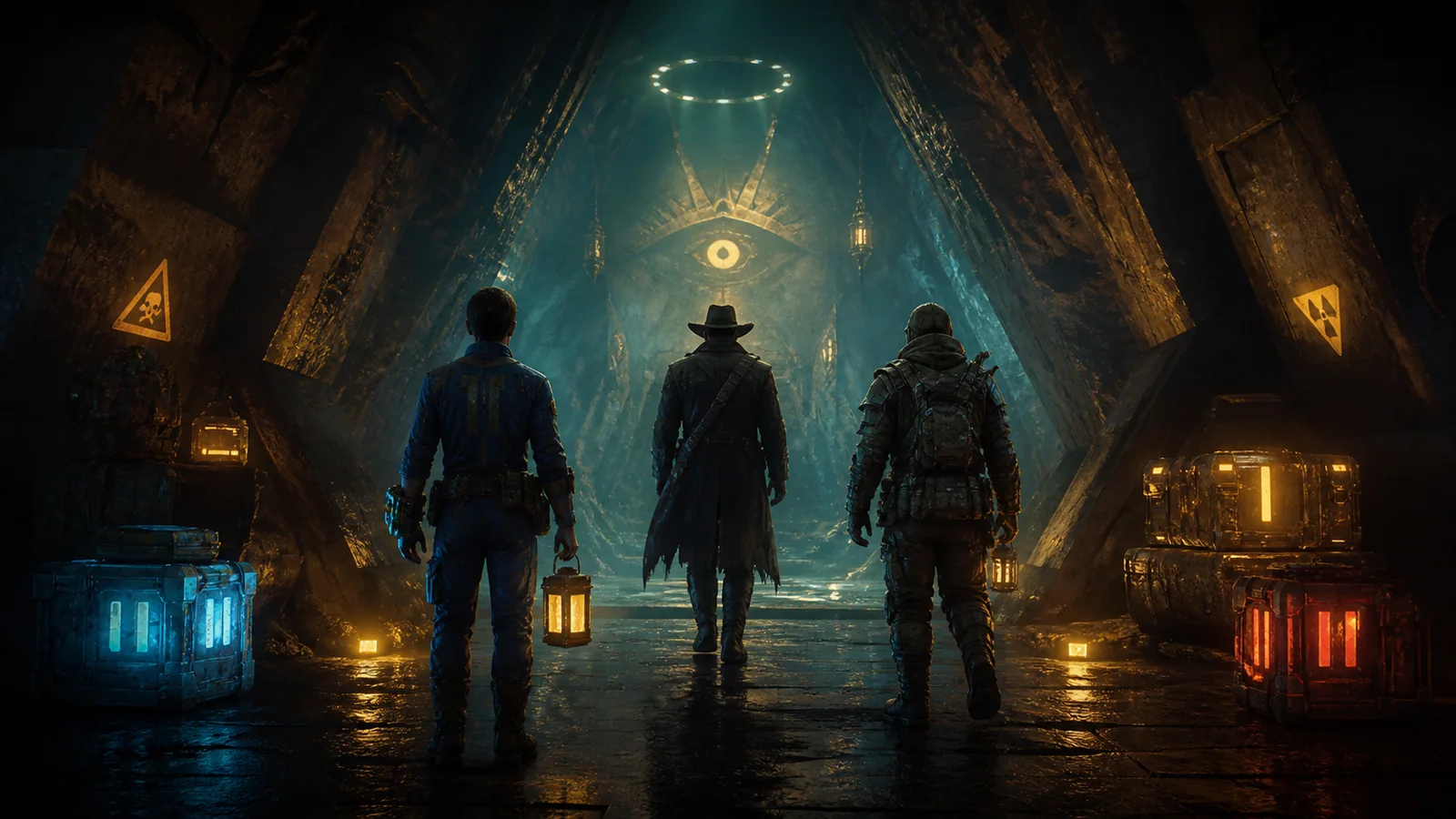
This article uses the Prime Video versions of Lucy MacLean, the Ghoul/Cooper Howard, and Maximus as its primary character baseline, while also drawing on broader Fallout survival archetypes such as Vault dwellers, wasteland scavengers, Brotherhood soldiers, raiders, and charismatic faction operators. It also discusses DCC mechanics through Book 8. Fallout characters would understand the dungeon faster than almost anyone from a normal modern setting. That does not mean they would survive it. The Wasteland trains people to expect bad information, poisoned resources, predatory institutions, improvised weapons, unstable alliances, hidden bunkers, absurd technology, mutated creatures, and bureaucracies that insist their violent systems are logical. Dungeon Crawler World would feel alien, but not conceptually impossible. Readers can compare that translation through System AI, Inventory, and Sponsorship. Lucy MacLean has spent her life inside a controlled underground community whose rules turn out to conceal larger institutional crimes. Maximus is trained by a militarized order that uses hierarchy, ritual, armor, and technology to create meaning in a ruined world. The Ghoul has survived for two centuries by assuming that every deal contains a hidden cost and every institution eventually betrays the person who trusts it too much. Those are excellent starting skills. The problem is that the dungeon does something the Wasteland rarely does: it formalizes survival into visible game mechanics. A wastelander can distrust a locked box. A crawler must decide whether opening a loot box is the only way to keep up with an enemy whose statistics are increasing faster. A Brotherhood soldier can understand armor maintenance. A crawler must understand class restrictions, inventory rules, magical resistances, skill cooldowns, race bonuses, and System AI behavior. A bounty hunter can understand reputation. A crawler must understand views, followers, favorites, sponsors, crawler shows, and public branding as survival resources. The Wasteland rewards paranoia. The dungeon rewards paranoia plus literacy in a system that wants to be watched. That distinction determines who thrives. Original non-canon editorial crossover artwork. It is not official Prime Video, Bethesda, or DCC artwork. This analysis uses the Prime Video series versions of the three main characters because they provide a clean shared timeline and clearly defined personalities. Amazon's official character material describes Lucy as an optimistic Vault Dweller whose peaceful, idealistic nature is tested when the people she loves are harmed. Maximus is a young soldier connected to the Brotherhood of Steel, a militarized faction committed to controlling advanced technology. The Ghoul, formerly Cooper Howard, survives the Wasteland as a pragmatic, ruthless bounty hunter carrying two centuries of history. Those descriptions already map onto three DCC survival philosophies. Lucy asks: How do I stay a person in a system that rewards becoming worse? Maximus asks: Which institution gives me the best chance to survive and matter? The Ghoul asks: Which rule is real, which rule is theater, and who benefits if I believe either one? Carl would recognize all three questions. Lucy would be underestimated immediately. Her early Vault upbringing creates obvious weaknesses. She begins with limited experience in open-world predation, deception, resource scarcity, and the kind of violence the dungeon treats as routine. But her Vault background gives her several strengths that would become unusually valuable after the first floor. She is educated. She learns systems quickly. She is socially capable. She is willing to negotiate before fighting. She begins with a strong belief in cooperation. Most importantly, her idealism is not the same as stupidity. The Wasteland forces her to update. That is exactly the skill a crawler needs. Lucy would initially treat System messages more literally than Carl or the Ghoul. She would want the rules to be rules. The early dungeon would punish that instinct. Once she experienced arbitrary achievements, misleading framing, sponsor pressure, and rule changes, she would begin applying the same lesson she learns about Vault-Tec and Wasteland institutions: A system can be internally coherent and morally fraudulent at the same time. That realization would make her dangerous. Lucy is at her strongest when she stops expecting institutions to deserve the trust they demand while refusing to abandon the values that made her trust them in the first place. That is close to Carl's moral evolution. Lucy would probably benefit from a hybrid social/support class rather than trying to become a pure front-line fighter. Her strengths suggest:
- high Charisma
- negotiation bonuses
- medicine or first-aid progression
- pistols or precision ranged weapons
- support buffs
- faction reputation advantages
- persuasion or diplomacy skills
- branded survival products
- "civilized" political messaging
- medical or humanitarian sponsors
- anti-crawl organizations
- factions hoping to turn her into a public symbol
- conserve ammunition
- read ambushes
- use intimidation
- move through hostile territory
- scavenge
- improvise
- survive injury
- distrust authority
- evaluate temporary alliances
- kill quickly when negotiation has failed
- ranged precision
- quick draw
- perception
- status resistance
- intimidation
- tracking
- bounty bonuses
- ammunition efficiency
- survival under injury
- anti-humanoid specialization
- magical damage types
- resistances
- curses
- divine quests
- inventory abstraction
- System-defined conditions
- teleport mechanics
- floor-wide event rules
- existing gear
- race-incompatible equipment
- restricted external technology
- upgradeable armor
- inventory-exempt mount-like hardware
- something with maintenance costs
- technical expertise
- military discipline
- controlled access to advanced equipment
- doctrine
- rank
- logistical identity
- complex party coordination
- shared inventory
- multi-day plans
- alliance diplomacy
- sponsor reputation
- NPC cooperation
- Faction Wars command
- education
- medicine
- record keeping
- engineering
- resource allocation
- community structures
- long-term planning
- system literacy
- network mapping
- rules interpretation
- patience
- information exchange
- willingness to solve a puzzle bigger than one room
- alliances
- morale
- supply
- diplomacy
- legitimacy
- public messaging
- command systems
The danger is that the AI loves irony. It would almost certainly offer her a class with a cheerful Vault-like title that turns out to carry horrifying social implications. Lucy would need Mordecai-level guidance before selecting anything. Lucy would attract sponsors quickly. She is visually legible as a story. Optimistic Vault Dweller enters hell. That is a media hook. Sponsors would see several ways to use her:
The danger is that Lucy wants to believe help can be sincere. DCC sponsorship is often sincere and manipulative. A benefactor can save your life and still want to steer your choices. She would learn that lesson faster than early-series Lucy would like. Lucy probably survives the early floors if she joins competent allies quickly. Her long-term ceiling is high because she adapts emotionally without fully surrendering moral judgment. She would struggle most on floors where social fairness is deliberately weaponized against her. She would do exceptionally well once crawler coalitions become political. By Faction Wars, Lucy could plausibly become an Imani-style institutional leader rather than a Carl-style demolition specialist. Her value would be keeping a community functional. If Lucy is better than she looks, the Ghoul is exactly as dangerous as he looks. Amazon describes him as a pragmatic, ruthless bounty hunter with a 200-year history in the Wasteland. The First Floor would feel almost relaxing by comparison to a normal newcomer. He already knows how to:
His biggest early advantage is psychological. He would not expect the dungeon to be fair. That saves time. The Ghoul has lived in a world where reputation is currency. The dungeon simply quantifies it. Views, followers, favorites, sponsors, and public identity would not offend his sense of how survival works. He would see the audience economy as another market. That could make him one of the most efficient crawler celebrities imaginable. Not because he would become charming. Because he would understand that being watched is leverage. He would deliberately cultivate a persona. The System AI would love him. That is also the problem. The AI rewards spectacle, unusual violence, humiliation, personality, and memorable behavior. The Ghoul is already theatrical in the way a veteran killer becomes theatrical when reputation reduces future resistance. He understands the power of walking into a room with everyone already afraid. The AI would reinforce that behavior with achievements. The audience would reinforce it with attention. Sponsors would reinforce it with loot. The danger is an escalation loop. The Ghoul could become more effective and less strategically flexible because the system keeps rewarding the most extreme version of his persona. Carl resists becoming only the character the audience wants. The Ghoul might decide the character is useful enough to keep. His ideal build would emphasize:
A DCC-style class might give him extraordinary effectiveness against named targets while increasing penalties for mercy or nonviolent solutions. That would be exactly the sort of trap he would need to avoid. The Wasteland is bizarre. It is still materially grounded compared with later DCC floors. The Ghoul understands bullets, radiation, monsters, drugs, armor, energy weapons, and old technology. He would have to learn:
He is excellent at surviving a dangerous place. The deeper dungeon is a dangerous rule set. That difference becomes serious around the Iron Tangle and later. Maximus is the hardest of the three to predict. His Brotherhood training gives him discipline, weapons familiarity, armor knowledge, and comfort inside hierarchy. Those are real advantages. Power armor would be an enormous First Floor asset if the dungeon allowed it to enter and function normally. But DCC does not reward dependence on one piece of equipment forever. The System could classify the armor as:
The exact ruling would matter more than the armor's raw power. The Brotherhood teaches Maximus to locate meaning in institutional membership. Dungeon Crawler World offers many institutions ready to exploit that instinct. A sponsor could promise resources. A guild could offer structure. A faction could offer rank. A god could offer purpose. A charismatic crawler leader could offer belonging. The question is whether Maximus has learned enough to distinguish useful hierarchy from manipulative hierarchy. Early Maximus is vulnerable here. Later Maximus is much better. The Brotherhood represents one of Fallout's most useful survival archetypes for DCC comparison. It has:
Those qualities could build a formidable crawler faction. The failure mode is equally obvious. The dungeon loves rigid doctrine because rigid doctrine is predictable. Carl survives by violating assumptions. A Brotherhood-style faction could dominate simple combat floors and become catastrophically vulnerable on floors that punish fixed thinking. The classic raider archetype would look strong at the beginning. Raiders understand violence, intimidation, scavenging, and opportunism. They would have no moral hesitation about player killing. The System might reward them heavily for exactly that reason. But later DCC progression punishes groups that cannot maintain trust. A raider faction would struggle with:
A group built entirely on fear becomes fragile once the System creates incentives for betrayal from below. Vault dwellers would struggle with immediate danger and excel at organization. A good Vault-derived crawler group could bring:
Their weakness would be institutional innocence. Anyone who still believes the Vault rulebook is morally neutral would be vulnerable to the dungeon's presentation of rules as objective facts. The fastest-learning Vault dwellers would become excellent mid-floor organizers. The slowest would die waiting for the rules to protect them. Original non-canon editorial artwork. The Brotherhood and Princess Posse would initially recognize something admirable in each other. Both can mobilize people. Both use symbols. Both create identity. Both understand logistics. The difference is legitimacy. The Princess Posse grows from accumulated trust among people who repeatedly choose to cooperate. The Brotherhood is more comfortable with inherited hierarchy and doctrine. Faction Wars would test which model adapts faster. Carl would almost certainly irritate the Brotherhood command structure within minutes. Imani would probably have a much more productive relationship with them. Original non-canon editorial artwork. Fallout survival teaches that useful objects are physical, local, and scarce. You find ammunition. You strip armor. You salvage components. You repair equipment. DCC inventory changes the meaning of scarcity. A crawler can carry impossible quantities while still lacking the exact consumable needed for a mechanic. Loot boxes create delayed access. Sponsor boxes create political access. Quest items may have no obvious physical logic. A Fallout survivor would need to stop thinking only in terms of objects and start thinking in terms of item categories and system permissions. The Ghoul would adapt fastest. Lucy would learn most thoroughly. Maximus would be most tempted to overvalue one superior piece of equipment. Fallout characters are unusually familiar with environmental hazards. That helps on poison, contamination, disease, and hostile-terrain floors. It would not solve most of DCC's dangerous status effects. Magic does not care that you understand radiation. A divine curse is not radiation sickness. A System debuff is not a toxin. The Wasteland gives the characters the right attitude toward invisible hazards, not universal immunity. Original non-canon editorial artwork. The Ghoul understands transactional help best. Lucy understands public sympathy best. Maximus understands faction sponsorship best. None should trust the system automatically. The smartest strategy would be Lucy as public face, the Ghoul as contract skeptic, and Maximus as logistics/armor specialist. That is an extremely strong small party. The problem is getting them to agree long enough to remain one. A dungeon party needs more than combat. The ideal trio division looks like this: She handles NPCs, parties, sponsor interviews, alliance negotiations, and community morale. He handles reconnaissance, ambushes, tracking, difficult targets, and the reality check whenever a deal sounds too generous. He handles heavy defense, technology, formation fighting, and larger organizational coordination. This trio can survive surprisingly deep if they learn to share information. The first real danger is moral. Lucy wants to save people. The Ghoul expects some people to be unsalvageable. Maximus may prioritize the mission or institution. The dungeon would deliberately create a quest that forces those philosophies into conflict. The AI would love the resulting drama. The audience would pick favorites. Sponsors would reinforce different sides. The party's greatest threat would not be a monster. It would be the System discovering exactly which pressure splits them. The Fourth Floor is where Fallout instincts stop being enough. The Iron Tangle requires:
Lucy becomes increasingly valuable here. The Ghoul would hate it but adapt. Maximus would need to stop waiting for command guidance. A Brotherhood platoon that insists on treating the floor like military territory might perform worse than three flexible scavengers with good maps. The Sixth Floor would feel more familiar. Hunters enter to kill crawlers. Suddenly reputation, ambushes, counter-hunting, terrain, and resource denial matter. The Ghoul would be exceptional. This is probably his best floor. He understands what it means when someone wealthy enters a dangerous environment because they think killing people is sport. He would not need the moral premise explained. Faction Wars changes the question from survival to governance. Lucy becomes much more important than the Ghoul here. Armies need:
The Ghoul can win battles. Lucy can help build the coalition that wins the war. Maximus can translate military structure into operational discipline. The three together could become a serious Princess Posse subcommand. Original non-canon editorial artwork. The System AI is unlike any Fallout institution because it is both personality and environment. The Ghoul would treat it as an adversary immediately. Lucy would initially try to understand its motives. Maximus might initially treat it like superior command until it violated the moral framework he expected. The AI would probably enjoy all three. It would mock Lucy's optimism. Reward the Ghoul's brutality. Exploit Maximus's need for rank. Their survival depends on recognizing that the AI's attention is both resource and danger. Likely early-to-mid floor survivor with the right party. Her odds increase dramatically once social and political play becomes central. Potentially dominant early with power armor or equivalent heavy gear, but vulnerable to system complexity and institutional manipulation. Exceptional early and mid-floor survival. His ceiling depends on adapting from physical threat logic to magical and system abstraction. A legitimately deep-run party. They have combat, diplomacy, skepticism, armor, adaptability, and story appeal. If they survive their internal conflict, they could plausibly reach the later floors.
| Character | Early Floors | Complex Mechanics | Social Game | Sponsor Game | Late-Floor Ceiling |
|---|---|---|---|---|---|
| Lucy | 6/10 | 9/10 | 10/10 | 9/10 | High with team |
| The Ghoul | 10/10 | 7/10 | 7/10 | 9/10 | High if adaptable |
| Maximus | 9/10 | 7/10 | 6/10 | 7/10 | Medium-high |
| Trio | 10/10 | 9/10 | 9/10 | 10/10 | Very high |
The Ghoul wins the First Floor. Lucy wins the long game. Maximus gives the party the best chance of surviving moments where raw defense matters. The trio works because each character covers another's blind spot. The larger Fallout lesson also fits DCC perfectly: The people who survive longest are rarely the people with the cleanest ideology. They are the people who can revise their model of the world faster than the world can punish the old one. The Wasteland already taught these characters that civilization lies about what keeps people safe. The dungeon would teach them that the lie can have a user interface. It depends on how the System classifies and permits the equipment. Raw defensive value would be excellent, but maintenance, inventory, class compatibility, and magical damage could limit it. The Ghoul would adapt fastest to immediate danger. Lucy would probably adapt best to the full combination of mechanics, politics, and alliances. Almost certainly. Her optimistic Vault identity, adaptability, and social intelligence would make her a very marketable crawler. No, but the AI would probably like him. His theatrical violence and reputation instincts would generate attention, which could become both advantage and trap. Potentially very deep. Their biggest weakness would be internal moral conflict and the dungeon's ability to target exactly that division.