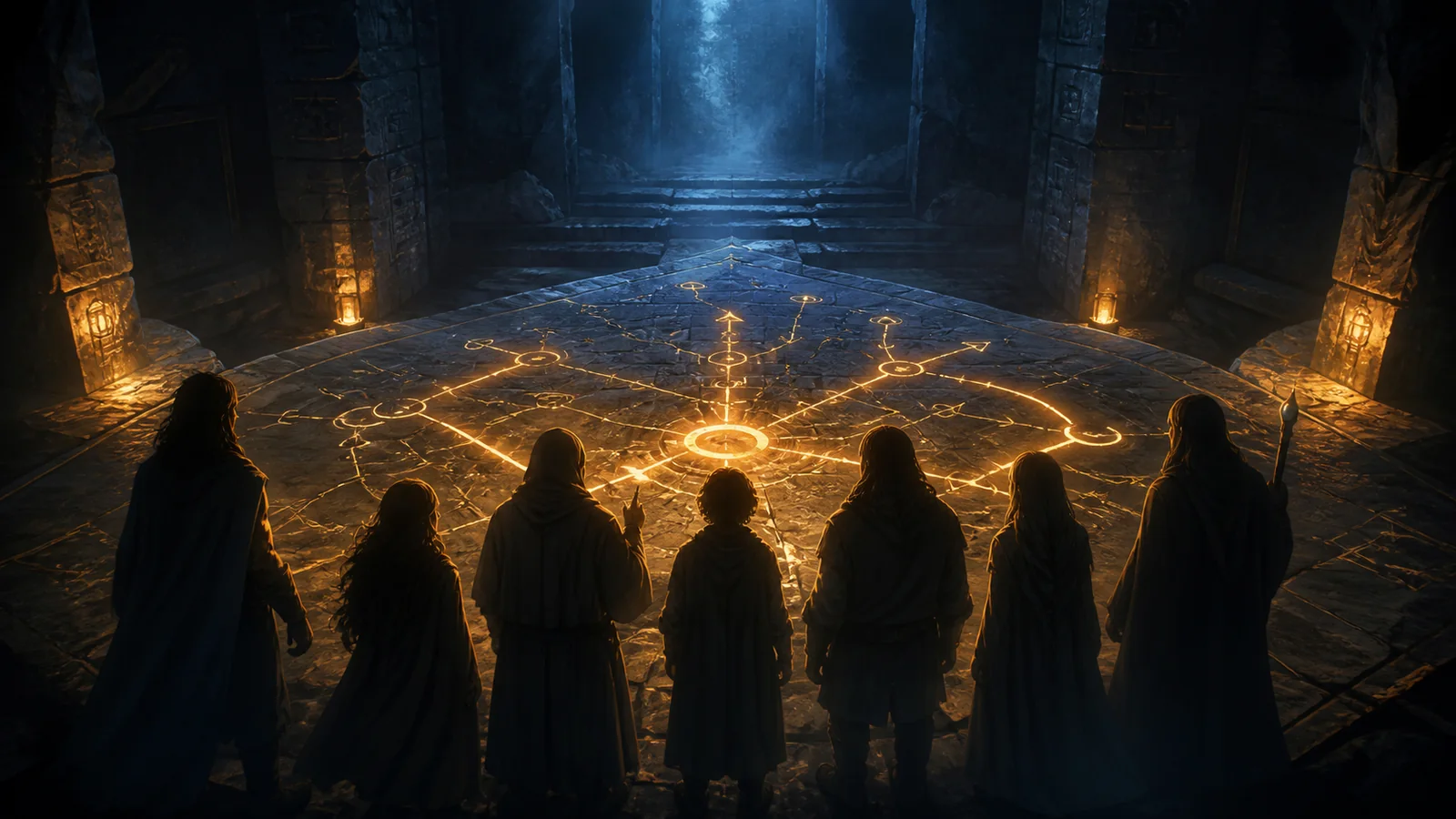
This article compares Dungeon Crawler Carl mechanics with the main Fellowship as presented in The Fellowship of the Ring and the broader early quest dynamic familiar to most readers. It is a crossover thought experiment, not a shared-canon page. Crossovers often collapse into a single shallow question: who would win a fight? Crawler Team Dynamics Map, Rules as Character Pressure, and Safe Rooms: Strategy, Recovery, and Emotional Reset make the more useful team-survival comparison. That question is not useless, but it misses what makes Dungeon Crawler Carl such an interesting environment. Dungeon Crawler World is not simply a monster-filled location where strong people kill weaker things. It is a pressure system. It reshapes identity through classes, loot, achievements, quests, timers, and audience incentives. It rewards adaptability, emotional endurance, and political intelligence as much as bravery. That makes the Fellowship of the Ring a particularly rich comparison group. The Fellowship is not a squad built for gamified survival. It is a morally serious coalition of very different beings bound by trust, purpose, and sacrifice. Its strength comes from loyalty, complementary ability, ancient knowledge, and a mission larger than personal advancement. Its weakness is that those same virtues are not always aligned with the dungeon's incentive structure. So would the Fellowship survive? The short answer is yes, at least for a while. The more interesting answer is that they would survive differently than Carl's world expects. Their greatest strengths would also trigger the dungeon's most dangerous forms of pressure. The Fellowship enters this thought experiment with a huge advantage. They are already a functioning party with a clear mission, layered skill set, and tested interpersonal bonds. Many crawlers die because they enter the dungeon alone, disoriented, or surrounded by strangers. The Fellowship has none of those problems. They have:
- frontline fighters
- ranged capability
- stealth and scouting
- knowledge of enemy movement
- magical wisdom
- leadership redundancy
- extraordinary morale under pressure
In pure party-composition terms, they are closer to an endgame raid group than to a random starting-floor cluster. But the dungeon would immediately challenge the assumptions that make them effective. Their world rewards loyalty, courage, and mission focus. The crawl rewards those things only intermittently. It also rewards opportunism, rules exploitation, audience performance, and pragmatic moral compromise. The Fellowship would therefore enter with superb tactical depth and poor cultural fit. Original non-canon editorial artwork. Any attempt to place the Fellowship inside DCC has to begin with role logic. Exact classes are speculative, but broad party roles are not.
Aragorn
Aragorn is the easiest to place. He would function as a hybrid leader-scout-damage role. He brings endurance, battlefield command, wilderness tracking, and improvisational tactical judgment. In DCC terms, he is the player everyone wants on a long floor because he makes fewer bad decisions under pressure than almost anyone else.
Gandalf
Gandalf would be both the strongest asset and the greatest danger to the dungeon's balance. He would likely map to an advanced caster-support-leader role with unusually high knowledge utility. The crawl would either restrict him aggressively through class framing or try to tempt him into role constraints that convert wisdom into system-manageable power.
Legolas
Legolas is a premier ranged damage and scouting specialist. He would excel at hazard reading, target prioritization, and party protection. He would also likely be one of the most mechanically efficient floor participants because so many dungeon problems reward precision and mobility.
Gimli
Gimli is the classic tank-bruiser archetype. He would anchor corridor combat, hold choke points, and serve as a morale stabilizer in grinding encounters. DCC loves giving tanks painful choices between survival and protection; Gimli would accept those burdens more willingly than the system expects.
Boromir
Boromir is extraordinarily valuable on early floors. He is physically formidable, brave, and loyal to the immediate group even when inwardly conflicted. He would excel in direct defense scenarios, especially where civilians or weaker allies must be shielded. His greatest dungeon vulnerability is not combat. It is temptation. The system loves people who can be pressured through pride, urgency, and the promise of efficient power.
Frodo
Frodo would initially seem miscast in DCC because the dungeon often rewards visible force. That would be misleading. Frodo's deepest strengths are moral endurance, burden-bearing, and the ability to continue under invisible pressure. He is not the ideal damage dealer. He is an extraordinary long-mission carrier. If a floor objective required completing a corrupting or psychologically invasive quest while others protected him, Frodo could outperform more glamorous fighters.
Sam
Sam would be one of the best survival-support characters in the entire crossover. He is loyal, practical, emotionally durable, and capable of carrying both labor and hope. The crawl rewards players who can stabilize others during collapse. Sam would be indispensable in safe rooms, recovery phases, and morale crises.
Merry and Pippin
The younger hobbits would be underestimated at first, then increasingly useful. They would likely fill scout-support-disruption roles with high synergy in trap navigation, social unpredictability, and small-body mobility challenges. The dungeon often punishes people who dismiss unconventional assets. Merry and Pippin would benefit from that dynamic. Most DCC groups break because they lack a strong internal reason to remain a group once the system starts rewarding selfish behavior. The Fellowship already has a unifying purpose. That is enormous. They are not together because they happened to meet. They are together because they have accepted a burden that cannot be solved through individual advancement. That shared mission allows them to absorb stress without instantly fragmenting. Carl's teams often have to build chosen-family trust under fire. The Fellowship begins with something close to that architecture already in place. Yet mission-centered cohesion is not identical to dungeon survival cohesion. Dungeon mechanics would constantly ask whether the party can remain itself once every member is offered a different optimized path. DCC's systems do not merely test courage. They test whether characters will internalize game logic. This is where the Fellowship would struggle. The party is unlikely to embrace arbitrary class identity as happily as a normal crawler might. They are unlikely to enjoy loot theater. They are unlikely to perform for audience amusement. They are unlikely to tolerate quests that force senseless cruelty or public humiliation. They would seek moral coherence where the system often offers only leverage. That is admirable. It is also dangerous. Carl survives partly because he learns to treat absurd mechanics seriously without accepting their moral authority. The Fellowship would need to learn the same trick very quickly. Gandalf and Aragorn probably could. Boromir might resent it. Gimli would complain but adapt. The hobbits would surprise everyone. The Fellowship would be a spectacular audience draw. Why? Because they have built-in archetypal clarity. Viewers would immediately understand them. The noble ranger. The wise wizard. The proud dwarf. The graceful archer. The tragic warrior. The brave small folk. The public loves groups it can narrate easily. That would help them early. Audience support could generate sponsor interest and soft protection. But it would also create new danger. The dungeon loves to weaponize audience expectations. If the public falls in love with the Fellowship as a symbol of unity, production pressure would intensify around situations designed to split them. A crowd-pleasing party becomes most useful as content when it breaks. Original non-canon editorial artwork.
1. Temptation mechanics
The Fellowship is thematically built around resisting corruptive power. That makes temptation-based floor design almost too perfect a threat. The system could offer faster advancement, legendary gear, or morally compromised shortcuts tailored to each member's vulnerability. Boromir is the obvious risk, but not the only one. Even Aragorn could be pressured through responsibility. Gandalf could be pressured through the promise of efficient victory. Frodo could be pressured through relief from burden.
2. Split-path mechanics
The dungeon loves dividing teams. It would almost certainly separate the Fellowship physically, forcing subgroups to act without full coordination. This would especially threaten the hobbits and any strategy dependent on Gandalf's centralized knowledge.
3. Audience-vote spectacle
The Fellowship is not built for cynical performance. Donut thrives in public-facing environments partly because she understands showmanship. The Fellowship contains charisma, but not the same instinct to convert spectacle into tactical control. They would need to learn quickly that public perception can determine survival resources.
4. Achievement and loot bait
Some floors tempt players to overvalue boxes, upgrades, or side objectives. The Fellowship's success would depend on not letting immediate advantage derail larger purpose. That sounds easy given their book text, but DCC's great trick is tying side rewards to real survival benefits.
5. PvP and betrayal structures
Any forced betrayal mechanic would be catastrophic because it attacks the moral center of the group. The Fellowship could handle loss. It would struggle far more with rules designed to make one member eliminate another for progress. The Fellowship's recovery choices can be read alongside Safe Rooms: Strategy, Recovery, and Emotional Reset. One under-discussed reason the Fellowship might outperform expectations is that they are exceptionally good at recovery culture. They know how to travel, rest strategically, share burdens, and restore morale through conversation, ritual, food, and mutual care. DCC safe rooms reward exactly that kind of soft competence. Sam in particular would become priceless in these phases. So would Aragorn's medical and logistical instincts. Gandalf would guide bigger-picture planning. Merry and Pippin would help keep despair from becoming total. A party survives the crawl not only by winning fights, but by remaining a psychologically usable group between fights. The Fellowship would be excellent at that. The main internal stress points are not arbitrary. They are already present in the Fellowship's original dynamic. Aragorn tends toward burdened duty. Boromir tends toward urgent pragmatism tied to political necessity. Gandalf tends toward strategic wisdom that can be frustratingly indirect to others. Gimli and Legolas begin from cultural distrust before moving toward friendship. The hobbits vary in innocence, courage, and comprehension. Inside the dungeon, these tensions would sharpen around questions such as:
- Do we accept a sponsor with bad motives if it saves the party?
- Do we exploit a floor loophole that harms outsiders?
- Do we prioritize the main quest or immediate safety?
- Do we sacrifice reputation for tactical advantage?
- Who gets the rare item if it solves only one member's problem?
These are not just combat questions. They are pressure questions. The Fellowship would remain admirable, but not frictionless. Assuming the Fellowship enters as a cohesive unit and avoids early wipe conditions, they have a strong chance of reaching middle and later floors. Their odds improve because they combine frontline capacity, flexible sub-teams, and moral commitment. The bigger question is what happens once the crawl becomes more openly political. Faction Wars and later-stage DCC pressures do not simply ask a team to survive hazards. They ask the team to govern coalitions, manage public symbolism, and navigate competing power structures. The Fellowship could do this, but it would transform them. Aragorn, Gandalf, and Frodo are suited to that level of moral-political burden. Some others would chafe. Still, compared with many fictional crossover teams, the Fellowship is unusually well-built for meaningfully hard choices. At first glance one might say Gandalf or Aragorn. In practice, the emotional core of the party inside DCC would likely become Sam and Frodo. Why? Because DCC constantly strips away grand rhetoric and asks what remains when people are exhausted, compromised, and afraid. Frodo and Sam specialize in endurance under exactly those conditions. The public might celebrate Aragorn's leadership and Gandalf's brilliance, but the heart of the team's continued survival would probably rest in small acts of loyalty, carried burdens, and refusal to abandon one another. That fits both source worlds surprisingly well.
| Theme | Fellowship strength | Dungeon threat |
|---|---|---|
| Party balance | Excellent built-in roles | Split-path and separation mechanics |
| Leadership | Redundant and capable | Audience and political pressure |
| Morale | High loyalty and purpose | Corruption, grief, and impossible choices |
| Combat | Strong across melee, ranged, magic | Rule changes and asymmetrical gimmicks |
| Recovery | Excellent safe-room culture | Time pressure and forced exits |
| Weakness | Temptation and moral fracture | Loot bait, sponsor offers, betrayal mechanics |
Would the Fellowship survive Dungeon Crawler World? Yes, probably longer than many readers initially assume. They would survive because they already understand sacrifice, mutual dependence, and mission-centered endurance. They would form a coherent party faster than most crawlers. They would make good use of safe rooms. They would fight effectively. They would resist panic. But they would not glide through the crawl. The dungeon would identify their virtues and turn those virtues into stress points. Loyalty would become leverage. humility would become an obstacle to showmanship. Moral seriousness would become a liability in systems that reward theatrical cruelty or opportunistic shortcuts. Their greatest danger would not be ordinary monsters. It would be mechanics designed to separate duty from survival. That is exactly why the comparison works. The Fellowship is a story about carrying moral purpose through a corrupting world. DCC is a story about keeping your soul while the world keeps trying to gamify it. Put those stories together and the result is not simply a fantasy brawl. It is an unusually revealing stress test. The Fellowship would survive not because they are optimized for the crawl, but because they would keep trying to remain themselves while adapting just enough to avoid extinction. And in Dungeon Crawler World, that may be the rarest skill of all. This question deserves special attention because sponsorship is one of the crawl's defining distortions. The Fellowship would not reject the idea simply because it is commercial. They would reject it because so many sponsors in DCC attempt to reshape action by attaching incentives to identity and behavior. Aragorn would likely view sponsorship pragmatically but cautiously. If a deal obviously protected the group or a larger cause, he would consider it. Gandalf would distrust any source of power that sought to narrow moral imagination. Legolas would likely value clean utility over showy prestige. Gimli might be tempted by direct material advantage, but not if it corrupted fellowship obligations. Boromir would be the most vulnerable because sponsor logic often speaks in the language of urgency and strength. Frodo and Sam would worry more about whether the aid carried a hidden chain. This means the Fellowship would probably adopt a collective standard rather than allowing private sponsor arrangements. That is smart. Individualized sponsorship is one of the fastest ways the crawl turns teams into markets. Because the dungeon loves separation, sub-party resilience matters. Aragorn and Legolas form a superb mobility and reconnaissance unit. Gimli and Boromir create a brutally effective frontline pair. Frodo and Sam remain the emotional and quest-carrying center. Gandalf can stabilize almost any subgroup but becomes most valuable when attached to whichever unit is facing unusual rules, unknown enemies, or moral confusion. Merry and Pippin thrive with either the hobbit core or a mentor-heavy subgroup where their adaptability can shine. This split resilience is a major asset. Many fictional teams rely too heavily on one central figure. The Fellowship has enough internal variety to remain viable even when damaged. The dungeon audience would rapidly build narratives around the group. Some viewers would follow the noble-leadership angle through Aragorn. Others would fixate on Gandalf as a wisdom figure. Many would become emotionally attached to the hobbits as embodiments of courage without grandeur. Gimli and Legolas would generate strong pair-dynamic attention once their mutual respect became visible. Boromir would attract tragedy-coded interest because the crawl loves honorable figures under corruptive pressure. This matters because in DCC, audience storytelling often becomes another rule thread. A party that is too symbolically tidy can be manipulated through that symbolism. The Fellowship would have to recognize that the public myth surrounding them might become as dangerous as the monsters ahead. If the Fellowship survives long enough, the group's evolution could become even more interesting than its initial adaptation. DCC rewards teams that learn the system without surrendering their ethical center. The Fellowship is one of the few fictional parties that might actually manage that balance for a significant period of time. They are not naive. They have already passed through grief, temptation, and conflict. They know what it means to continue without guarantees. Would everyone make it? Probably not. DCC is too cruel, and the Fellowship's structure is too emotionally central for the system to leave untouched. But the group would leave a mark on the crawl. Its example would likely influence other crawlers because visible loyalty under coercion is contagious. In that sense, the Fellowship would not simply survive the dungeon. It would alter the moral temperature of the floors it crossed. Aragorn, Gandalf, and Sam all have strong claims for different reasons. Aragorn offers leadership and tactical balance, Gandalf offers knowledge and power, and Sam offers irreplaceable emotional and practical support. Boromir is the clearest answer because the dungeon specializes in pressure through urgency, power, and responsibility. Almost certainly. Their archetypal clarity and visible loyalty would make them easy to follow and easy to market. Temptation and betrayal mechanics, because they target the moral heart of the group rather than merely their combat capacity. They would try, and that effort would be one of the main reasons viewers would care about them. The crawl would repeatedly try to split them because of that very appeal.