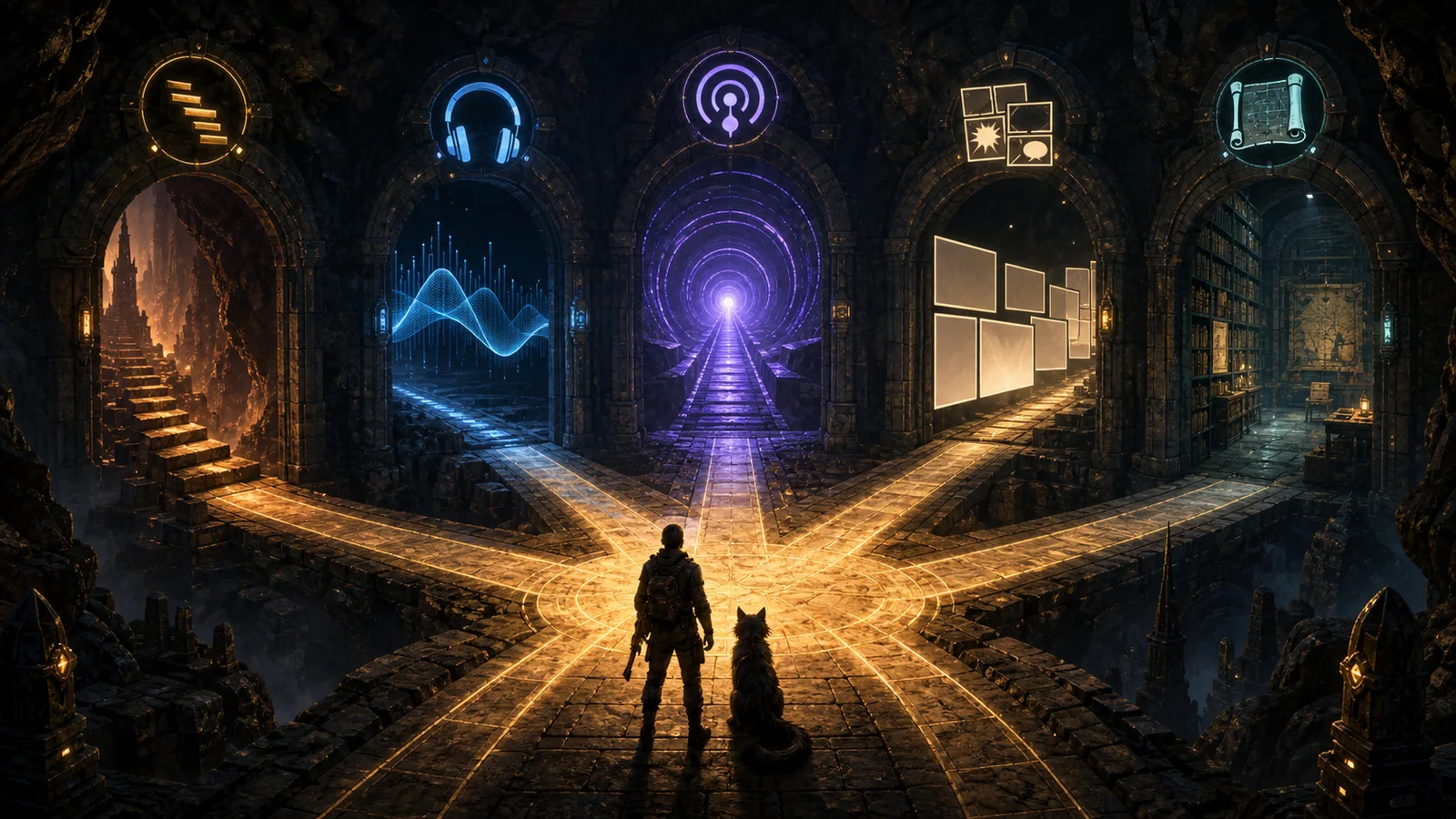
This guide is written for readers who have finished Dungeon Crawler Carl, Book 1. It discusses the ending setup of Book 1, but it does not reveal major Book 2 plot events, later-floor outcomes, later deaths, later alliances, or major series twists. When a future format needs to be described, the description stays at the level of official publisher or platform information. Finishing the first Dungeon Crawler Carl novel creates an unusual problem: there is no shortage of places to go next. You can simply open Book 2 and keep descending. You can restart Book 1 in audio and discover why the Jeff Hays performance has become such a major part of the series' identity. You can hear the same opening adventure rebuilt as a full-cast Audio Immersion Tunnel production. You can watch the story take visual form through the official WEBTOON and Vault graphic novel. Or you can stop before moving forward and use the archive to make sense of the enormous amount of information Book 1 has already introduced. All of those are legitimate next steps. They are not interchangeable. The best choice depends on what you liked most about Book 1. If the thing you want is more story, go directly to Book 2, Carl's Doomsday Scenario. If you want to experience Carl, Donut, Mordecai, the AI, and the Dungeon as performances, try the classic audiobook. If you want Book 1 turned into something closer to cinematic audio drama, start the Audio Immersion Tunnel. If you want to see the world and characters interpreted visually, start the WEBTOON or the collected Vault graphic novel. If you want to understand what you just read without learning what happens later, stay in the Book 1 portion of the archive and follow the spoiler-safe route described below. There is no required detour between Books 1 and 2. The novel itself is designed to send you forward. But there are now enough DCC formats that the space after Book 1 can also be used as a rewatch, relisten, reference, or collector phase before the next descent. For most readers, the recommendation is simple: Read Book 2 next. Book 1 ends by preparing Carl and Princess Donut for the next stage of the crawl. Mordecai explains that the Third Floor will bring race selection, class selection, stat decisions, and class guild information. Carl and Donut have survived the opening floors, gained an audience, accumulated equipment and skills, and reached the point where the dungeon begins treating character builds as more permanent strategic commitments. That makes Book 2 the natural continuation rather than a separate adventure. The current Ace edition of Carl's Doomsday Scenario identifies it as Book 2 and explicitly places Carl and Donut on the Third Floor. The publisher also frames quests as a major new problem without requiring a reader to know anything beyond Book 1 before starting.[1] If you finished Book 1 and are asking only, "What book comes next?", the answer is Carl's Doomsday Scenario. Everything else on this story is about choosing how you want to experience the series around that continuation.
| What you want | Best next step | Spoiler risk after Book 1 | Why choose it |
|---|---|---|---|
| Continue the plot immediately | Book 2: Carl's Doomsday Scenario | Low if you start at page one | Direct continuation of Carl and Donut's crawl |
| Re-experience Book 1 through performance | Classic audiobook, Book 1 | None | Jeff Hays performs the novel as a single-narrator audiobook |
| Continue the story in classic audio | Classic audiobook, Book 2 | Normal Book 2 spoilers as you listen | Same story path as the novel, performed by Jeff Hays |
| Re-experience Book 1 as cinematic audio | Audio Immersion Tunnel, Season 1 | None beyond Book 1 | Full cast, music, sound design, and additional adaptation material |
| Continue in cinematic audio | Audio Immersion Tunnel, Season 2 | Normal Book 2 spoilers as you listen | Next Immersion Tunnel season after the complete Book 1 season |
| See the story visually | WEBTOON or Vault Graphic Novel Vol. 1 | Primarily a Book 1 retelling | Visual adaptation rather than the prose sequel |
| Sample the comic format | Dungeon Crawler Carl #0 | Very low | Free Comic Book Day preview material from the WEBTOON adaptation |
| Review what you just read | Book 1 archive route | None if you remain in marked Book 1 sections | Characters, chapters, achievements, locations, mechanics, rewards, and timeline |
| Pick up current print bonus material | Check the Ace print edition | Book 1 safe | Current Book 1 print editions include part one of the bonus story "Backstage at the Pineapple Cabaret" |
Book 1 has a much more deliberate ending than it can appear to have on a first read. The immediate monster crisis has passed, but the final chapter does not function as a clean reset. It spends substantial time preparing the next phase of the game. Carl and Donut are no longer anonymous entrants. Their viewer, follower, and favorite counts have become enormous. Zev is actively thinking about their public performance. Donut has Mongo. Their skills have been growing. Mordecai is no longer teaching them only how to open inventory menus or survive basic encounters. He is preparing them to make choices that will affect their identities and builds. Most importantly, Mordecai explains what happens when they descend. They will choose races. They will choose classes. They will distribute or account for stat progression. They may gain access to class guilds. The System AI will provide recommendations, but Mordecai warns that a mechanically strong recommendation can carry social consequences. That final warning is one of the clearest indications that the series is expanding. Book 1 teaches the rules of survival. Its closing pages make it clear that future survival will also require understanding identity, audience reaction, specialization, and the fact that an optimal game decision is not automatically an optimal social decision. That is why Book 2 is the most natural next step. Book 1 does not end by closing the first chapter of Carl's life in the dungeon. It ends by opening the character-build screen for the next one. Carl's Doomsday Scenario is the second novel in the series and the direct continuation of Book 1.[1] You do not need to read a side story first. You do not need to listen to the audiobook first. You do not need the archive to explain the transition. You do not need the comic adaptation to bridge a gap. The final chapter of Book 1 already gives you what you need. Book 2 begins after the training levels have effectively ended and moves Carl and Donut into the Third Floor portion of the crawl. Race and class selection, which Mordecai has just explained, becomes part of the transition. The publisher's own Book 2 description also identifies quests as a new major concern.[1] That is enough to know before starting. The advantage of going directly to Book 2 is momentum. Book 1 spends a great deal of time teaching the reader how Dungeon Crawler World functions. It introduces achievements, loot boxes, safe rooms, guilds, bosses, audience metrics, show appearances, sponsor attention, crawler rankings, inventory mechanics, and the increasingly personal System AI. By the time the book ends, you understand enough of the language that the series no longer has to introduce every concept from zero. Book 2 can therefore spend more time complicating the systems you already know. If you are highly spoiler-sensitive, avoid browsing broad later-series pages before beginning the sequel. Do not jump into:
- later-floor guides
- later-book character biographies without spoiler controls
- later organizations and factions
- series-wide death lists
- full-series timelines
- "strongest characters" or "best builds" discussions
- later equipment inventories
- pages whose titles reference floor-specific events you have not reached
- read the first book quickly
- skimmed stat or system messages
- want to refresh character voices
- want to revisit early Carl and Donut interactions
- enjoy catching foreshadowing on a second pass
- want a commute or workout version of the story
- are curious why the audio performance is discussed so often by fans
- multiple voice performers
- environmental sound
- combat sound design
- music
- scene-based pacing
- additional adaptation material
- a more cinematic sense of space
- Donut's dialogue
- the AI's interruptions
- boss fights
- public announcements
- television-show absurdity
- dungeon atmosphere
- the collision between comedy and violence
- the easiest digital starting point
- serialized visual reading
- an active current adaptation
- a format you can sample before buying a collected edition
- a physical book
- a collected presentation
- a shelf-friendly version of the visual adaptation
- a defined chunk of WEBTOON episodes
- a sampler
- a collectible
- the Free Comic Book Day entry point
- single-issue variant collecting
- identify where an event occurred
- revisit an achievement
- remember when a character entered
- reconstruct the sequence of the First and Second Floors
- confirm when a system rule was explained
- find the context for an item or reward
- Carl
- Princess Donut
- Mordecai
- Mongo
- Zev
- Odette
- Frank Q.
- Maggie My
- Team Meadow Lark
- Dungeon Crawler World: Earth
- World Dungeon
- Crawlers
- System AI Notifications
- Dungeon Announcements
- Floor Collapse Timer
- Loot Box
- Achievement Reward System
- Inventory
- Safe Rooms
- Party System
- Viewer Metrics
- Favorites
- Followers
- Sponsors
- First Floor
- Second Floor
- First Floor Tutorial Guild
- First Safe Room
- other Book 1 safe rooms
- Book 1 boss routes
- Book 1 stairwells and transition locations
- the Book 1 achievement index
- Carl's early achievements
- Donut-related achievement pages
- Bronze, Silver, Gold, and other Book 1 reward-box pages
- the general Loot Box page
- the Achievement Reward System page
- entry into the dungeon
- the first tutorial phase
- early safe-room discovery
- the First Floor timer
- major boss encounters
- Meadow Lark
- media appearances
- the Second Floor transition
- Mongo's arrival
- the final preparation for the Third Floor
The DCC series constantly recontextualizes earlier details. Even an apparently harmless later page can reveal that a Book 1 character remains important, that a minor object becomes significant, or that an early mystery eventually receives an answer. For a first-time reader, uncertainty is part of the experience. As of August 25, 2026, Penguin Random House lists Carl's Doomsday Scenario in hardcover, paperback, and large-print formats, with the current paperback published August 4, 2026.[1] The current Ace print edition includes part two of the bonus story "Backstage at the Pineapple Cabaret."[1] That matters if you are a completionist. The current Ace Book 1 print edition includes part one of that bonus story, so readers using those editions can continue the bonus material alongside the main series.[2] If your Book 1 copy is an older edition, ebook, or audiobook, check your table of contents before assuming you have already read the bonus story. The main Book 2 novel does not require that bonus material. A significant number of DCC readers eventually become DCC listeners. The classic audiobook series is performed by Jeff Hays. Soundbooth Theater's official DCC page lists Hays as the narrator and gives the Book 1 classic audiobook a length of 13 hours and 31 minutes. Book 2 is listed at 11 hours and 28 minutes.[3] The most important distinction is that the classic audiobook is not the same product as the Audio Immersion Tunnel. The classic audiobook is the novel performed as an audiobook. Jeff Hays is the narrator, and his vocal range creates the impression of a large cast even though the production is fundamentally a single-performer narration. For readers who have only experienced DCC in print or ebook form, this can make Book 1 feel surprisingly new. Donut's personality changes when heard. The AI's interruptions feel more intrusive. Mordecai's frustration becomes more immediate. System announcements gain timing and rhythm that are easy to skim on The story. Carl's internal reactions take on a conversational pace. Comedy that depended on the reader's imagined delivery suddenly has a fixed performance. You do not need to. But it is one of the strongest optional routes if you finished Book 1 and want more DCC without immediately advancing the plot. A Book 1 audiobook replay is especially useful for readers who:
If your priority is discovering what happens next, skip the replay and start the Book 2 audiobook. There is no canon difference in the underlying novel. The decision is about experience. Choose the prose edition if you like controlling your own pace, rereading system text, stopping on item descriptions, or visually tracking names and mechanics. Choose the audiobook if performance is a major part of what you enjoy and you would rather experience scenes continuously than pause over the interface details. Many readers eventually use both. One productive pattern is to read the prose first and use the audiobook for rereads. Another is to listen first and use the archive for reference when a name, achievement, item, or mechanic becomes difficult to remember. The Audio Immersion Tunnel is the most substantial alternate-format version of DCC currently available. Soundbooth Theater describes it as a separate production from the classic audiobook, using a full cast, layered sound design, original music, and bonus material. The platform states that each season covers an entire book.[4] Season 1 covers the entirety of Book 1.[5] That makes it a particularly strong "after Book 1" option because it lets you stay within the spoiler boundary you have already crossed while experiencing the story in a different form. Soundbooth's current series page lists eight Season 1 episodes, followed by Seasons 2 and 3.[3] The core story remains recognizable, but the production approach is different. Instead of hearing a narrator perform the novel straight through, you hear a dramatized adaptation built around:
Jeff Hays remains central and continues voicing Carl, Donut, the AI, and other characters, but he is joined by a larger cast.[4][5] The result is closer to an audio drama than a conventional audiobook. Choose the Immersion Tunnel if your favorite parts of Book 1 were:
The production can make the media-spectacle element of Dungeon Crawler World feel more obvious because sound itself becomes part of the show. Yes, if your goal is to continue the DCC story in the Immersion Tunnel format rather than replay Book 1. As of August 2026, Soundbooth's official series page lists Seasons 1, 2, and 3, with Season 2 episodes released from December 2025 through March 2026 and Season 3 episodes released through June 2026.[3] For a reader who has completed Book 1, the choice is therefore: Replay path: Season 1, then continue. Continuation path: Begin Season 2. The only caution is that the Immersion Tunnel is an adaptation, not simply the classic audiobook with sound effects added. If you want the exact prose experience of Book 2, choose the novel or classic audiobook. The visual route is now much larger than it was when the original Book 1 was first released. The official Dungeon Crawler Carl WEBTOON is published on WEBTOON and credits Aethon, Laurel Pursuit, Tevagah, Matt Dinniman, Actus, and other creators.[6] As of August 2026, the series is active in Season 2 and WEBTOON lists new episodes weekly. The platform reports millions of views and hundreds of thousands of subscribers.[6] For a reader who has finished Book 1, the important point is not the current episode number. It is that the WEBTOON is a visual adaptation, not Book 2 in comic form. Start at Episode 1 if you want to see the opening of the crawl reinterpreted visually. Do not treat the latest WEBTOON episode number as a reading-order substitute for the novels. Vault Comics has also published Dungeon Crawler Carl, Vol. 1 (Graphic Novel). Simon & Schuster's publisher page lists the release date as May 19, 2026, with Matt Dinniman, Aethon, Laurel Pursuit Studios, Tevagah, and Actus credited on the book.[7] A Vault rights catalog states that Volume 1 collects episodes 1 through 14 of the WEBTOON edition.[8] That makes the collected graphic novel a convenient option for readers who prefer a physical volume rather than scrolling through episodes. Again, this is a retelling of early DCC material. It is not the next prose installment after Book 1. The Free Comic Book Day 2026 issue, Dungeon Crawler Carl #0, was released by Vault Comics as a preview. Free Comic Book Day describes it as containing the first WEBTOON episode plus additional material.[9] That makes #0 a sampler. If you already own it, it is a fun physical artifact and an easy way to see whether you enjoy the visual adaptation. If your goal is to continue the story after Book 1, it does not replace Book 2. Choose the WEBTOON if you want:
Choose the Vault graphic novel if you want:
Choose issue #0 if you want:
The essential spoiler-safe rule is simple: Visual DCC is best treated as another way to experience material you know, not as the required bridge to Book 2. the archive can be extremely useful after Book 1 because the first novel introduces more information than most readers will retain on one pass. The danger is obvious. A archive is built to connect information. Connections can become spoilers. The safest approach is not to browse randomly. Use a Book 1 route. The current archive build contains all 47 polished Book 1 chapter pages, along with dedicated views for characters, achievements, systems, rewards, mechanics, skills, spells, progression, equipment, monsters, locations, organizations, relationships, media, and timeline content. That structure makes it possible to build a genuinely spoiler-controlled post-Book-1 path rather than sending a new reader into an unrestricted series encyclopedia. If you want to remind yourself what happened, begin with the chapter index. The Book 1 chapter pages are the strongest spoiler-safe reference because their scope is naturally limited. Use them to:
Start with characters already central to the first novel:
Character pages are more dangerous than chapter pages because biographies naturally want to continue beyond first appearance. Use only the Book 1 sections of these biographies. Later sections and metadata can reveal subsequent status, affiliations, or survival, so return to this guide if a page moves beyond the first novel. The following concepts are safe and useful because Book 1 already introduces them:
These pages help explain the architecture of the crawl without requiring later-story knowledge. Useful Book 1 location pages include:
Locations are especially useful because Book 1 can blur together on a first read. The First Floor and Second Floor are different environments with different purposes, even though the book moves through both quickly. Book 1 is where the achievement system teaches the reader how the Dungeon thinks. A post-Book-1 reader can safely explore:
These pages help distinguish jokes from actual mechanical consequences. This is an important exception to the usual "avoid future mechanics" rule. Race Selection and Class Selection are introduced in the final chapter of Book 1. Mordecai explains the transition before Carl and Donut descend. That means the existence of these mechanics is not a Book 2 spoiler. The pages remains carefully scoped, however. A post-Book-1 reader can safely learn what the selection process is. They should not automatically be shown which specific choices characters eventually make if that information occurs in Book 2. A master Book 1 timeline is also safe. It is useful for understanding:
The timeline should stop at the Book 1 boundary unless the reader explicitly changes spoiler settings. This guide keeps its recommendations within information established by the end of Book 1, but a connected archive can still expose later details through biographies, status fields, related links, and search results. The 47 Book 1 chapter pages and Book 1 timeline are the safest review route. Treat any full-series entity page as a potential spoiler unless its visible scope stops at Book 1. If you want the cleanest first-read experience, postpone the following: Floor names, scenario descriptions, map concepts, and floor-specific mechanics can reveal the direction of future books. These often contain relationship changes, later affiliations, power growth, deaths, survival status, or information that reinterprets Book 1. Carl and Donut's inventories become historical records of their progression. A later item list can spoil both survival and plot direction. Book 1 establishes that the crawl has a much larger political and entertainment framework, but later faction pages can reveal who becomes important and why. Relationship changes are among the most consequential spoilers in the series. A timeline is essentially a spoiler delivery system if you have not reached the events it summarizes. the archive should make all of these accessible, but not by accident. You do not need to choose only one format. Book 1 -> Book 2 -> Book 3 Use the archive only when you need a name, mechanic, or recap. Best for readers who are hooked primarily by plot. Book 1 prose -> Book 1 classic audiobook -> Book 2 audiobook This is a strong choice if you want to hear the characters before advancing. You will repeat Book 1, but the performance changes the texture enough that it often feels like a reinterpretation rather than a simple reread. Book 1 prose -> Audio Immersion Tunnel Season 1 -> Book 2 Best for readers who want more time with the first novel before crossing into new story territory. Book 1 prose -> Immersion Tunnel Season 1 -> Immersion Tunnel Season 2 This converts your DCC experience from reading to cinematic audio. Book 1 prose -> WEBTOON Episode 1 onward or Graphic Novel Vol. 1 -> Book 2 Best if you want to see how another creative team interprets the opening crawl. Book 1 -> Book 1 chapter guide -> Carl/Donut/Mordecai guides -> achievements and mechanics -> Book 2 Best for readers who enjoyed the worldbuilding and systems as much as the immediate plot. Book 1 -> check for Pineapple Cabaret bonus material -> classic audio or Immersion Tunnel -> WEBTOON/graphic novel -> Book 1 archive -> Book 2 This takes the longest, but it gives you the broadest possible experience without crossing the Book 2 story boundary. If you only want the current novel order without plot descriptions, the official Penguin Random House series page lists the main series in numbered order.[10] 1. Dungeon Crawler Carl 2. Carl's Doomsday Scenario 3. The Dungeon Anarchist's Cookbook 4. The Gate of the Feral Gods 5. The Butcher's Masquerade 6. The Eye of the Bedlam Bride 7. This Inevitable Ruin 8. A Parade of Horribles This guide intentionally does not summarize Books 3 through 8. For a reader who has just finished Book 1, only one title matters immediately: *Book 2: Carl's Doomsday Scenario. Current Ace editions create one more route for collectors. Penguin Random House's current Book 1 page lists paperback, large-print, and hardcover formats and states that the print edition includes part one of "Backstage at the Pineapple Cabaret."[2] A separate deluxe collector's edition of Book 1 is scheduled for November 17, 2026. Penguin Random House describes it as including new physical presentation features, interior artwork, a solvable maze on the case, stenciled edges, a ribbon marker, and a Q&A.[11] That deluxe edition is not a new Book 1 story. It is a collector edition. If you have already finished the novel, buying it is about format, art, design, and collectibility rather than finding out what happens next. The same principle applies to comic variants and special covers. Collecting DCC and continuing DCC are different activities. Both can be fun. Only Book 2 continues the main prose story. If you are extremely spoiler-sensitive, use this order: 1. Read Book 2. 2. Use Book 1 archive pages only when necessary. 3. Revisit Book 1 in audio whenever you want. 4. Use the visual adaptation from Episode 1 or Volume 1. 5. Do not search later character names or floor names until you encounter them naturally. The most dangerous option is random fandom browsing. Search engines, social media, retailer descriptions, thumbnails, audiobook chapter titles, and comic cover copy can reveal future concepts before you understand their context. A curated Book 1 guide is safer because it can intentionally hold information back. Read Carl's Doomsday Scenario. Do not overthink it. Listen to the classic audiobook or the Audio Immersion Tunnel. Performance makes Donut a different kind of experience. Audio is especially rewarding because timing, interruption, and delivery are central to how the AI works. Use the Book 1 archive route before moving on. Start with System AI Notifications, Dungeon Announcements, Floor Collapse Timer, Loot Box, Inventory, Safe Rooms, Viewer Metrics, Race Selection, and Class Selection. Start the WEBTOON from Episode 1 or pick up Vault's collected Volume 1. Issue #0 is a natural sampler and collectible entry point, but it is not the prose sequel. Go directly to Book 2 audio if you want continuation. Try the Immersion Tunnel if you want a more dramatized replay. Use the chapter guide and Book 1 timeline first. Then decide whether you need a complete reread. The next novel is Carl's Doomsday Scenario, Book 2 of the Dungeon Crawler Carl series.[1] No. Book 2 directly continues the main series. Current Ace print editions include serialized bonus material called Backstage at the Pineapple Cabaret*, but it is supplemental rather than a required bridge between novels.[1][2] No. The classic audiobook is narrated by Jeff Hays as an audiobook performance. The Audio Immersion Tunnel is a separate full-cast production with music, sound design, and additional adaptation material.[3][4] Yes. Soundbooth Theater states that Season 1 covers the entirety of Book 1.[5] Yes. If you do not want to replay Book 1 in the Immersion Tunnel, Season 2 is the next season in Soundbooth Theater's current DCC Immersion series.[3] No. The WEBTOON is a visual adaptation of the DCC story. A reader who has finished Book 1 should start it from Episode 1 if they want a visual retelling rather than treating the current WEBTOON episode as the sequel to the prose novel.[6] It is a Free Comic Book Day 2026 preview comic from Vault. Free Comic Book Day describes it as including the first WEBTOON episode plus additional material.[9] Volume 1 is a collected visual adaptation. A Vault catalog states that it collects WEBTOON episodes 1 through 14.[8] It functions as another format for the opening story, not as a replacement for Book 2. The safest routes are the 47 Book 1 chapter pages, Book 1 timeline pages, First and Second Floor locations, Book 1 achievements and rewards, core mechanics introduced in Book 1, and spoiler-controlled versions of Carl, Princess Donut, Mordecai, Mongo, Zev, Odette, Frank Q., Maggie My, and Team Meadow Lark. Their existence is not a spoiler after Book 1 because Mordecai explains both mechanics in the final chapter. The specific choices made after descent remains hidden until the reader reaches them. If you are still deciding after reading this entire guide, the answer is probably the obvious one. Start Book 2. Book 1 has already done the work of getting you there. Carl and Donut have survived the opening levels. Their audience is growing. Mongo is part of the equation. Mordecai has explained the next progression step. Race, class, stats, and social consequences are waiting on the other side of the descent. The audiobooks, Immersion Tunnel, comics, graphic novels, chapter guides, and archive are excellent ways to deepen the experience. They are not prerequisites. The story is ready for you to keep going. So if what you want is the next floor, take the stairs.