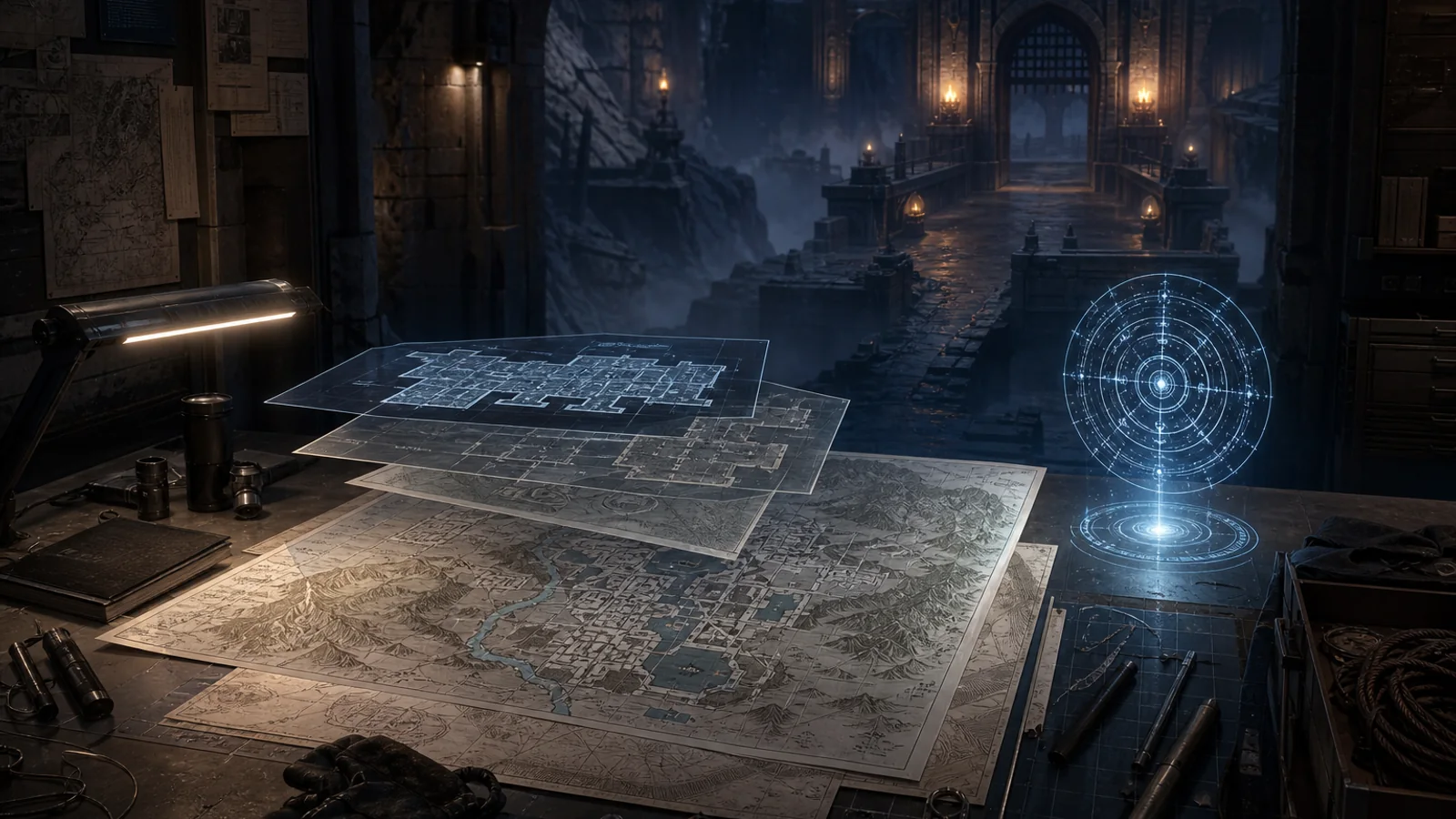
Spoiler notice
Spoilers for Dungeon Crawler Carl through Book 8 and the named source franchise may appear. This is an analytical thought experiment using broad, official Batman character traits such as detective skill, preparation, advanced equipment, and his widely established resistance to lethal force. It does not place any specific DC continuity into DCC canon.
Batman is one of the easiest characters in popular fiction to imagine surviving the opening minutes of Dungeon Crawler World and one of the hardest to imagine tolerating what the crawl becomes.
The distinction matters.
The dungeon rewards physical competence, tactical calm, information gathering, equipment mastery, and contingency planning. Batman is built around all of those traits. DC's official profile emphasizes skills Batman has developed through training: investigation, physical discipline, tactical judgment, technology, and contingency planning, rather than innate superpowers. That makes him almost offensively well suited to the first practical question of the crawl: what is happening, what are the rules, and what is trying to kill me?
But Dungeon Crawler World is not a normal emergency.
It is an entertainment environment whose rules are controlled by powers that are not physically present in the room. It rewards spectacle, changes incentives, tracks audience response, and exposes a character's habits to a System AI that can modify the environment itself.
Batman prepares for opponents.
The crawl is an opponent that writes the battlefield.
That is why the most interesting version of this crossover is not Batman versus a boss monster.
It is Batman versus the idea of preparation itself.
Can a hero whose greatest advantage is planning remain ahead of a system that sees his patterns, controls information, modifies the arena, and may actively enjoy making his plans fail?
Early Floors: Batman Starts With an Enormous Advantage
On the First Floor, Batman would immediately outperform the average crawler in several categories.
He is physically conditioned.
He is comfortable in darkness.
He notices details.
He can distinguish a trap from an apparent opportunity.
He does not freeze when authority becomes unreliable.
Most importantly, he would not mistake the System's interface for truth in a moral sense. He might trust a displayed timer as a system fact while remaining deeply skeptical of the incentives around it.
That is exactly the mental separation Carl gradually learns to make.
Batman would begin there.
He would map safe rooms, observe monster patrol patterns, test notification behavior, and start comparing what the dungeon says with what actually occurs. The first hours of the crawl would become an intelligence problem before they became a progression problem.
That is a major advantage.
Intelligence Gathering Is His Real Superpower
The comparison connects to Rules as Character Pressure, System AI: Interface, Character, and Environment, and The Audience Economy and Crawler Risk.
Batman is often described through gadgets or martial arts, but inside DCC his most valuable trait would be disciplined information collection.
He would want to know:
- which notifications are global
- which messages are personalized
- whether safe-room protections are absolute
- how loot probabilities change
- what viewer attention affects
- which entities can see private communication
- how quests define failure
- whether System descriptions are technically precise or rhetorically manipulative
This is not paranoia for its own sake. DCC repeatedly rewards characters who recognize that a rule has edges. Carl's best exploits come from treating the language of the system as something that can be examined rather than obeyed intuitively.
Batman would approach that language like a hostile contract.
The result could be extremely effective.
It could also attract the System AI's attention immediately.
Preparation Versus an Adaptive System
Preparation works best when reality remains stable long enough for the plan to matter.
Dungeon Crawler World is dangerous because stability is conditional.
Floor rules change.
Phases activate.
Sponsors introduce new variables.
Audience pressure changes which opportunities become valuable.
The AI itself develops preferences and increasingly personal behavior.
Batman can prepare for a known enemy because he studies the enemy's capabilities. He can prepare for Superman, magic users, criminal organizations, citywide crises, or hostile technology because those threats have patterns.
The System AI has patterns too.
The problem is that it is also part of the mechanism generating new patterns.
Batman could therefore fall into a preparation trap: building increasingly elaborate contingencies for a system that responds to his contingencies by making the next problem weird in a different direction.
Carl survives partly because he is willing to improvise in ways that look irrational until the underlying exploit becomes clear.
Batman can improvise, but he is more likely to want a model first.
The crawl punishes the assumption that a complete model is possible.
The Nonlethal Rule Becomes a Mechanical Problem
DC has repeatedly treated Batman's refusal to kill as one of the central rules defining the character, even while acknowledging variations across decades and adaptations. In DCC, that rule would become one of the largest structural obstacles he faces.
Early monster combat is already complicated.
Are dungeon mobs living beings?
Are they generated entities?
Are they resurrected?
Does destroying one count as killing in the same moral sense as killing a human crawler?
The later books make those questions worse by revealing that NPCs, mobs, gods, and AI-linked entities may possess far more personhood than the entertainment system admits.
Batman would not accept the System's category labels as moral absolution.
If the interface says `mob`, that does not automatically mean morally disposable.
This would make him cautious in ways that could slow progression.
It would also make him one of the earliest crawlers to identify the NPC personhood problem as a central injustice rather than a late discovery.
Nonlethal Combat Is Still Combat
The no-kill issue does not mean Batman becomes helpless.
He specializes in disabling, restraining, isolating, and controlling dangerous opponents without necessarily using lethal force. Against ordinary crawlers, hostile humanoid NPCs, or many physically vulnerable enemies, he would be extremely effective.
The problem is that DCC contains encounters where the game objective assumes death.
A boss may not have a surrender state.
A quest may count only a kill.
A floor-collapse condition may make prolonged restraint impossible.
A monster may regenerate unless destroyed.
The system can therefore turn the moral rule into resource pressure. Batman may be able to avoid killing, but doing so could cost time, inventory, space, and team safety.
That is exactly how the crawl attacks values: it turns them into expensive mechanics.
Equipment Dependence
Batman enters most stories with one of the finest private equipment ecosystems in fiction.
Dungeon Crawler World would strip much of that away.
If he enters with only whatever he happens to carry, his normal advantage collapses. No Batcave. No global computer network. No vehicle fleet. No private manufacturing support. No familiar city infrastructure.
This is a major weakness.
At the same time, Batman is not simply a man who owns gadgets. He understands why gadgets work. DCC rewards crafting, item analysis, salvage, and modular loadouts. He would rebuild capability quickly from local materials.
The key change is psychological: he would have to accept that the dungeon owns the supply chain.
That would bother him intensely.
Every useful item would carry provenance questions.
Who designed it?
What hidden effect exists?
Why did the AI choose this reward?
Is the sponsor box helping, tracking, or steering?
Batman would treat loot as evidence before treating it as equipment.
Sponsor Appeal
Batman would be a sponsorship phenomenon.
The galactic audience would instantly understand the archetype: disciplined, mysterious, highly competent, resistant to authority, technologically creative, visibly nonlethal when possible.
That combination is incredibly marketable.
The problem is that Batman would despise being marketable inside a death game.
He would recognize sponsor support as a form of leverage. Accepting resources could keep people alive, but it could also create expectations. Refusing resources preserves independence while increasing avoidable risk.
This is the kind of dilemma he would take seriously.
His likely answer would be controlled acceptance: take the resource when necessary, document the influence pathway, refuse exclusivity where possible, and never allow the sponsor to define mission priorities.
In DCC terms, that is a very Carl-like answer.
Audience Popularity as Surveillance
Batman would understand quickly that popularity is not merely a benefit.
A large audience gives enemies information.
Every demonstrated technique becomes footage.
Every preferred item becomes a pattern.
Every ally becomes a potential pressure point.
That makes the Ratings system a security problem.
Most crawlers think first about gaining viewers.
Batman would think about what viewers can infer.
He would probably develop deliberate false patterns, reserve tactics, and public-facing misdirection. The audience would think it knows his standard approach. He would cultivate that belief because predictable public identity can become camouflage.
This is one of the strongest reasons he could become dangerous to the crawl's production layer.
He already understands the tactical use of myth.
The System AI Would Be Fascinated by Him
The System AI is drawn toward interesting behavior, and Batman would generate it constantly.
He would resist unnecessary spectacle.
He would refuse obvious achievement bait.
He would investigate item descriptions.
He would probably identify patterns in the AI's personality before many others did.
That could create a strange adversarial relationship.
The AI wants behavior it can classify and reward. Batman would deliberately avoid allowing reward logic to become motivational logic.
The more the AI tried to bait him, the more carefully he would study the bait.
This could become mutually escalating.
Carl survives because he sometimes uses the AI's preferences against it.
Batman would try to do the same systematically.
The danger is that systematic behavior is exactly what an adaptive intelligence learns to counter.
Likely Race and Class Logic
Any exact DCC race/class assignment is speculative, but Batman would probably choose conservatively.
He would avoid transformations whose full consequences he cannot verify.
He would favor a class preserving:
- perception
- investigation
- stealth
- nonlethal control
- tactical preparation
- crafting access
He might actually reject a flashy superhero-coded class if it imposed too many visible rules on his behavior.
That restraint could cost early stats while protecting long-term flexibility.
Mordecai would probably approve of the caution and become increasingly frustrated by the number of questions.
The Iron Tangle Would Be His Floor
The Fourth Floor's Iron Tangle is exactly the kind of environment where Batman's mind becomes more valuable than raw damage.
Routes, stations, timing, information asymmetry, repeating patterns, and deceptive system logic reward an investigator.
He would build maps obsessively.
He would track anomaly frequency.
He would compare rumor against observed movement.
The hidden Cookbook network would also fascinate him if he gained access. A multigenerational archive of resistance exploits is almost perfectly suited to Batman's worldview.
The problem would be secrecy. He would need to conceal what he knows while continuing to act as if each deduction is independent.
That is difficult.
It is also something he is unusually prepared to do.
The Fifth and Sixth Floors Attack His Ethics
The later middle floors would be harder.
The Fifth Floor's NPC populations and divine complications would force him to confront the personhood problem directly.
The Sixth Floor's hunter structure would be even more difficult. Batman is willing to fight armed killers, but the crawl's incentives could push him toward lethal efficiency against participants who arrived expecting to hunt humans for sport.
He would still seek nonlethal options.
The problem is that other crawlers may not have the luxury to wait for him.
This is where Batman's personal rule could create team conflict.
Carl's coalition survives partly by accepting that different people have different moral thresholds under coercion.
Batman would need to learn the same tolerance without abandoning his own standard.
Resistance Planning
Batman would eventually stop thinking of the crawl as a sequence of floors and begin thinking of it as an institution.
At that point, his priorities change.
He would map:
- Borant authority
- Syndicate oversight
- sponsor influence
- System AI autonomy
- communication chokepoints
- viewer manipulation
- safe-room surveillance boundaries
- NPC labor structures
This is where he becomes strategically dangerous.
Batman is at his best when he can convert fragmented intelligence into a structural model.
DCC is a universe filled with fragmented intelligence.
The Cookbook authors, Open Intellect resistance, NPC awakening, and System AI instability would give him more leads than he could process alone.
His biggest challenge would become coalition trust.
Batman is famous for preparation.
He is also famous for secrecy.
A resistance movement cannot scale if one person keeps every contingency private.
The Secrecy Problem
This may be Batman's largest character weakness in the crawl.
Dungeon resistance requires distributed trust.
Carl's network succeeds because people like Imani, Florin, Donut, Rosetta, Tipid, and others can act independently. Batman's instinct to compartmentalize information protects against betrayal but can weaken coalition ownership.
The System AI would exploit that.
A team that does not understand the real plan cannot adapt if the plan breaks.
Batman would have to learn to distinguish operational secrecy from relational secrecy.
If he fails, he becomes the smartest person in a room nobody fully trusts.
That is not enough to beat the crawl.
How Far Does He Get?
Physically and tactically, very far.
The first four floors strongly favor his strengths.
The Fifth and Sixth create moral friction but not necessarily defeat.
The later political floors become a question of whether he can build a resistance rather than simply plan one.
If he adapts socially, he could become one of the most dangerous anti-system crawlers imaginable.
If he remains too solitary, the crawl will eventually isolate his preparation from the human network needed to execute it.
Survival Matrix
| Category | Rating | Why |
|---|---|---|
| Investigation | Exceptional | Detective work maps directly to hidden-rule discovery |
| Combat | Excellent | Broad nonlethal and tactical competence |
| Equipment | Strong but initially constrained | Loses normal infrastructure, rebuilds through salvage/crafting |
| Audience appeal | Extremely high | Mystery, competence, and defiance are highly marketable |
| Sponsor cooperation | Low to moderate | Will accept leverage only cautiously |
| System manipulation | High | Treats rules as evidence and adversarial text |
| Team transparency | Risk area | Secrecy can undermine coalition trust |
| Long-term resistance | Very high if social adaptation succeeds | Excellent structural thinker |
Final Verdict
Batman survives the early crawl easily compared with the average entrant.
He does not dominate because he can punch harder.
He dominates because he starts solving the wrong problem faster than most people.
He would realize that the dungeon is not just a collection of monsters. It is an information system designed to shape behavior under observation.
That is exactly the kind of adversary he understands.
But the crawl also targets his biggest weaknesses.
It strips away equipment infrastructure.
It makes nonlethal ethics costly.
It monetizes his public image.
It gives him too many reasons to keep secrets.
And it places an adaptive intelligence inside the system he is trying to prepare against.
Preparation gets him far.
Preparation alone does not beat the AI.
To reach the deepest levels, Batman would need to learn the lesson DCC teaches repeatedly: the best contingency plan is sometimes a community that knows enough to improvise when you are wrong.
If he learns that, he becomes terrifying to the people running the show.
If he does not, the System AI eventually finds the contingency he forgot to build for: other people needing to understand him.
The Prep-Time Paradox
Batman is famous for preparation, but Dungeon Crawler World makes "prep time" a moving target. A traditional contingency plan assumes the planner can define the threat set, collect intelligence, acquire resources, and then act before the opponent changes the underlying rules. The crawl denies at least one of those assumptions on almost every floor.
That does not make preparation useless. It changes what preparation should mean. Batman would eventually stop trying to prepare for specific events and start preparing processes: redundant escape routes, communication fallbacks, portable evidence archives, rules-testing protocols, sponsor due-diligence checklists, and team decision trees. In other words, he would move from "I have a plan for this enemy" to "I have a method for surviving when my plan is wrong."
That evolution is probably the key to his long-term survival. Carl's strongest plans are rarely perfect predictions. They are flexible structures that leave room for a last-second exploit. Batman would need to learn the same style without losing the rigor that makes his preparation valuable in the first place.
Batman and the Cookbook Network
If Batman ever gained access to the Dungeon Anarchist's Cookbook or to its surviving author network, the fit would be extraordinary and dangerous. He would respect the logic immediately: preserve hard-won intelligence across seasons, conceal the source, compare prior exploits against current rules, and never assume the current production layer understands every part of the system it is using.
He would also be tempted to centralize too much of it. That is where the Cookbook's multigenerational model would teach him something important. The network is powerful because it survives individual failure. A single master planner is a single point of collapse. A distributed archive of people who can act independently is harder to erase.
This is one of the rare places where the dungeon could improve Batman's resistance philosophy. The crawl would force him to think beyond "contingency plans for allies" and toward "shared strategic literacy among allies." Those are not the same thing.
What the Audience Would Misunderstand
The galactic audience would likely turn Batman into the "prepared genius" archetype almost instantly. That branding would be useful and dangerous. Viewers would expect elaborate traps, hidden gadgets, impossible deductions, and dramatic reveals. Once the expectation exists, the System and the producers can bait it.
A smart Batman response would be to deliberately win some encounters in boring ways. Let the audience believe he is saving the spectacular plan for later. Hide competence inside consistency. Avoid teaching viewers and enemies that every victory contains a theatrical twist.
That would lower short-term engagement in exchange for information security. In a system where popularity creates resources, choosing to be less entertaining can itself become a tactical sacrifice.
FAQ
Would Batman kill dungeon monsters?
He would likely distinguish between non-sapient hostile creatures and entities with credible personhood rather than accepting the System's labels automatically.
Would Batman accept sponsors?
Reluctantly and selectively. He would treat sponsor aid as useful leverage carrying intelligence and influence risks.
What floor suits Batman best?
The Iron Tangle is probably his strongest conceptual match because investigation, mapping, timing, and hidden-rule analysis matter heavily.
What is his biggest weakness?
Secrecy. Long-term resistance in DCC requires distributed trust and independent allies.
Could Batman outsmart the System AI?
He could exploit it and learn its patterns, but permanently staying ahead of an adaptive environment-controlling AI would be much harder than defeating a conventional mastermind.
Source and update note
Broad official Batman character framing supplies the detective, preparation, discipline, and nonlethal-code baseline. The DCC side is a hypothetical synthesis of published-series mechanics through Book 8, including classes, equipment, System AI, audience pressure, and floor progression. No shared canon is claimed.
Primary starting point: DC: official Batman character profile. These materials establish the source-franchise baseline; the dungeon outcomes, ratings, and comparisons above are editorial interpretations, not an announced crossover.