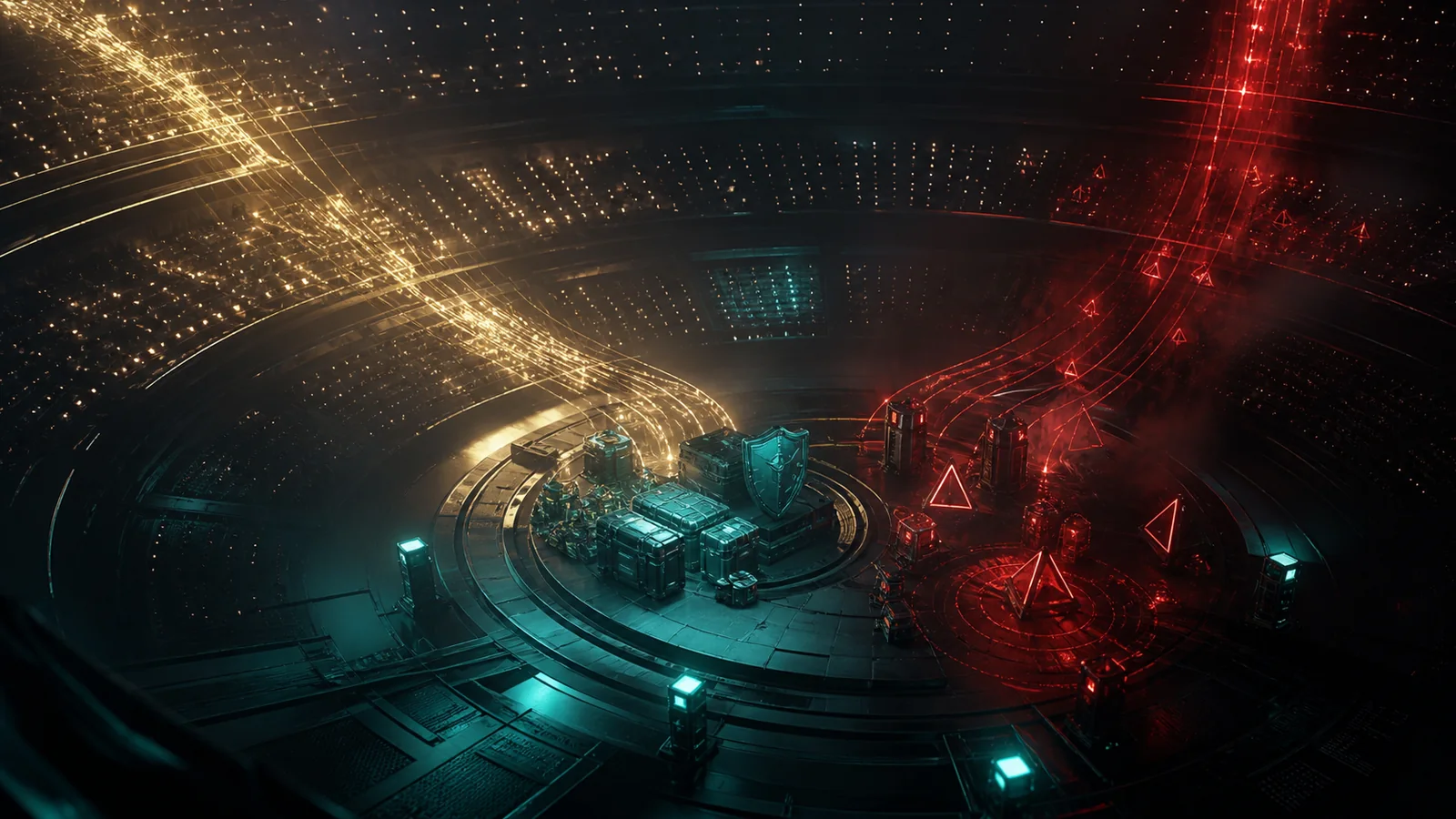
This article discusses media systems, sponsorship, fan boxes, crawler shows, public branding, and Faction Wars publicity through This Inevitable Ruin. Dungeon Crawler World turns attention into a survival resource. That fact is introduced so early that it can initially look like satire attached to the real game. Carl has health. Carl has statistics. Carl has skills. Then Mordecai opens the Ratings screen. Views. Followers. Favorites. Patrons. Suddenly popularity is another progression system. Mordecai explains the funnel in Book 1: people watch, some become followers, a smaller group favorites a crawler, and organizations may sponsor someone who attracts enough committed attention. Sponsors buy boxes. Better support can contain gear that would be difficult or impossible to obtain through ordinary dungeon drops. The joke is obvious. The crawl is a death game built like a social platform. The darker implication takes longer to emerge. If attention can buy survival, then behavior that attracts attention becomes strategically valuable. Risk is no longer judged only by: Will this kill me? It is also judged by: Will this make me stronger later? A dangerous stunt can produce an achievement. An achievement can produce a box. A spectacular fight can drive views. Views can generate followers. Followers and favorites can improve sponsor interest. Sponsors can send better equipment. Better equipment can make another dangerous stunt survivable. The entire economy can therefore create a feedback loop in which spectacle protects crawlers and pressures them toward more spectacle. That contradiction is the center of the audience economy. Fame is armor. Fame is bait. Book 1, Chapter 4 is the foundational source. Mordecai tells Carl that the Ratings menu is one of the most important interfaces he has. The system tracks views, followers, favorites, and patrons. Favorites represent a stronger level of commitment, while patrons are usually organizations capable of sponsoring crawlers by purchasing boxes. This creates a hierarchy of attention. Someone saw you. Views create reach but do not guarantee commitment. Someone wants to find you again. Followers make future visibility more durable. Someone has made a more limited, meaningful commitment to track your status. Favorites signal stronger audience investment. An organization is willing to spend resources on your continued presence. At this point attention becomes material support. The audience economy therefore behaves like a conversion funnel where the final conversion can be armor, spells, emergency gear, or political support. The protective side of fame is real. A popular crawler can receive sponsor attention, benefactor boxes, fan boxes, media invitations, public sympathy, external allies, better leverage, and visibility that makes quiet abuse politically expensive. Mordecai has personal experience with audience support from his own crawl, which is one reason he takes the Ratings screen seriously. The later books repeatedly confirm that sponsor-funded boxes can be unusually valuable. Carl notes in Book 3 that even a Bronze Benefactor Box may outperform much higher-tier ordinary loot. That means a crawler can be physically safer because people are watching. This is not metaphor. The equipment arrives in inventory. Attention can provide political protection even when it does not provide a shield item. A crawler followed by enormous audiences cannot always be disappeared without consequences. Public controversy can force Borant or other actors to manage perception. Zev's work exists because narrative matters. The hosts and showrunners care about what viewers think. Outside governments care about what their citizens see. Sponsors care about the public association. Carl's growing visibility therefore gives him a small amount of leverage against institutions far more powerful than he is. The leverage is unstable. But it exists. The danger begins with the question of what audiences actually watch. Ordinary caution is often poor content. A crawler who always chooses the safest route may reduce the chance of death in one encounter and reduce the chance of attracting the resources needed for later encounters. The AI's achievement system reinforces this problem. Achievements recognize novelty, humiliation, spectacle, extreme violence, improbable tactics, firsts, records, and absurd behavior. The reward can be a box. The notification can become part of the broadcast. The audience sees both. This encourages an escalation loop. A crawler does something dangerous enough to stand out. The System and the audience both notice. Loot, fan support, media attention, and sponsorship become more likely. The crawler survives the next stunt partly because the previous stunt paid. A rational crawler living inside this system cannot simply ignore publicity. That is what makes the system coercive. The early achievement chain in Book 1 teaches Carl what the System notices before he even understands the interface. Being an early entrant matters. Entering with Donut matters. Being unarmed matters. Not wearing pants matters. The System converts circumstances into content and reward. Later, player-killing achievements can award equipment that makes future crawler hunting easier. The important lesson is that reward value and moral value are not aligned. The System rewards what produces game value and entertainment value. That teaches crawlers to ask: What will trigger the system? rather than: What is right? Carl's resistance often consists of refusing to let those become the same question. The crawl's shows are not side content. They are part of the economy. Carl and Donut are pulled into interviews. They appear with Odette. They are discussed through recaps. Zev manages appearances. Hosts frame conflicts. Audience reaction feeds back into their public identity. The media system performs several functions at once:
- gives viewers recognizable storylines
- creates stars
- increases sponsor inventory
- exposes crawler personality
- creates public pressure
- extracts information
- turns trauma into reusable footage
A battle ends once for Carl. It can be replayed indefinitely for the audience. That changes the value of the event. Recap programming is one of the cruelest parts of the media system because it packages events after the participants have survived them. A crawler may experience panic, injury, grief, shock, and confusion. The recap can present a clean narrative, a joke, an impressive highlight, a rivalry, a dramatic edit, or a sponsor segment. This creates a gap between lived reality and audience reality. Safe-room screens make the gap visible because crawlers can watch themselves being turned into a story. The audience economy does not only reward risk. It edits risk into something consumable. Donut's pre-dungeon cat-show experience makes public performance intuitive to her. Book 1, Chapter 28 makes the division explicit when she tells Carl that interviews are her environment. Carl understands physical danger. Donut understands the room. This becomes strategically important because refusing the media game entirely would sacrifice resources. Donut can perform without believing every part of the performance. She can use the princess identity. She can manage status. She can engage viewers. The danger is that a useful public persona can become a cage. Book 3 provides one of the clearest examples of audience economics entering private relationships. Zev worries about Katia's entertainment value and connects lower viewer interest to fewer future prizes from sponsors and fan boxes. This creates a horrifyingly rational question: Should a party keep a teammate if that teammate hurts the ratings? The answer should have nothing to do with sponsorship. The system makes it relevant anyway. Carl and Donut's refusal to reduce Katia to a ratings problem becomes a character statement. The audience economy pressures teams to optimize people as content. Chosen family resists that optimization. Book 2 introduces fan boxes whose contents are voted on by followers. This moves the audience from spectator to limited participant. The viewers are no longer merely deciding what is popular. They can influence what enters the crawler's build. That makes the relationship more intimate and more dangerous. A crawler may begin asking: What will my fans choose? What do they think I need? What do they want to see me use? A build can partly reflect audience imagination. Sponsors turn popularity into a market. Book 3 shows sponsorship bidding, expensive benefactor support, emergency delivery fees, and product placement. Book 4 attaches sponsor advertisements directly to Carl's feed. The crawler becomes a media property whose survival produces impressions. This creates a new kind of risk. A sponsor may genuinely help. It may also prefer continued visibility, certain branding, a product demonstration, political alignment, religious choice, or access to the crawler's audience. The gift can save a life and steer behavior. A recognizable brand gives a crawler identity across a gigantic audience. Princess Donut is not merely crawler number X. She is Princess Donut. The Royal Court is a recognizable pair. The Princess Posse becomes a movement and later an army. Branding helps because it creates recognition, emotional loyalty, sponsor interest, morale, political symbolism, and continuity across floors. In Faction Wars, the public brand has become an institutional identity. That growth shows how audience attention can escape the entertainment system that created it. The show makes Carl and Donut famous. They use fame to organize resistance. The same identity creates expectations. Viewers expect Donut to act like Donut. Carl's anti-authority reputation becomes part of his marketability. A crawler who changes can disappoint an audience. A crawler who fails to perform the familiar role can lose attention. This is one reason public persona and private self need separate archive sections. The audience sees a productized version of a person. The story keeps showing the person underneath. Audience pressure can create several kinds of danger. Take a more dangerous action for spectacle or reward. Reveal capabilities during a broadcast. Turn trauma into content before it is processed. Become a symbol to outside factions. Accept support carrying hidden expectations. Treat teammates according to audience value. Become trapped by a public persona. The audience economy therefore belongs on survival pages, not only media pages. The system does not require the audience to like a crawler in a simple sense. They need to watch. Outrage can produce views. Rivalry can produce engagement. Humiliation can produce memorable clips. Carl's confrontational relationship with institutions can make him more compelling precisely because he refuses to behave like a cooperative television personality. This is another way resistance gets monetized. The show can sell the rebellion against the show. That paradox becomes increasingly important as Carl's public political role grows. By the later floors, viewers are not merely fans. They exist in governments, corporations, sponsor organizations, and political factions. Crawler stories can influence public opinion outside Earth. The scale of Carl and Donut's audience becomes so large that media visibility is a political fact. A crawler can become a symbol in debates they do not control. This gives the crawler influence and makes the crawler a target. Book 7 extends the media economy into formal warfare. The audience watches battalions, faction defeats, gods, political maneuvers, and massive casualty events. The war is real to the people dying inside it. It remains content to the wider system. This intensifies the moral contradiction that has existed since Book 1. The better the crawler becomes at surviving public spectacle, the larger the spectacle becomes. A crawler cannot opt out. The better strategy is selective exploitation. Predictability lets producers design against you. The show can monetize the persona without receiving the full strategy. Sponsors and fan systems can be life-saving. An interview can expose fear, alliances, equipment, or future plans. A person is not disposable because viewers find them boring. Ask why a sponsor wants you to have the item. Do not confuse controversy with invisibility. The Princess Posse becomes powerful because the audience-facing brand evolves into real community. The audience economy changes not only what crawlers do but when they are allowed to stop doing it. Media appearances occur between dangerous floor obligations. Sponsor deliveries arrive on their own timelines. Fan boxes can require voting periods. Interviews can pull crawlers away from rest, crafting, planning, or private conversations. A crawler may reach a safe room exhausted and discover that public obligations are still waiting. This makes attention a competitor for recovery time. The cost is easy to overlook because an interview does not look like combat damage. It can still consume the hours needed to sleep, study an item, coordinate with allies, or emotionally process a death. Zev's role repeatedly reveals this tension. Her job is to maximize the opportunities created by Carl and Donut's popularity while keeping them usable as media talent. From her institutional perspective, a successful appearance protects the pair's future value. From Carl's perspective, every appearance can also be one more thing keeping him from preparing for the next floor. The result is another audience-economy paradox: The attention that may help you survive tomorrow can take away the time you need to survive tonight. A spectacular tactic may succeed for reasons the audience cannot see. Carl may have spent hours preparing an exploit. Donut may have used a social distraction that made the tactic possible. Mordecai may have warned them about a mechanic. Another crawler may have taken the greatest personal risk. The audience receives the highlight. That creates the possibility that viewers reward the visible part of a strategy while ignoring the invisible labor underneath it. For the crawlers, this matters because public reward can reinforce the wrong behavior. If the audience responds to the explosion rather than the preparation, future pressure favors bigger explosions. If the audience responds to Donut's outrage rather than the information she extracted, her public persona becomes more exaggerated. If a rivalry produces more attention than cooperation, the media system has an incentive to keep the rivalry alive. This is how the audience economy can distort not only crawler behavior but the story the crawlers think they are living. Visibility has another tactical downside. A famous crawler is easy to identify. Enemies can study footage. Outside factions can learn abilities. Sponsors can infer preferences. Other crawlers can recognize equipment, pets, allies, and recurring tactics. The same footage that makes Carl valuable to viewers can make him easier to prepare for. This becomes more important as his reputation grows. Early in the crawl, anonymity means nobody knows what Carl can do. Later, his name itself carries information. The smart response is not to become invisible, which may no longer be possible. It is to control which parts of the build become predictable. Carl's increasingly complicated plans often depend on keeping the real objective hidden even while the audience watches the visible action. The audience economy therefore creates a kind of strategic camouflage problem: How do you remain famous without becoming fully legible? The audience economy is usually discussed as something done to crawlers. By the later books, Carl and Donut also recognize that their visibility gives them influence over viewers. What they say matters. What they expose matters. Which institutions they embarrass matters. Which NPCs they humanize matters. Which abuses they make impossible to hide matters. That does not make the relationship equal. The viewers are still spectators to a coercive death game. But popularity gives the crawlers a limited ability to send information outward. This is one reason public branding becomes politically significant. The Princess Posse is not only a brand imposed by the entertainment system. It becomes a community identity that Carl and Donut can use for purposes the entertainment system did not intend. The most dangerous crawler celebrity is therefore not the crawler who simply loves attention. It is the crawler who understands that attention is infrastructure and starts redirecting it.
| Audience mechanism | Protection | Risk |
|---|---|---|
| Views | Visibility and political attention | Encourages spectacle |
| Followers | Durable audience | Creates performance expectations |
| Favorites | Stronger fan investment | Makes status and injury publicly salient |
| Fan boxes | Useful audience-selected loot | Build becomes partly audience-shaped |
| Sponsors | High-value gear and emergency support | Commercial/political influence |
| Interviews | Visibility and narrative-control opportunities | Information extraction and manipulation |
| Recaps | Public recognition | Trauma repackaged by others |
| Public brand | Morale, community, sponsor value | Persona can become a cage |
| Controversy | Attention and leverage | Backlash, targeting, escalation |
| Fan-box voting | Participation and possible tactical leverage | Popular preference can shape crawler rewards |
Views feed a larger attention funnel. Followers, favorites, and sponsorship interest can lead to boxes, resources, and political visibility. No. Sponsor support can be extremely useful while also carrying advertising, product-placement, religious, or political incentives. Follower-voted reward boxes. Their contents show that the audience can directly influence crawler progression. Media management explicitly treats her audience appeal as a factor affecting future views and prizes, forcing Carl and Donut to choose between loyalty and optimization. Yes. Her performance instincts make audience engagement a strategic strength, but the public princess identity can also create expectations and pressure.