Major spoilers through Book 8 of Dungeon Crawler Carl. This article uses general professional wrestling concepts such as kayfabe, promos, heat, faces, heels, and crowd work. This site-specific analysis connects the source work's central pressure system to DCC's rules, audience economy, and reader routes. One of the most revealing ways to understand Dungeon Crawler Carl is to stop thinking of the crawl as a neutral fantasy game and start thinking of it as an entertainment product that has learned from every form of mass spectacle available to it. Reality television explains part of the picture. Satirical science fiction explains another part. But there is also a distinctly wrestling-shaped logic running through the series. The dungeon thrives on personas, recurring bits, carefully framed rivalries, public allegiance, exaggerated reactions, and the management of crowd feeling. If professional wrestling asks audiences to believe emotionally in a performance while knowing on some level that presentation is being shaped behind the scenes, then Dungeon Crawler Carl radicalizes that arrangement by making the consequences real. This is where kayfabe becomes useful. In wrestling, kayfabe is the working reality of the show. It is the agreement that the match, rivalry, persona, or emotional beat should be experienced as real within the performance frame, even though everyone involved knows there are production choices, booking decisions, and narrative manipulations behind the curtain. DCC takes that split and makes it lethal. The crawl constantly presents itself as spontaneous combat and authentic survival, but it is also a show in which narratives are encouraged, public identities are reinforced, and crowd reactions can be managed, exploited, or weaponized. Carl and Donut are not wrestlers, but they do have to perform for an audience that wants clarity, emotional payoff, and recognizable types. They need to create a durable public image. They need to understand when to lean into a bit and when to break from one. They need to know how to generate sympathy, outrage, intimidation, and loyalty. They have to read the room. They have to survive the gap between persona and person. That is why the language of wrestling opens up so much of the series. Kayfabe is not the same thing as simple dishonesty. It is more precise than that. It is a performance framework that governs how reality is packaged, how emotion is directed, and how the line between public story and private truth gets negotiated. In DCC, the crawl’s overseers want something very similar. They want viewers to receive events as immediate, meaningful, and dramatically coherent. They want crawlers to become recurring characters, not just surviving organisms. They want rivalries that can be summarized in a sentence. They want alliances that create tension. They want entrances, callbacks, humiliations, reversals, and signature moments. In other words, they want kayfabe without openly admitting that they are building it. The crawl insists on the reality of danger, but it also quietly depends on the entertainment usefulness of framing. Carl is more than a crawler. He becomes a recognizable anti-authoritarian center of gravity. Donut is more than a powerful companion. She becomes a singular public personality who can charm, infuriate, and captivate. Other figures across the series acquire reputations, styles, mythologies, and narrative roles that influence how they are treated before a single tactical decision is made. The wrestling analogy matters because it explains how identity can become strategic. A face, in wrestling terms, is not just a good person; it is a performer positioned to attract sympathy and investment. A heel is not just a bad person; it is a figure designed to generate negative heat, fear, contempt, or fascination. DCC characters are not cleanly reducible to those categories, but the audience machinery around them often tries to turn them into digestible equivalents. The Carl-Donut partnership works in part because it resembles an elite tag act with radically different but perfectly complementary crowd energies. Carl projects resolve, frustration, fury, stubborn competence, and a deep unwillingness to submit to the system’s preferred script. Donut projects flamboyance, status consciousness, theatrical intelligence, vanity, brilliance, and extraordinary command over presentation. He can carry righteous heat. She can control spotlight. He grounds the show’s anger. She sharpens its spectacle. Together, they understand something vital about entertainment systems: the audience reads quickly. If you do not define yourself, someone else will define you. Carl and Donut therefore develop public identities that are partly organic and partly tactical. Their bond is real, but its visibility also matters. Their banter is genuine, but it is also legible. Their recurring patterns become reassuring to viewers in the way signature bits, entrance routines, or established match dynamics are reassuring in wrestling. Familiarity breeds attachment. This public-facing thread never cancels the private truth of their relationship. It complicates it. Donut is especially good at understanding that the crowd does not simply reward authenticity. It rewards heightened authenticity, emotionally shaped authenticity, authenticity performed in a memorable form. That is very close to wrestling logic. A persona works not because it is fake, but because it organizes fragments of the self into something readable under pressure. One of wrestling’s most powerful tools is the promo. Promos are not filler between fights. They tell the audience how to feel, what is at stake, and who owns the mic. A great promo creates momentum before physical conflict begins. DCC has its own equivalents. Interviews, public appearances, recap framings, sponsor interactions, system messages, and visible acts of defiance all function like promo space. They let crawlers declare identity, frame conflict, and seize interpretive control. Carl’s anger is often most effective not when he is merely fighting, but when he clearly communicates what the fight means. Donut’s status as a public figure similarly depends on her ability to convert presence into meaning. That is pure crowd work. Wrestling fans know that a performer can win or lose a match and still leave stronger if they control the story being told about the match. DCC applies that logic to survival. A crawler who understands how to control the story around an event can convert danger into leverage. This is also why the system’s intermediaries matter. In wrestling, commentary, production packages, replay selections, and interview framing all guide the crowd’s response. In DCC, media structures, sponsor systems, official recaps, and in-world audience discourse perform similar labor. Even when the series foregrounds raw chaos, narrative management is happening. Wrestling thrives on rivalry because rivalry organizes attention. It gives the audience a pair of emotional poles and teaches them where to invest. DCC repeatedly generates the same kind of tension. Some of that comes from genuine ideological or interpersonal conflict. Some comes from survival pressure. But the audience thread ensures that conflict rarely stays private. Once tension becomes visible, it becomes spectacle. This is why betrayal, reversals, and shifting alliances land so hard in the series. They are tactically significant, but they also satisfy the entertainment machine’s appetite for turns. Wrestling understands that the crowd loves a story pivot that feels both surprising and retrospectively inevitable. DCC’s world is full of incentives that produce exactly that sensation. Trust is unstable, pressure is constant, and the crawl rewards volatility as content. A private disagreement can become public drama almost instantly. The audience’s desire for clarity intensifies the process. Crowds like to know who they are supposed to cheer, boo, fear, or distrust. DCC complicates those categories morally, but the media logic surrounding the crawl keeps trying to simplify them. That tension is one of the series’ cleverest pleasures. The show wants archetypes. The characters remain painfully human. Wrestling uses the language of heat to describe crowd response, especially emotionally charged negative or antagonistic reaction. Heat is not inherently bad for a performer. In fact, heat can be a sign of successful investment. DCC’s entertainment machine thinks similarly. Attention is attention. Love, outrage, fascination, and scandal all have value so long as they keep viewers engaged. This matters because not every crawler needs to be beloved in the same way. Some will survive by becoming inspirational. Some by becoming notorious. Some by becoming chaotic curiosities. Some by becoming symbols of resistance. Carl and Donut are unusually strong because they can draw more than one kind of reaction at once. Carl can generate admiration and righteous fury. Donut can generate delight, exasperation, and protective attachment. In wrestling terms, they are multi-dimensional crowd workers. Crowd control therefore becomes a survival skill. You do not control a crowd by making everyone feel the same thing. You control it by understanding what they are ready to feel next. Donut often grasps this intuitively. Carl learns to weaponize it more reluctantly. The crawl wants their image to become product. They respond by trying to turn product into leverage. Wrestling fans know that the split between performer and gimmick is never clean. The public role may contain exaggerated truths, defensive fictions, market positioning, and real emotion rearranged for use under bright lights. DCC explores a similar split in a harsher register. The crawl forces people to become legible under impossible conditions. Private complexity has to survive inside public simplification. Donut is the obvious case because she is so gifted at presentation, but Carl experiences the same pressure. He becomes readable to the audience as a particular kind of defiant protagonist. That role contains truth. He really is furious, brave, loyal, and resistant. But the role also risks flattening him. The public Carl is easier to consume than the full Carl who carries grief, exhaustion, doubt, and the need for private space. This is where the wrestling comparison gets emotionally sharp. A performer may use the persona to protect the self, express the self, and enlarge the self at the same time. Yet the longer the crowd responds to the persona, the harder it becomes to step outside it. DCC turns that into a pressure chamber. Since public image can affect literal survival, crawlers cannot treat identity as a purely personal matter. They have to manage it, sometimes against their own psychological needs. Professional wrestling is always partly about backstage power, even when the audience only sees what happens in the ring. Bookers, promotions, commentators, camera choices, and network incentives shape the public product. DCC has its own backstage thread: Borant, the wider entertainment apparatus, sponsors, floor administrators, media intermediaries, and the ever-shifting systemic intelligence governing the show. Crawlers may generate the content, but they do not initially own the platform. That is why the analogy to wrestling crowd control becomes politically significant. Wrestlers who understand the crowd can sometimes force management to adjust. Likewise, crawlers who can rally audience attention, generate public pressure, or become too valuable to discard carelessly create friction against the machine. The system still has tremendous structural power, but public feeling is one of the few forces that can bend the frame from inside. Carl and Donut repeatedly benefit from this. Their popularity does not free them, but it changes the texture of their imprisonment. It gives them narrative armor, bargaining power, and a degree of public consequence. Again, this is not unlike wrestling, where getting over with the crowd can change what management is willing or able to do. The wrestling comparison is illuminating because DCC borrows the logic of crowd-shaped personas, but the analogy has limits. Wrestling pain is real, yet it exists inside a structured performance system with agreed constraints and professional norms. DCC strips away those protections. The crawl’s rivalries may produce wrestling-like emotional structure, but the violence is not simulated and the losses are not scripted in any humane sense. Crawlers do not get to go home after the match. This difference matters because it sharpens the critique. DCC shows what happens when the persona economy of entertainment no longer has a safety net. A heroic identity can keep you alive, but it can also keep you exposed. A memorable feud can build leverage, but it may also guarantee more danger. A crowd can love you and still demand more of you than any person should have to give. Thinking about DCC through WWE-style concepts helps explain why the series feels so electric even in scenes without combat. It is not just the fights. It is the crowd psychology around the fights. It is the anticipation, the framing, the symbolic roles, the battle to control narrative before and after direct confrontation. It is the constant negotiation between what the audience wants and what the characters need. This lens also helps readers understand why Donut is indispensable. She is not only powerful. She is a master of television presence. She recognizes that the crawl is a show even when the show is monstrous. Carl supplies stubborn moral force. Donut supplies acute media intelligence. Together, they are extraordinarily hard to frame against their will, which is one reason they remain dangerous to the larger system. Wrestling has always understood that people do not enter the arena neutrally. They arrive with presentation. Entrance gear, posture, lighting, catchphrases, signatures, and tone all help tell the audience how to receive the performer before the first move lands. DCC works on similar terms. Carl and Donut are not protected by a formal entrance ramp, but they are constantly engaged in a battle over first impression. When a crawler appears in public view, what story arrives with them? Are they reckless, noble, dangerous, strange, hilarious, elite, doomed, or untouchable? Those labels matter because they influence how allies approach them, how enemies plan around them, and how the broader audience invests. This is why branding is not a shallow add-on in the series. It is operational. A memorable identity makes a crawler easier to sponsor, easier to narrate, and harder to erase. But it also generates expectation. Once the public knows your “act,” you are under pressure to keep delivering versions of it. That is another place where wrestling offers a powerful comparison. A gimmick that gets over can become a prison if the performer cannot evolve it. Likewise, a crawler who becomes known for one mode of behavior may find that the audience resists complexity. Carl and Donut do better than most because they keep expanding what their public image can hold. Their image is never static. It is responsive, which makes it harder for the system to trap them inside one easy label. Professional wrestling long ago learned how to turn performers into products: shirts, slogans, signs, callbacks, highlight packages, recurring iconography. DCC’s sponsor economy and attention economy create a much darker version of the same process. A crawler who becomes famous is not just admired. They become packageable. Their emotional life, aesthetic signals, and tactical highlights are all potential inventory in an economy that wants repeatable recognition. That matters because it changes the stakes of self-presentation. In wrestling, merchandise success may mean a bigger push. In DCC, becoming commercially legible can generate lifesaving support while also inviting deeper ownership claims from the machinery around the crawl. The more legible the brand, the easier it is for outside power to exploit, pressure, or redirect it. This is where the performer-person split becomes especially painful. People might genuinely love what a crawler represents while caring very little for the exhausted individual trapped underneath the representation. Seen this way, DCC is not merely using wrestling logic as color. It is using wrestling logic to expose how entertainment systems turn personality into infrastructure. The crowd wants someone to chant for. The platform wants someone to package. The character has to survive both. The best way to state the relationship between WWE logic and Dungeon Crawler Carl is this: the dungeon turns real suffering into something processed through the emotional grammar of wrestling spectacle. It wants personas, feuds, reactions, and mythic public images. It wants viewers to feel as though they know the cast, understand the stakes, and can anticipate the next beat. It wants spectacle with narrative coherence. In that sense, kayfabe is everywhere. But DCC’s critique begins exactly where the analogy becomes unbearable. In wrestling, the split between persona and person is difficult, but survivable. In the crawl, the split becomes existential. Performance is not a career skill. It is part of staying alive. Crowd control is not just a way to get over. It is a defense against being consumed. Public image is not just branding. It is armor, bait, currency, and sometimes a trap. That is why the comparison works so well. It reveals how deeply Dungeon Crawler Carl understands the mechanics of spectacle. The series knows that people do not merely watch outcomes. They watch identities under pressure. They watch characters become symbols. They watch the line between performance and selfhood blur. The crawl exploits that appetite mercilessly. Carl and Donut survive partly because they learn to exploit it back. Readers can continue with The Audience Economy and Crawler Risk, Crawler Team Dynamics Map, and Rules as Character Pressure. It refers to the performed reality of the show, where the audience is invited to emotionally commit to public narratives even while production structures shape what they are seeing. Because her command of presentation, status, crowd response, and public framing is one of her biggest strategic advantages. He functions like a volatile anti-authoritarian protagonist who can carry face energy with an edge of dangerous unpredictability. No. It actually highlights the horror by showing how entertainment structures shape the conditions of real suffering. No. This is a labeled hypothetical comparison and does not alter Dungeon Crawler Carl canon.
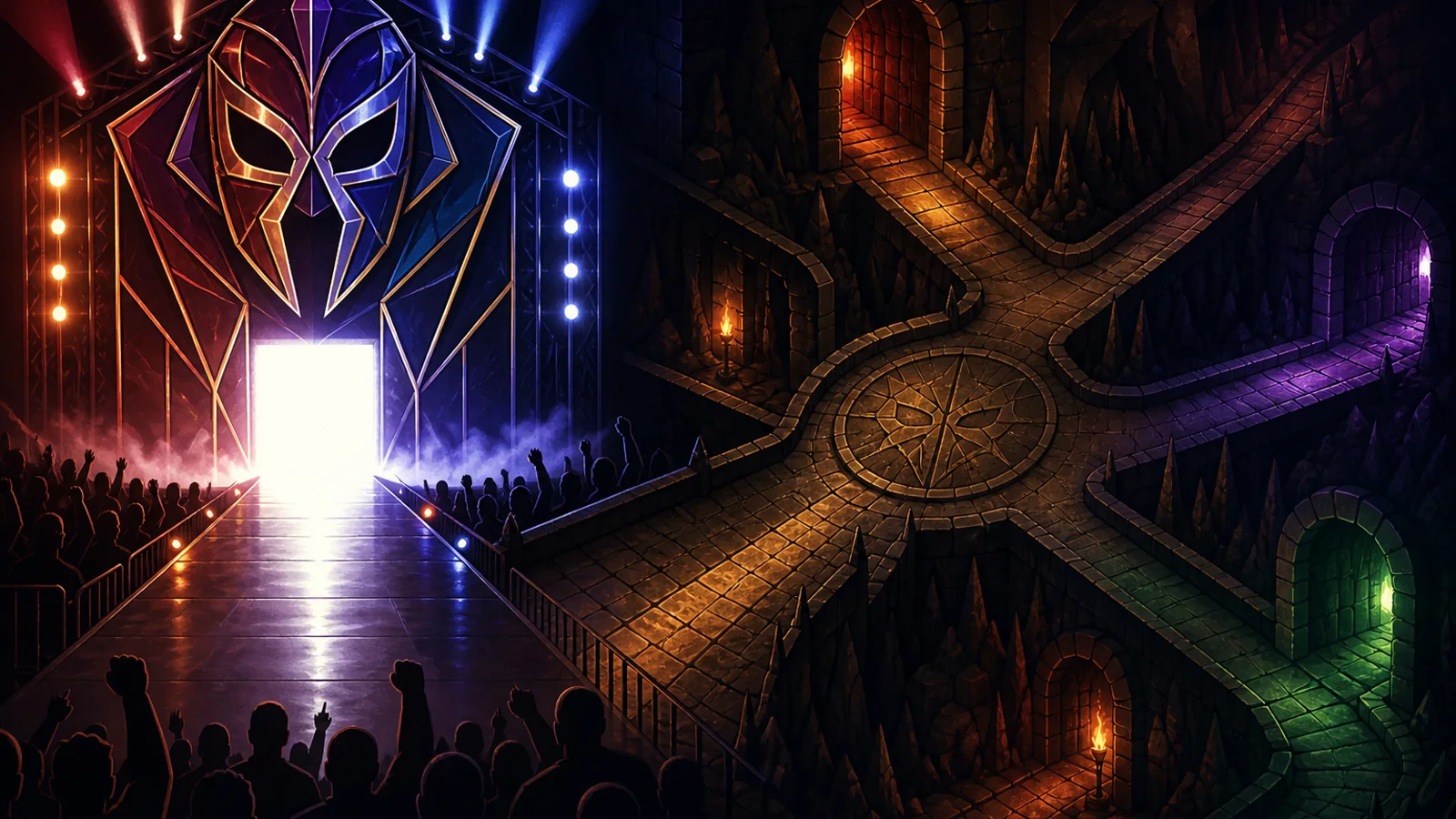
From WWE to Dungeon Crawler World: Kayfabe, Personas, and Crowd Control
Major spoilers through Book 8 of Dungeon Crawler Carl. This article uses general professional wrestling concepts such as kayfabe, promos, heat, faces, heels, and crowd work. This site-specific analysis connects the source work's central pressure system to...
Common questions
What does kayfabe mean in this comparison?
It refers to the performed reality of the show, where the audience is invited to emotionally commit to public narratives even while production structures shape what they are seeing.
Why compare Donut to a performer instead of only a fighter?
Because her command of presentation, status, crowd response, and public framing is one of her biggest strategic advantages.
Is Carl more of a face or antihero in this framework?
He functions like a volatile antiauthoritarian protagonist who can carry face energy with an edge of dangerous unpredictability.
Does the wrestling lens reduce the seriousness of the series?
No. It actually highlights the horror by showing how entertainment structures shape the conditions of real suffering.
Is this shared canon?
No. This is a labeled hypothetical comparison and does not alter Dungeon Crawler Carl canon.