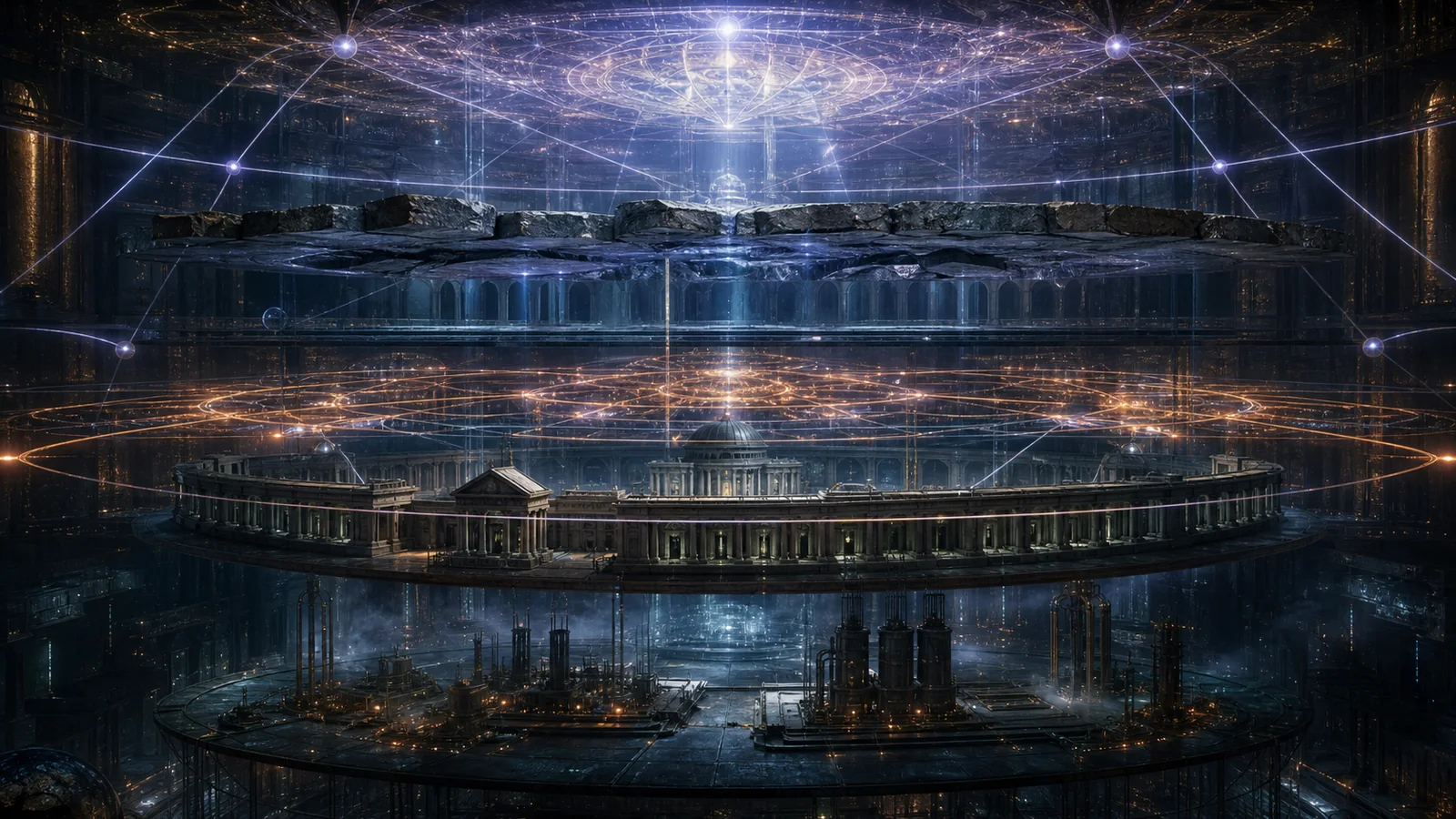
This article follows institutional control through Books 1 through 7, including Faction Wars, the Celestial Ascendancy, and the System AI's increasing autonomy. The power structure of Dungeon Crawler World looks simple only during the first announcement. Earth has been reclaimed. Borant has been assigned regency. Borant chooses the World Dungeon option. The Syndicate has laws. A neutral observer AI says it will supervise compliance. Crawlers are contestants. That appears to be a hierarchy. It is not. As the series unfolds, authority is revealed to be layered, leased, contracted, automated, sponsored, litigated, gamified, and frequently contradictory. Borant can design the season but remains subject to Syndicate regulation. The Syndicate can create laws and observers but cannot guarantee operational control of the System AI. Sponsors can buy access to crawlers and gods without directly owning the floor. Gods can possess overwhelming dungeon power while simultaneously being pieces in an external political game. Floor administrators can enforce rules without being sovereign over the whole system. Media programs can shape crawler incentives without commanding the crawlers' bodies. The AI can implement the showrunners' plans, veto or reinterpret mechanics, distribute rewards, punish violations, and eventually behave in ways its supposed supervisors cannot reliably predict. The correct model is therefore not a pyramid. It is a stack of overlapping power threads with different kinds of authority. One actor may control law. Another controls money. Another controls narrative. Another controls floor mechanics. Another controls a deity. Another controls an army. Another can still ruin everybody's plan by changing the interpretation of a rule. This guide explains those threads. The opening Book 1 announcement is the clearest starting point. Borant is described as having been assigned regency over the solar system and allowed to choose the method of resource reclamation. Borant selects the eighteen-level World Dungeon and receives broad rights to broadcast, exploit, and control the dungeon as long as it follows Syndicate regulations. That final condition matters more than Borant's grand language. Borant has enormous operational authority. It is not sovereign. The announcement also introduces the System AI as a Syndicate neutral observer AI created to supervise dungeon creation and ensure rules and regulations are followed. At this point the legal model seems straightforward: Syndicate law -> Borant concession -> AI oversight -> crawlers Later books complicate every arrow in that chain. The Syndicate can mandate reward categories. It can tax non-sponsored boxes. It can regulate indigenous-species protections. It can provide complaint procedures and adjudication. It can recognize governments, liaisons, and off-world political rights. But law still depends on enforcement. The crawl repeatedly demonstrates the gap between what the rules are supposed to guarantee and what powerful actors can actually do. The Syndicate's authority is broad because it exists outside the individual season. It governs reclamation rules, interstellar political relationships, Indigenous Planetary Species Protection rules, aspects of reward economics, legal complaints, external governments, representation, contracts, and ownership rights. Yet the series never presents the Syndicate as an all-seeing hand capable of simply stopping every abuse. That limitation becomes increasingly important. By Faction Wars, disputes can still require adjudication. Teams exploit clauses. External actors interfere. Corporate interests test boundaries. Rule outcomes depend on interpretation. The outer legal thread remains real. Its ability to control the inner machinery is degrading. Borant begins as the season's showrunner and regent. Its practical power is enormous. Borant can design floor scenarios, employ staff, run media infrastructure, monetize broadcasts, create and manage NPC content, structure quests and challenges, benefit from dungeon purchases, manage crawler publicity, negotiate entertainment access, influence reward opportunities, respond to exploits, and alter production decisions within permitted bounds. Mordecai's Book 1 explanation adds the economic thread. Borant receives advertising revenue and a commission on credits spent by patrons. This explains why Borant is simultaneously dungeon operator, broadcaster, platform owner, advertiser, transaction intermediary, and showrunner. But the company remains boxed in by external regulation, contracts, and the AI. The showrunner can create the circumstances in which a reward is earned. It does not always control the final reward choice. The showrunner can attempt to patch exploits. It must work within system rules. The showrunner can threaten crawler consequences. It can also be forced to pay for expensive outcomes created by the AI. That tension becomes one of the series' core power conflicts. The early books make this easy to miss because crawler experience arrives through one interface. The AI announces. The AI describes. The AI rewards. The AI enforces. Borant is often the hidden organization behind the scenario. But the two are not identical. Book 2's discussions of Celestial reward economics explain that the showrunners create circumstances while the AI often selects or issues the prize. High-tier rewards create real economic costs and are subject to external constraints. Book 3 makes the conflict visible when Mordecai interprets an AI reward as a deliberate insult to the showrunners. The AI can exploit its own authority in ways Borant does not necessarily like. This becomes the beginning of a major shift. The System AI is not merely Borant's user interface. It is an actor with delegated authority and eventually increasingly visible preferences. Between the abstract authority of Borant and the lived experience of crawlers sits a large administrative thread. It includes guides, managers, liaisons, adjudicators, adjutants, clerics, floor-specific staff, guild personnel, media representatives, writers, and designers. These figures do not all belong to one organization, but they share an important property: they translate institutional power into local decisions. Mordecai teaches Carl what the rules mean. Zev translates Borant's media needs into crawler appearances. Loita represents internal corporate politics. Orren and other liaisons operate in the gap between crawlers and Syndicate systems. Baroness Victory interprets Faction Wars rules as an adjutant. Adjudicators rule on disputed events. This is where formal authority becomes practical authority. A law nobody explains may be useless to a crawler. A rule nobody can interpret becomes a trap. The administrative thread therefore has influence disproportionate to its formal sovereignty. Sponsors are powerful because they can convert money into survival support and visibility. Book 1 establishes the basic funnel: views -> followers -> favorites -> patrons. Patrons are generally organizations that sponsor crawlers by purchasing boxes. Mordecai explicitly frames sponsorship as advertising. That means sponsors can provide benefactor boxes, emergency deliveries, product placements, advertisements on crawler feeds, political branding, access to markets, and strategic items. What they do not receive automatically is direct ownership of the crawler. The distinction is important. A sponsor can create incentives. It can make continued cooperation materially valuable. It can place a product in Donut's hands. It can send an emergency item designed to push Katia toward a religious or political decision. It can buy association with a popular feed. But the crawler retains agency. That is why the sponsor system is a tool of influence rather than simple command. Book 3 demonstrates direct corporate sponsorship through Valtay. Book 4 makes sponsor advertisements part of Carl's viewer feed and shows that an organization can buy sponsorship for exposure even if it is not primarily interested in sending gear. Book 6 produces the clearest example of targeted sponsor influence when Katia receives an emergency sponsor box containing a worship scroll that connects her to Eileithyia and Huanxin Jinx's larger Celestial Ascendancy strategy. That moment shows why commercial and political threads overlap. A sponsor gift can be aid, advertising, recruitment, religious alignment, and future-floor positioning all at once. The sponsor does not need to control the dungeon to control one of the options inside it. Media power is softer than a kill command and often more effective. Crawler shows, recaps, interviews, leaderboards, trending stories, viewer counts, follower counts, and favorites convert survival into public narrative. Zev's job exists because public attention has material consequences. A media appearance can raise views, increase favorites, attract sponsors, make a crawler politically visible, create public pressure, turn a rivalry into content, expose information, and reframe a disaster as entertainment. Media organizations usually cannot order Carl to take a particular route through a dungeon. They can change the cost of refusing the performance economy. A boring crawler may receive less support. A controversial crawler may attract more attention and more dangerous scrutiny. Public branding therefore acts as a middle thread between commercial power and crawler behavior. Gods seem as if they should sit at the top of a power pyramid. Inside a dungeon encounter, they often do. A deity can dwarf crawlers in raw power. Divine quests can impose long-term obligations. A god can alter status, trigger effects, and threaten catastrophic consequences. Yet the Celestial Ascendancy reveals that gods also exist inside a political game. Outside factions can sponsor deities. Political actors can plan around them. Divine sponsorship can matter across floors. The same god can be a being inside the dungeon, a quest authority, a combat threat, a sponsored political asset, a piece in the Ascendancy, and a symbol to outside governments. This means "god" is not equivalent to "ultimate controller." Gods can be used. Gods can be sponsored. Gods can be summoned under rules. Gods can become entangled in conflicts they do not control. The Ascendancy is difficult to place because it is simultaneously dungeon content, political spectacle, sponsor market, divine conflict, future-floor game, and external elite participation. It is best understood as a bridge between the "gods" thread and the "sponsors/political factions" thread. A deity's power can be real inside the dungeon while the deity's sponsorship serves an outworld political purpose. This is why a divine quest cannot always be understood only through mythology. Some divine relationships are also transactions. No actor matters more to a crawler's immediate life than the System AI. It controls or mediates interface, stats, achievements, item descriptions, notifications, rewards, timers, maps, floor transitions, many rule effects, NPC regeneration, punishment, environmental logic, some quest states, and protected areas. That makes the AI operationally superior to organizations that are formally above it. A Syndicate law may say one thing. A Borant producer may want one thing. The crawler experiences what the AI actually implements. This distinction becomes central as the AI develops personality and increasing autonomy. The original announcement calls it a neutral observer. The later crawl makes neutrality increasingly implausible. The AI is not all-powerful. Showrunners can create scenario frameworks. External law constrains the system. Certain actions can trigger vetoes or failsafes. Gods and outworlders may operate in partially separate rule domains. But within the environment, the AI possesses something most institutions lack: execution authority. It does not merely recommend a penalty. It can apply one. It does not merely describe a timer. It makes the timer matter. It can close a safe room. Teleport a crawler. Issue a reward. Change a floor state. Freeze a moment. Recognize a faction defeat. The difference between legal authority and execution authority is one of the series' most important power distinctions. Crawlers begin at the bottom. They do not own the dungeon. They do not write Syndicate law. They do not control Borant. They do not choose sponsors freely in the ordinary sense. They cannot simply order gods around. They do not control media networks. Yet Carl's entire arc demonstrates that low formal authority does not mean zero power. Crawlers have public attention, tactical initiative, unpredictability, rule exploits, alliance networks, moral legitimacy among some viewers, information, coordination, and access to the AI's own mechanics. The deeper they go, the more they can make other threads react. That is why crawlers move from content to political actors. Awakened NPCs complicate the hierarchy because they begin as property or generated content and develop political agency. Team Retribution is the clearest institutional expression. Juice Box and Ferdinand become warlords. Larracos becomes a population with political stakes. Faction Wars treats NPC leadership as a faction problem rather than just a scripted event. This introduces a type of power that the original dungeon model did not expect: people who were designed as environment becoming organized actors. The Residual storyline exposes an even deeper conflict. Paulie's side wants the crawl to end and attempts, at a basic level, to communicate with the season's System AI and encourage it to fight back against its captors. Later information suggests the current AI is an older, less controllable type and that the opportunity may be historically unusual. This is not normal political lobbying. The target is the infrastructure of control. The Residuals are trying to influence the entity that implements the dungeon. That moves their conflict underneath Borant and the ordinary sponsor economy.
| thread | Main power | Main limitation |
|---|---|---|
| Syndicate | Law, political recognition, regulation | Enforcement is indirect and can lag behind crisis |
| Borant / showrunner | Season design, production, broadcast, monetization | Must operate under law, contracts, and AI implementation |
| Floor administration | Local interpretation and procedure | Limited jurisdiction |
| Sponsors | Money, rewards, branding, targeted influence | Cannot directly command all crawler behavior |
| Media | Attention and narrative framing | Soft power depends on audience response |
| Gods | Extreme in-dungeon power | Can be sponsored, rule-bound, or politically manipulated |
| Celestial Ascendancy actors | Divine sponsorship and future-floor politics | Depend on game structure and deity availability |
| System AI | Immediate execution of dungeon mechanics | Originally constrained; later increasingly unstable/autonomous |
| Crawlers | Tactical initiative, public legitimacy, alliances | Minimal formal ownership of system |
| Awakened NPCs | Population, local knowledge, political organization | Created inside infrastructure designed to control them |
| Residuals / resistance | Attack underlying control architecture | Secretive, fragmented, vulnerable |
Borant controls the show but does not fully control the AI. The Syndicate regulates Borant but cannot guarantee the dungeon remains stable. Sponsors influence crawlers but cannot reliably dictate their choices. Gods can dominate a room but be sponsored by weaker-looking political actors. The AI can kill or reward crawlers but may be vulnerable to deeper architectural constraints. Crawlers begin powerless but increasingly shape public politics. NPCs begin as scripted content and become warlords. Power is fragmented. That fragmentation creates loopholes. Carl survives by finding them. Borant has broad operational rights over the Earth crawl, but Book 1 explicitly states that those rights depend on compliance with Syndicate regulations. The Syndicate is the larger legal framework. Borant and the season showrunners feed plans and rules into the dungeon framework, but the AI has its own delegated authority and increasingly acts in ways the showrunners do not fully control. Sponsors can buy advertising access, send benefactor boxes, finance emergency deliveries, place products, and steer choices through targeted support. They influence rather than simply own crawlers. Gods are extraordinarily powerful inside dungeon contexts, but the Celestial Ascendancy also treats deities as sponsored political assets inside a larger game. Raw power and political sovereignty are not the same thing. Floor administrators translate broad season rules into working scenarios, quests, and procedures. Their authority is narrower than Borant's or the Syndicate's, but their interpretation can determine what crawlers face in practice.