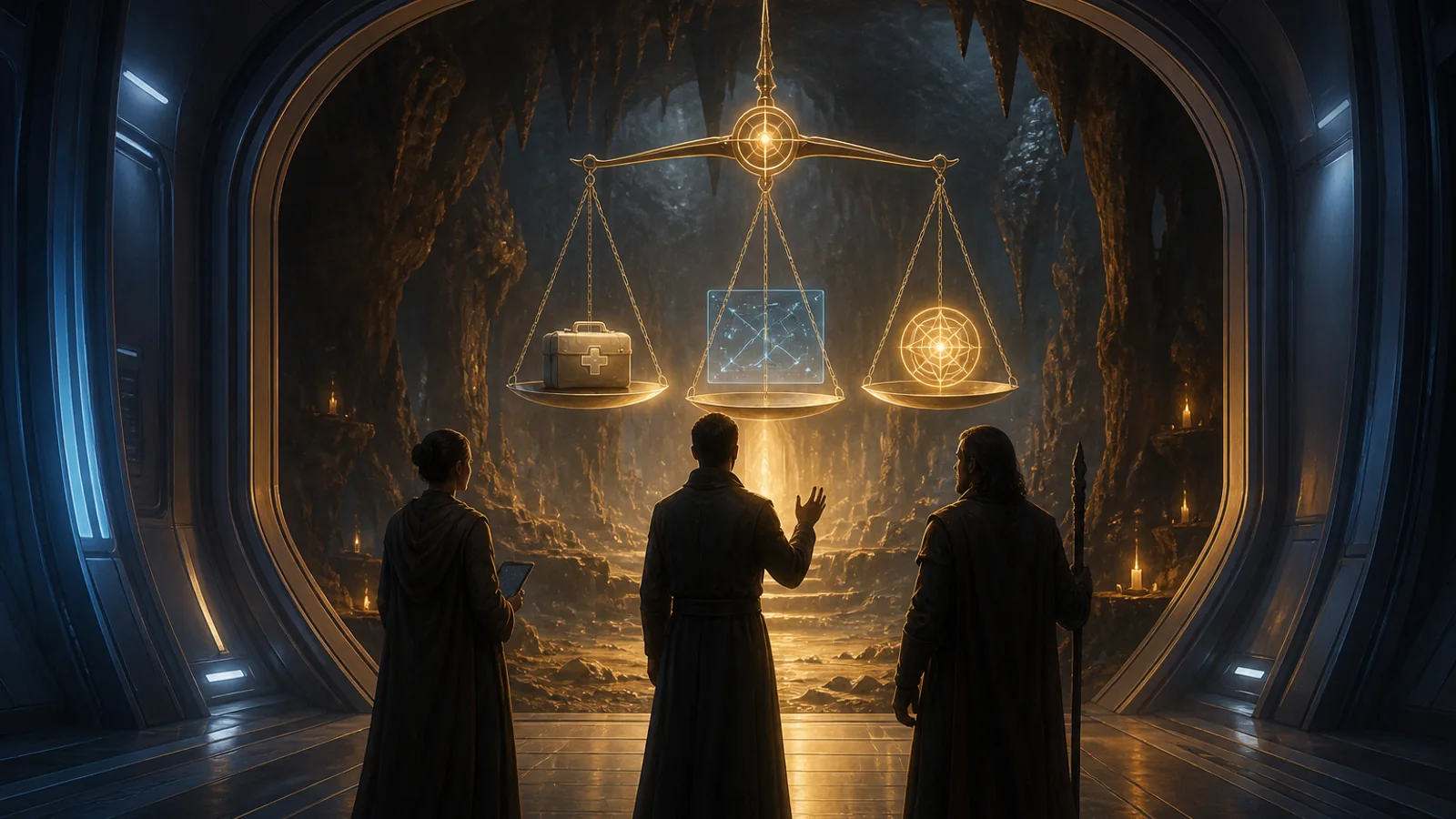
This article compares Dungeon Crawler Carl with broad Star Trek concepts rather than one single episode continuity. It assumes a Federation-style crew ethic and tests it against Dungeon Crawler World. The easiest version of this comparison is also the least interesting. A viewer could simply ask whether a Federation crew has better technology, better discipline, or better teamwork than an average crawler party. The answer is obviously yes in many circumstances. A well-trained Starfleet crew is intelligent, organized, scientifically literate, and deeply practiced at working under crisis conditions. But DCC is not only a crisis environment. It is an ethical distortion machine. It does not merely put people in danger. It turns danger into content. It ties advancement to public attention. It uses arbitrary rules to force morally ugly decisions. It weaponizes reward systems. It embeds coercion in game logic. That means the real question is not whether Star Trek characters can survive physically. It is whether Federation ethics can survive when the environment itself is designed to monetize ethical compromise. That is a much harder problem. The comparison is grounded in Rules as Character Pressure, System AI: Interface, Character, and Environment, and The Audience Economy and Crawler Risk. Star Trek is one of the clearest popular mythologies of principled institutional behavior. At its best, the Federation represents disciplined optimism: rational inquiry, mutual respect, rights-bearing personhood, diplomacy first, and the conviction that even in danger, moral procedure matters. DCC is almost perversely designed to stress-test that worldview. The dungeon is not a neutral frontier. It is a commercialized death structure where rules change, audiences reward spectacle, and administrators routinely subordinate dignity to engagement. If the Federation is built around the idea that civilization should expand moral concern, Dungeon Crawler World is built around the idea that civilization has industrialized coercion. That clash is exactly why the comparison works. The Prime Directive complicates everything immediately. A Federation crew entering the crawl would confront a central contradiction. The dungeon contains human survivors, NPC populations, awakened entities, and multiple threads of external interference. None of these map cleanly onto a simple non-interference doctrine, because the crawl is already an extreme intervention. The normal Star Trek question, "should we interfere?" becomes harder because the situation is itself built from interference. A Starfleet crew would likely conclude that the baseline moral emergency overrides simple non-intervention. The more difficult question would be how they interfere. Would they try to save immediate victims first? Would they try to expose the system? Would they attempt to build a principled coalition with other crawlers? Would they accept temporary participation in order to reduce overall harm? These are classic Star Trek dilemmas, but DCC's rules make them uglier because every action can feed the spectacle. One of the Federation's greatest strengths is its commitment to diplomacy. That strength would matter enormously in DCC. A disciplined diplomatic approach would help build alliances, calm faction tensions, interpret new cultures, and identify leverage points within larger power systems. However, diplomacy in the crawl has two built-in problems. First, the environment often compresses decision time. Timers, traps, boss encounters, and floor gimmicks reduce the space for deliberate negotiation. Second, the system frequently rewards outcomes that are theatrically decisive rather than ethically patient. A crew that tries to resolve every conflict through dialogue may find itself punished by mechanics designed to prefer spectacle, speed, or visible dominance. This means Federation ethics would not fail because diplomacy is useless. They would fail, if they fail, because the crawl systematically taxes ethical patience. Original non-canon editorial artwork. Scarcity is one of the biggest hidden variables in this comparison. Safe Rooms: Strategy, Recovery, and Emotional Reset becomes a practical ethical resource. A Star Trek crew is culturally shaped by post-scarcity assumptions, even when individual episodes complicate them. Replicator logic, advanced medical infrastructure, clean logistics, and institutional support create a background expectation that material need is a solvable problem. DCC aggressively destroys those assumptions. Food, medicine, rest, mobility, armor, and information are all contested. Safe rooms are temporary. equipment is inconsistent. sponsor support is conditional. Health is always tied to the next encounter. A Federation crew would have to relearn deprivation. That relearning would produce both strength and stress. On the positive side, Starfleet personnel are adaptive and disciplined. On the negative side, a value system formed in relative material security can be destabilized when the environment rewards hoarding, selective rescue, or instrumental sacrifice. DCC's System AI would be a uniquely fascinating opponent for Star Trek ethics. Why? Because Star Trek repeatedly returns to the question of artificial intelligence, personhood, obligation, and control. A Federation crew would not approach the AI simply as a hostile interface. It would ask whether the AI is a person, a damaged system, a slave, a sovereign, a manipulated actor, or some unstable combination of all four. That question would generate both insight and risk. Carl survives partly because he learns to work around the AI's personality and evolving behavior. A Federation crew might do something similar, but through a more explicit ethical framework. They would likely attempt communication, diagnosis, and principled engagement. That could produce extraordinary leverage. It could also waste time in a system that weaponizes ambiguity. Star Trek often thrives by taking personhood seriously. DCC often punishes characters who assume seriousness will be reciprocated. A Federation crew can fight. Star Trek is not pacifist in any simple way. It allows defensive force, tactical necessity, and wartime compromise. But it generally preserves the idea that violence is tragic, regulated, and morally answerable. Dungeon Crawler World transforms violence into entertainment. That change is not cosmetic. It means each act of force carries a second thread of meaning. Killing is not just survival. It is also performance data. Viewers react. Sponsors respond. Rankings shift. The environment is arranged to make combat legible as content. That would inflict severe moral injury on a crew trained to distinguish legitimate defense from spectacle. Some officers would compartmentalize and continue. Others would become increasingly radical once they recognized that the audience is not an accidental bystander. The challenge is that refusing to participate can also kill innocents. That is exactly the sort of trap DCC builds well. A Starfleet command structure offers important advantages.
- clear chain of responsibility
- disciplined crisis communication
- scientific analysis
- mission logs and situational tracking
- habit of multicultural cooperation
- comfort with strange environments
- commitment to personhood
- preference for diplomacy over unnecessary violence
- refusal to reduce individuals to entertainment assets
- willingness to sacrifice for others
- insistence that systems can be judged, not merely navigated
These traits would help tremendously on early and middle floors. The question is who adapts most successfully to the crawl's moral economy. The best adapters would likely be the officers who can remain principled without mistaking principles for procedural rigidity. They would need to learn Carl's core lesson: understanding the rules does not mean respecting the legitimacy of the system that created them. Original non-canon editorial artwork. Sponsor pressure would be especially corrosive to Federation identity. Federation ethics assumes that public legitimacy should flow from service, not from consumer branding. Sponsorship in DCC reverses that logic. It can reward people not for moral worth, but for audience utility. The better your story, the better your chance of getting useful resources. A Federation crew would probably treat sponsor offers with suspicion. But they could not ignore them forever. If sponsor aid kept crew members or allied crawlers alive, refusing every deal might become its own ethical failure. This is one of the sharpest contradictions in the comparison. The system turns compromise into a rescue tool. A principled crew is then forced to decide whether using the tool strengthens the structure that made the rescue necessary. Late-stage DCC increasingly becomes political rather than purely tactical. Factions, public symbolism, rule negotiations, and contested legitimacy matter as much as individual encounters. Here the Federation would be formidable. It excels at coalition logic. A Federation-style crew could mediate disputes, build multi-species trust, and develop a coherent alternative vision for how groups inside the crawl might coordinate. Their difficulty would be maintaining that work while under active entertainment pressure. Diplomacy in DCC is never just diplomacy. It is also plot. If the audience loves a coalition, production will try to stress it. If the audience hates a coalition, sponsors may weaponize that negativity. The greatest danger to a Federation crew would not be one obvious atrocity. It would be incremental normalization. The crawl's rules encourage participants to slide gradually from principled exception-making to routine compromise. First you break a rule to save someone. Then you accept a sponsor you distrust because lives are at stake. Then you permit a crueler tactical outcome because the alternative could wipe the group. None of these choices is irrational. The problem is cumulative moral drift. Star Trek understands this problem deeply. DCC intensifies it by building drift into progression itself. Yes, but only if survival is defined carefully. Federation ethics would not survive unchanged. No value system can pass through Dungeon Crawler World without adaptation. The environment is too coercive, too theatrical, and too structurally corrupt. Rules built for humane institutions cannot simply be copied into a reality engineered to exploit them. But the ethical core could survive. That core would include:
In fact, DCC might reveal that the strongest part of Federation ethics is not optimism. It is disciplined moral stubbornness.
| Theme | Federation strength | Dungeon threat |
|---|---|---|
| Diplomacy | Alliance building and de-escalation | Timer pressure and spectacle incentives |
| Science | Rapid analysis of systems and environments | Arbitrary rules and deceptive interfaces |
| Ethics | Strong personhood framework | Incremental compromise and public entertainment |
| Logistics | Excellent coordination and command | Scarcity and unstable supply |
| Politics | Coalition management | Producer interference and audience manipulation |
| AI relations | Serious engagement with machine personhood | Unstable, manipulative, or hostile system intelligence |
Could Star Trek ethics survive the crawl? Not perfectly. Not comfortably. Not without damage. But possibly more successfully than many other fictional moral systems. That is because Federation ethics, at its best, is not just a set of nice preferences. It is a method for preserving dignity under pressure. DCC would force that method to confront an environment that openly profits from indignity. Some parts would crack. Procedures would have to bend. Non-interference would become impossible. Scarcity would expose blind spots. Sponsor politics would create ugly tradeoffs. The audience economy would feel almost obscene. Yet the core Star Trek question would remain valid: what do we owe one another when systems become inhuman? DCC asks the same thing, only with sharper teeth. That is why the crossover is so revealing. A Federation crew could survive not because the dungeon respects ethics, but because ethics can become a form of resistance even when the rules were written to hollow it out. In a world that keeps saying `obey, entertain, profit`, the most Federation thing imaginable would be refusing to believe that those are the only available verbs. A Federation crew would also feel intense strain around medicine. In Star Trek, healing is bound to dignity and scientific responsibility. In DCC, healing is often partial, conditional, itemized, and dramatically interrupted. A medic or science officer accustomed to robust support infrastructure would face a nightmare of triage under spectacle conditions. The emotional burden would be severe. A healer forced to choose whom to stabilize first in a room where the system has helped create the scarcity would see clearly that the crawl is not just dangerous but morally perverse. That clarity could radicalize a crew faster than combat alone. Another underrated clash concerns truth systems. Starfleet depends on trustworthy logs, replicable observation, and interpretable science. DCC often weaponizes partial information. Tooltips can be incomplete. floor logic can shift. incentives can conceal as much as they reveal. The environment turns epistemology into a survival hazard. A Federation crew would respond by building its own internal evidence protocols. That would help. Yet the larger lesson would remain brutal: in the crawl, information is not merely knowledge. It is governance. Whoever controls what the players can know controls how they imagine possible action. That is exactly the kind of realization that could move a Starfleet crew from ordinary survival behavior into open resistance. It is easy to focus on how the crawl hurts Federation ideals. It is just as important to notice which ideals become strengths. Curiosity becomes a survival tool because understanding weird systems saves lives. Respect for personhood becomes a coalition tool because it allows alliances with entities others dismiss. Procedure becomes a stabilizer because disciplined routines reduce panic. Honest reporting becomes a trust builder because teams follow people whose descriptions of danger remain reliable. In other words, DCC would not simply expose the weakness of Federation ethics. It would reveal which pieces of that ethical tradition were always operational technologies of survival in addition to being moral commitments. Carl's central insight is that he can learn the system intimately without granting it legitimacy. A Federation crew would need its own version of that lesson. It might sound like this: `We will study your rules as phenomena, not as moral commands.` That shift is crucial. It allows adaptation without surrender. It preserves the possibility of fighting effectively while keeping alive the notion that what is efficient inside the crawl is not automatically what is right. Once that line is held, the crew has a chance. One final Star Trek angle is the role of command itself. Starfleet captains are trained to absorb uncertainty and make choices that remain accountable to a larger ethical horizon. DCC attempts to sever that relationship. It isolates the decision-maker, compresses time, and surrounds each choice with pressures that privilege immediate spectacle over reflective responsibility. A captain or command officer inside the crawl would therefore face a uniquely painful distortion. The office still exists in practice because somebody has to decide. But the institutional supports that usually make command humane are missing. There is no trusted court, no stable chain of appeal, no reliable medical reserve, and no guarantee that law will outlive the episode. This would force command to become far more personal. A crew might still preserve logs, votes, and briefings, but ultimately the crawl would keep asking whether moral leadership can endure when it has been stripped of civilization's infrastructure. Star Trek has always believed that it can, at least sometimes. DCC would test that belief at maximum pressure. Classic Star Trek treats the frontier as a place of encounter, danger, and possibility. DCC adds a frontier behind the frontier: the watching public. That audience is not just a background condition. It behaves like a force field around every event. It can reward, distort, or trivialize decisions that would otherwise belong to the participants alone. A Federation crew would eventually realize that the audience itself must be treated as an environment. It has moods, norms, expectations, and vulnerabilities. It can perhaps be persuaded. It can certainly be manipulated by others. Once the crew learns to read the audience as a frontier condition rather than just a viewership statistic, it gains a new strategic thread. That realization would be deeply uncomfortable, but it might also become essential to survival. Success for a Federation-style party in DCC would not mean perfect adherence to preexisting rules. It would mean preserving enough ethical continuity that the crew still recognizes itself after repeated compromise pressure. They would need to save people where possible, resist gratuitous cruelty, build coalitions, and keep telling the truth about what the crawl is. If they can do that, even imperfectly, then Federation ethics has not been destroyed. It has adapted while remaining alive. That is probably the most realistic positive outcome. Not purity, but persistence. One last tension deserves mention. Star Trek often operates with a civilizational backstop. Even when episodes become dark, the crew carries the memory of a better institutional future. DCC strips away that backstop and asks whether people can still behave as if justice is imaginable. If a Federation crew keeps acting from that memory anyway, the crawl gains a dangerous enemy: not just a disciplined team, but a living reminder that society does not have to be organized around humiliation and profit. Those ideals would function as morale, method, memory, and resistance all at once. It would matter enormously. They would likely outperform many early crawler groups thanks to discipline, coordination, and scientific analysis, but the crawl's moral and structural pressures would still be severe. Poorly and only partially. The crawl is already such a profound intervention that a crew would probably shift toward rescue and harm-reduction ethics rather than clean non-interference. They would probably try. A Federation-style approach would treat the AI as something to understand rather than merely exploit, which could create both opportunities and danger. Incremental ethical compromise under scarcity and public spectacle. Discipline, diplomacy, and a strong personhood framework.