Spoiler notice
This article discusses major themes and selected character arcs from Dungeon Crawler Carl through Book 8 and from The Boys television adaptation. It focuses on power, celebrity, and spectacle rather than graphic detail.
At a superficial level, The Boys and Dungeon Crawler Carl do not look like close cousins.
One is a corporate superhero satire built around public relations, celebrity branding, and corrupt American power. The other is a science-fiction fantasy survival series built around a murderous dungeon, a System AI, and an entertainment machine operating on a galactic scale.
But once each story shows its true machinery, the resemblance becomes hard to ignore.
Both are interested in the same central question:
Who really controls the people the audience calls heroes?
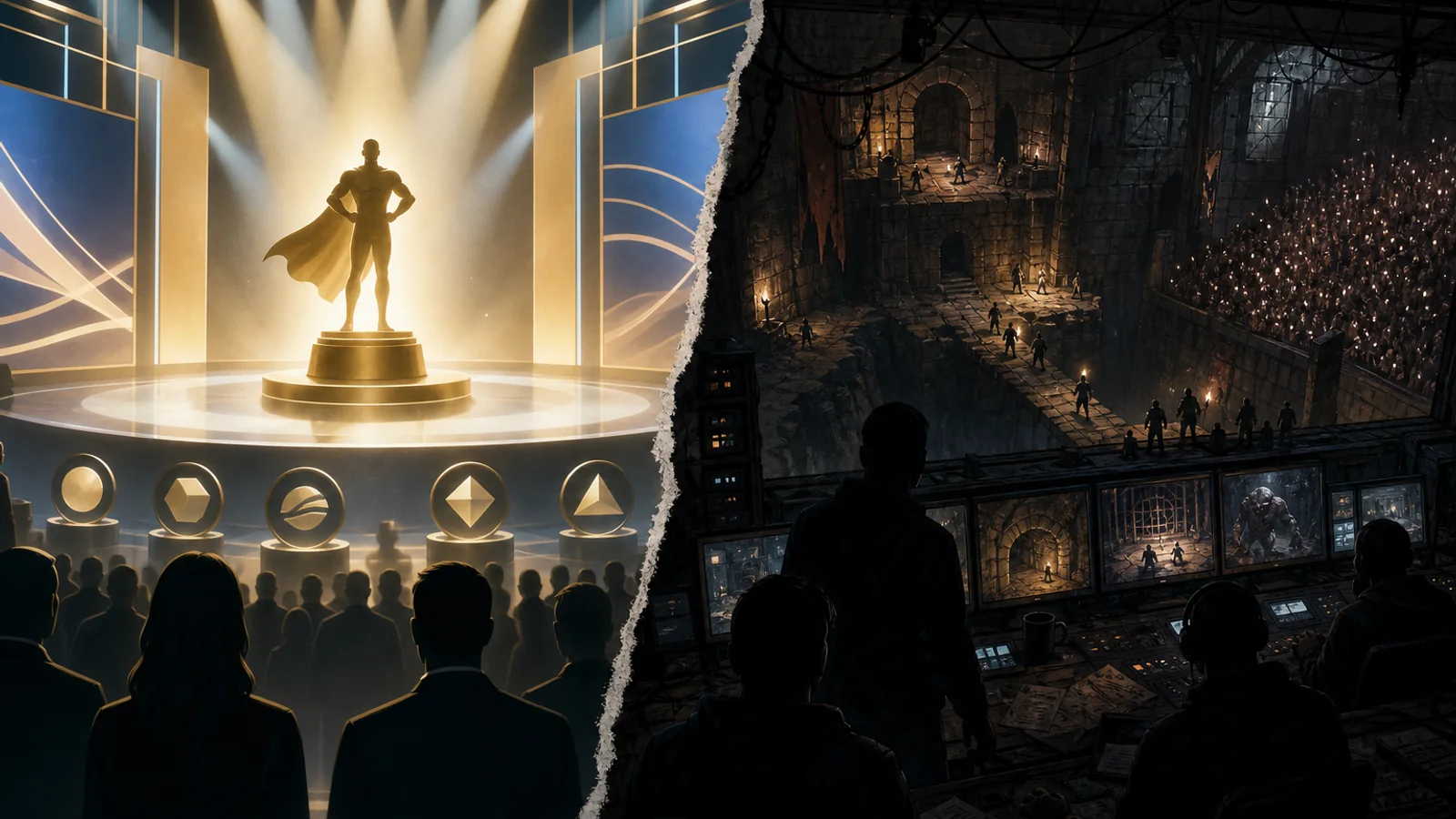
In The Boys, the supposed heroes are not truly free public protectors. They are assets. Their image is managed by Vought. Their crimes are suppressed by Vought. Their rise and fall is negotiated through marketing, legal strategy, media campaigns, and controlled access to the public. Heroism becomes a product line.
In Dungeon Crawler Carl, Carl, Donut, and the larger population of crawlers are also turned into products. They may not wear corporate capes, but they are packaged through recap shows, viewer metrics, sponsor relations, class fantasies, media positioning, and audience expectations. They are told that survival is their objective. The system quietly reveals that performance is also their job.
That shared structure is the real reason the comparison matters. Readers can trace it through The Audience Economy and Crawler Risk, Power Layers: Borant, Syndicate, Sponsors, and Gods, and Rules as Character Pressure.
Both stories reject the naive fantasy that the strongest hero controls the story.
Power belongs to whoever manages the frame around the hero.
Sometimes that is a corporation. Sometimes it is a production office. Sometimes it is a sponsor. Sometimes it is a government. Sometimes it is a System AI. Sometimes it is a crowd that rewards the wrong behavior because spectacle is more legible than morality.
In both worlds, the hero is rarely just a person.
The hero is a negotiated public image.
Heroism as a Managed Brand
One of the sharpest achievements of The Boys is that it treats celebrity heroism as a vertically integrated business. Vought does not merely employ superheroes. It develops them, markets them, monetizes them, and disciplines them. Public heroism is only one department inside a larger system that includes entertainment, pharmaceuticals, lobbying, crisis communications, and consumer identity.
A supe's public worth is determined by more than raw power. Audience appeal, demographic positioning, political usefulness, scandal management, and monetizable authenticity matter just as much. A rescue is not just a rescue. It is campaign material. A speech is not just a speech. It is a positioning exercise. An apology is not just remorse. It is brand repair.
DCC distributes the same logic across the crawl. Carl and Donut are survivors, but they also become media entities. Their choices create fan reactions. Their visibility creates sponsor opportunities. Their successes reshape how viewers and institutions classify them. The dungeon constantly pressures crawlers to become legible brands. A crawler who is charismatic, funny, defiant, or emotionally resonant may attract concrete survival advantages unavailable to equally capable but less visible competitors.
This means both stories are fundamentally about managed image.
The most dangerous power is not always the strongest fist.
It is the system that decides what the audience sees when the fist is raised.
Corporate Ownership Versus Entertainment Ownership
There is an important structural difference between the two series, but the difference reveals a larger similarity.
In The Boys, ownership is corporate and terrestrial. Vought owns the infrastructure around heroism. It shapes access, contracts, media messaging, and official narratives. The heroes are public but not autonomous. They are trapped inside a machine that rewards compliance and punishes deviation.
In DCC, ownership is broader and more diffuse. Borant launches the crawl as a product. The Syndicate regulates the commercial and political environment. Sponsors inject capital and incentives. Gods, production rules, floor administrators, and the System AI all exert pressure. The result is not a single corporation but a layered sovereignty built on entertainment. Nobody fully owns Carl, yet almost everyone tries to own a piece of what Carl means.
This distinction matters.
Vought behaves like a corporation pretending to be a moral order.
Dungeon Crawler World behaves like a moral order pretending to be an entertainment ecosystem.
That is a deeper horror, because it means the audience can forget that ownership is happening at all. The dungeon calls its coercion a game. It calls its manipulation progression. It calls its punishments rules. Ownership becomes invisible because it is embedded in the environment.
Manufactured Celebrity
The Boys makes celebrity itself into a weapon. A public hero becomes valuable precisely because the public must never see the gap between the image and the person. Ratings, endorsements, military positioning, evangelical appeal, nationalist rhetoric, and factional messaging all depend on suppressing reality.
The audience inside The Boys is trained to consume the symbol, not the human being.
DCC does something similar, but with a twist. The public image of crawlers is often built from genuine danger. Carl's anger, Donut's theatricality, Katia's vulnerability, and the bonds among teams all emerge from real trauma. Yet the system quickly turns those authentic responses into recurring content categories. Authenticity becomes another monetizable surface.
That distinction matters because DCC understands something The Boys also hints at: control systems prefer authenticity that can be measured. A public breakdown, a romantic moment, a brave sacrifice, or a funny line all become more useful once the system can attach follower growth, sponsor responsiveness, or market value to them.
The hero becomes easier to own when the audience thinks it discovered the "real" version.
Public Persona Versus Private Self
The public-private split defines both stories.
In The Boys, the private self of a supe is often profoundly unstable, frightened, cruel, or lonely. The public self is carefully staged. The gap between those two versions is not accidental. It is where Vought lives. Vought monetizes that gap. It manufactures reassurance for the audience while hiding the damage required to maintain it.
DCC also produces a gap between public role and private identity. Carl is increasingly recognized as a symbol of resistance, competence, and fury. Donut is a celebrity and a crowd magnet. Many crawlers become known through archetypes that flatten them. Yet their private reality is safe-room exhaustion, grief, fear, resentment, tenderness, and improvisation.
This is why the private scenes matter so much in both works. A controlled system is strongest when it colonizes the public image. The private conversation becomes the only place where moral complexity can survive intact.
The problem, of course, is that these systems also try to invade privacy.
Audience Manipulation
In both stories, the audience does not simply exist. It is cultivated.
That point is essential.
The people watching are not neutral observers who independently reach honest conclusions. They are influenced by curation, framing, selective visibility, and narrative management.
In The Boys, Vought manages the terms of attention. It determines which hero gets platformed, which scandal gets buried, which crisis becomes a patriotic spectacle, and which outrage becomes a talking point. The audience believes it is reacting to reality. In practice, it is often reacting to a package.
DCC's version of audience manipulation is more mechanized. Viewer metrics, recaps, sponsor boxes, public shows, ranking systems, and cross-platform visibility shape what the audience cares about. The system does not need every viewer to agree. It only needs them to remain engaged. Sympathy, disgust, laughter, pity, and admiration all become usable once they feed the same economy of attention.
That is why the audience question in DCC is more uncomfortable than it first appears. Fans can help. Sponsors can save lives. Public visibility can create protection. Yet those same mechanisms keep the crawl culturally central. The audience does not merely witness suffering. It helps stabilize the machine by caring about it in monetizable ways.
Who Writes the Hero's Moral Script?
Both stories ask whether heroism can remain moral once someone else controls the script.
In The Boys, official heroism is built from spectacle rather than ethical duty. The appearance of service is more important than service. In that world, a heroic act that harms the brand may count as failure, while a morally empty gesture with strong optics may count as success.
DCC is different, but equally corrosive. The system gives crawlers quests, achievements, class synergies, and incentives that often reward behavior without regard for moral context. The crawler who acts bravely may be rewarded. The crawler who acts monstrously but entertainingly may also be rewarded. What matters to the machine is not goodness. It is legibility, escalation, and audience value.
This means both stories turn heroism into a conflict between ethics and externally rewarded role performance.
A real hero may need to disobey the script.
Once that happens, the system begins treating the hero as a threat.
Violent Resistance
The resistance figures in these stories are not pure opposites.
The Boys presents violent resistance through characters who see the institutional rot clearly and who respond with rage, sabotage, infiltration, and counter-violence. Their problem is not merely that the system is bad. Their problem is that the system has already naturalized itself. It has merged with politics, media, and culture.
Carl's resistance in DCC starts smaller and becomes more structural over time. He begins as someone trying to live through an imposed nightmare. As he learns more about the dungeon's layers, his anger becomes strategic. He is not only fighting monsters. He is trying to understand how to break the relationships among audience desire, sponsor pressure, regulatory hypocrisy, AI volatility, and institutional control.
The key similarity is that violent resistance in both series is reactive, not decorative.
Nobody becomes a rebel because rebellion looks cool.
They become rebels because the official channels were designed to preserve the lie.
The Illusion of Agency
A major insight shared by both works is that participants are often given enough freedom to take responsibility for outcomes without enough freedom to change the structure.
Supes in The Boys may look like autonomous beings. Many are actually dependent on Vought's approval, legal shield, and public architecture. Their agency is real but constrained. The audience is encouraged to mistake constrained agency for full freedom.
Crawlers in DCC receive choices constantly. They pick races, classes, quests, allies, tactics, and sponsor paths. The existence of choice can make the system seem fair. But the menu itself was built by external power. Carl's real rebellion begins when he stops confusing menu choice with freedom.
That is the heart of the comparison.
A controlled hero is allowed to choose within the frame.
A dangerous hero starts attacking the frame.
Celebrity as Vulnerability
In many stories, visibility protects a protagonist. In these two, visibility is double-edged.
A visible supe in The Boys gains influence, access, and bargaining power, but also becomes more tightly managed. Public love creates dependence. Controversy creates blackmail opportunities. Fame does not free the hero from control. It can deepen the hero's dependence on whoever manages the spotlight.
The same is true in DCC. Carl and Donut benefit from visibility. Their fame makes them harder to erase casually. It gives them leverage. It creates audience coalitions. It improves sponsor options. At the same time, it increases surveillance, expectations, and pressure. The famous crawler cannot simply disappear into ordinary tactical obscurity. The system expects performance.
This is why both stories understand celebrity not as power alone, but as a trap disguised as relevance.
The Crowd's Hunger for Coherence
Audiences dislike complexity.
That is one reason control systems survive.
The Boys and DCC both show that viewers prefer clean narratives: the noble hero, the justified punishment, the inspiring speech, the monstrous enemy, the triumphant underdog. Once a person fits one of those roles, reality becomes harder to see. The system profits from that simplification.
In The Boys, Vought can sell reassurance because audiences want certainty. In DCC, the crawl can sell spectacle because audiences want strong narrative shapes. Carl the rebel, Donut the diva, the hated villain, the tragic casualty, the redeemable fighter: all of these are easier to market than full human complexity.
This means control does not work against audience desire.
It works through audience desire.
Why Carl Is Harder to Control Than a Corporate Hero
Carl's resistance also belongs beside The Audience Economy and Crawler Risk.
Carl is unusually difficult to own because he combines competence with contempt for the legitimacy of the system. He can perform when necessary, but he does not fundamentally believe the crawl deserves obedience. That distinction is crucial.
A controlled hero can hate individual managers while still accepting the core grammar of the system. Carl increasingly rejects the grammar itself. He understands that sponsor economies, rule structures, audience manipulation, and institutional arbitrariness are linked.
This makes him more destabilizing than someone who merely wants better treatment inside the same machine.
Why Donut Matters to This Comparison
Donut belongs in this discussion because she demonstrates that performance literacy can become a survival weapon.
A superficial reading might say Donut is the more media-friendly half of the duo. That is true, but incomplete. Donut also understands that public feeling can be mobilized. She is not simply controlled by image. She can use image tactically.
That makes DCC more complicated than The Boys. In The Boys, image is often top-down. In DCC, image can become a site of counter-power.
Yet even then the system remains dangerous, because every successful act of self-branding still unfolds inside the entertainment economy the crawl built.
Comparison Matrix
| Theme | The Boys | Dungeon Crawler Carl |
|---|---|---|
| Core control structure | Vought and allied institutions | Borant, Syndicate, sponsors, gods, System AI |
| Heroic image | Corporate brand | Survival brand and audience identity |
| Audience role | Consumes managed narratives | Rewards, ranks, and funds spectacle |
| Public persona | Carefully stage-managed | Built through real survival, then commodified |
| Ownership | Contractual and corporate | Distributed, regulatory, economic, technological |
| Resistance | Exposure, sabotage, counter-violence | Survival, coalition-building, structural rebellion |
| Visibility | Increases market value and dependence | Increases leverage and pressure |
| Moral danger | Optics override ethics | Mechanics and audience incentives override ethics |
| Hidden truth | Heroes are managed assets | Crawlers are entertainment labor under coercion |
| Most dangerous rebel | Person who breaks the brand story | Person who attacks the system frame |
Final Verdict
The strongest connection between The Boys and Dungeon Crawler Carl is not that both stories include violence, fame, or institutional corruption.
It is that both understand heroism as something fought over by larger systems.
The audience thinks it is watching heroes act.
The deeper reality is that corporations, sponsors, media systems, and governing structures are constantly trying to decide what heroism will mean before the hero even moves.
In The Boys, the controlling question is: Can a corporation own heroism?
In DCC, the controlling question is: Can an entertainment empire turn resistance itself into content?
Those questions are related.
Both series insist that the answer is yes, at least temporarily.
But both also insist that systems of control have a weakness.
They need the hero to keep performing the assigned role.
The moment the hero refuses the role, or rewrites it in public, control becomes harder to stabilize.
That is why rebellious image is so frightening.
A corporation can survive scandal.
A sponsor economy can survive outrage.
A production machine can survive casualties.
What it struggles to survive is a hero who teaches the audience to see the machine.
Brand Failure and System Failure
One of the biggest differences between The Boys and DCC becomes visible when a hero or a crawler stops functioning as intended.
In The Boys, a hero who becomes inconvenient is often treated as a brand-management problem first. The corporation asks questions like: Can the scandal be redirected? Can the person be reframed? Can the news cycle be controlled? Can another personality be elevated to absorb the damage? The assumption is that the institution should survive even if the individual hero is broken, replaced, or sacrificed.
DCC also sacrifices individuals freely, but the logic is not only reputational. A broken crawler can still be useful as warning, tragedy, spectacle, or outrage. The system does not merely protect itself by suppressing the failure. It often metabolizes failure into new content.
This distinction is revealing. Vought wants stability. The crawl wants volatility so long as volatility remains monetizable. That makes Carl more dangerous than a scandalous corporate hero, because his resistance is not just embarrassing. It threatens to teach audiences how the volatility machine works.
Resistance Through Narrative Seizure
Many analyses of both works focus on violence, but narrative control is often more important than physical control. The institution wants to decide what events mean. Once oppositional characters start defining that meaning publicly, the balance changes.
In The Boys, exposing truth matters because truth interrupts a sanitized narrative of heroism. In DCC, exposing truth matters because the truth can reclassify the crawl from a game into a regime. The audience is far easier to manage when it thinks it is consuming entertainment rather than participating in a political order built from coercion.
Carl's strongest moments often come when he seizes narrative territory. He does not just survive an encounter. He makes the encounter mean something the system did not intend. Donut is critical here too because she understands theatrical delivery. She can help convert private anger into public symbolism.
That ability has a clear analogue in The Boys. Systems that dominate attention are vulnerable when someone inside them becomes articulate in the wrong direction.
Why the Comparison Resonates So Strongly for Readers
Readers and viewers respond to these two properties because both dramatize a common modern fear: that visible public virtue can be managed from above while real moral life is pushed offstage. In both worlds, official heroism is suspect. Image is not trusted. Institutions are never merely backgrounds. The audience has to ask whether admiration itself is part of the trap.
This is why the comparison feels richer than a surface crossover. It speaks to the sense that in media-saturated systems, power increasingly belongs to whoever packages the hero most effectively. DCC and The Boys both reject passive trust in the package.
They suggest that if a hero appears too legible, too polished, or too narratively convenient, the viewer should start asking who benefits from that legibility.
If Vought Ran a Crawl
A useful thought experiment is to imagine Vought trying to operate Dungeon Crawler World. What would change?
The most obvious answer is tone. The corporate language would become more polished, more patriotic, and more brand-safe on the surface. But the deeper structure would remain chillingly similar. Audience segmentation would intensify. sponsor campaigns would become more overt. selected crawlers would be developed as franchise personalities. Tragedy would be packaged as resilience. outrage would be redirected into loyalty.
What makes DCC uniquely grim is that it has already moved past the point where those cosmetic differences matter. The crawl is what hero management looks like once survival itself has been commercialized. Vought feels like an earlier stage of the same civilizational disease.
If Carl Walked Into Vought Tower
Carl would likely grasp the Vought model quickly. He understands systems that speak the language of entertainment while using that language to conceal deeper brutality. He would also recognize the danger of allowing a corporation to define rebellion for public consumption. If Vought ever tried to market Carl as a rebellious brand, his real battle would begin at that exact moment.
That thought experiment clarifies the final connection between the two series.
The hero is never fully safe once the institution learns that resistance itself can be sold.
That is the horizon both worlds approach. A corporation can sell critique as authenticity. A dungeon can sell defiance as premium content. The hero then faces the hardest challenge of all: resisting not only control, but the system's effort to profit from visible resistance.
FAQ
Is Carl more like Homelander or more like Butcher?
Neither comparison is exact. Structurally, Carl resembles a resistant anti-system figure more than a corporate celebrity hero, but his goals and moral center differ substantially from Butcher's.
Is DCC's sponsor system basically Vought?
Not exactly. Vought is a centralized corporate manager. DCC's sponsor system is distributed across a wider entertainment and political ecosystem.
Which world gives heroes less freedom?
DCC often offers less meaningful freedom because the game rules are embedded in survival reality, not just branding and employment structures.
Why compare Donut to public-facing heroes?
Because Donut understands performance, audience response, and symbolic positioning in ways that make media literacy a survival asset.
What is the biggest shared theme?
Both stories show that public heroism can be controlled from above unless the supposed hero learns how the image machine actually works.
Source and update note
Official The Boys series materials provide the corporate-hero and public-branding baseline. The DCC side is a hypothetical synthesis of published-series mechanics through Book 8, including audience economy, sponsors, quests, achievements, and resistance. No shared canon is claimed.
Primary starting point: Sony Pictures: The Boys. These materials establish the source-franchise baseline; the dungeon outcomes, ratings, and comparisons above are editorial interpretations, not an announced crossover.