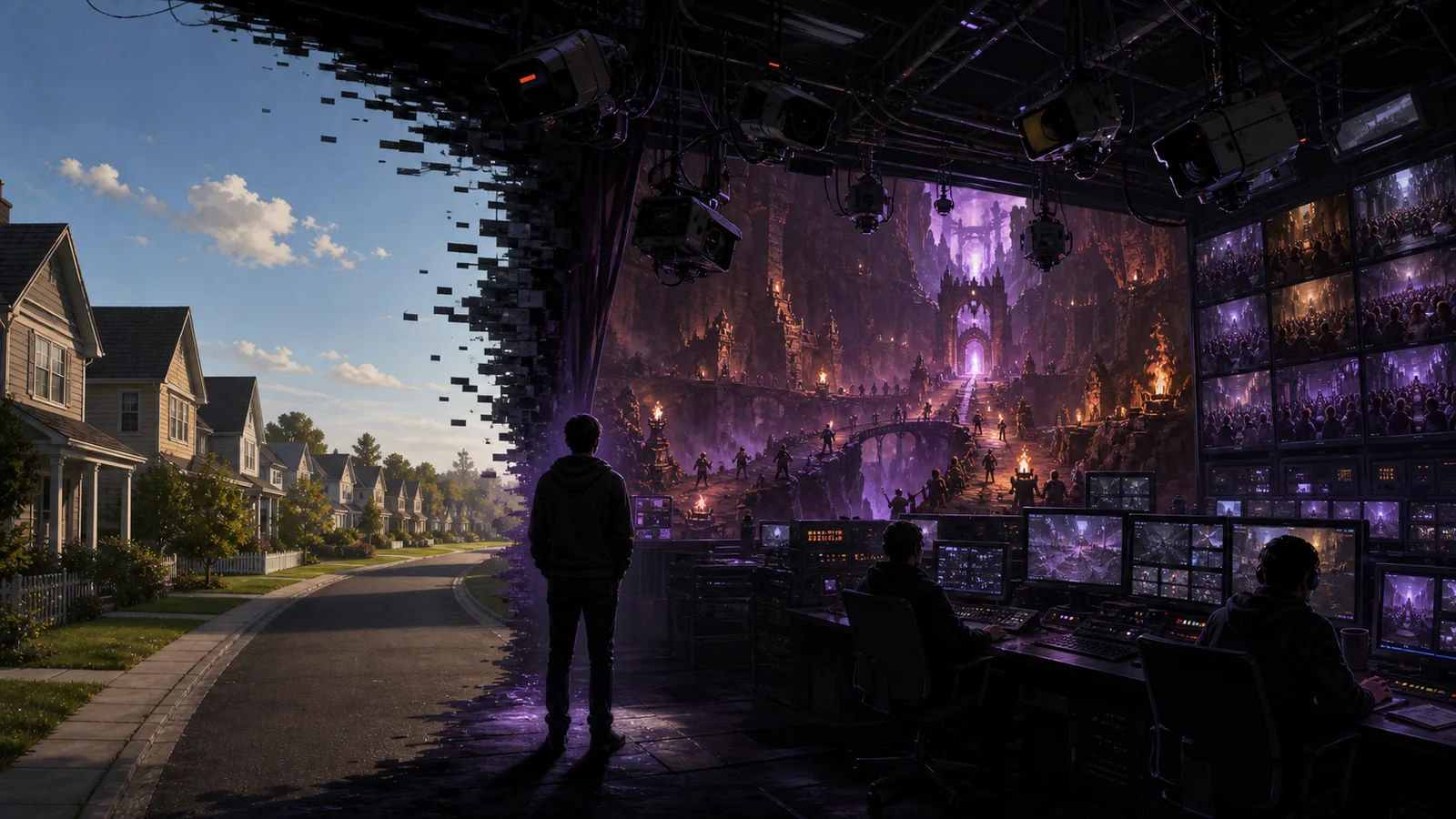
This article discusses major themes and the central reveal of The Truman Show, along with core Dungeon Crawler Carl material through Book 8. If The Boys is the natural comparison for hero branding and Squid Game is the natural comparison for survival spectacle, then The Truman Show is the comparison that best exposes what Dungeon Crawler Carl thinks about surveillance, producer control, and the weaponization of audience attachment. The two works are very different in tone. The Truman Show is melancholic, satirical, and intimate. It focuses on one man whose entire life has been turned into a commercial entertainment product. His neighborhood is a set. His relationships are staged. His emotional life is curated. Millions of viewers consume his ordinary existence without his meaningful consent. DCC is louder, deadlier, stranger, and far more overtly political. It opens with world-shattering catastrophe and then drops its survivors into an entertainment machine where risk, grief, strategy, and rebellion are publicly mediated. Yet beneath the tonal gap, the two stories ask related questions. What happens when life itself becomes content? What happens when the audience loves you but also needs you to remain inside the machine that exploits you? What happens when the producer claims that the artificial world is safer, more meaningful, or more honest than freedom? And what kind of rebellion becomes possible once the person on camera realizes the set is real enough to shape their entire identity but fake enough to be escaped? Those questions make The Truman Show one of the most revealing comparison points for DCC. The comparison opens through The Audience Economy and Crawler Risk, System AI: Interface, Character, and Environment, and Power threads: Borant, Syndicate, Sponsors, and Gods. Truman Burbank's existence is built on total observation. His home, workplace, and social world are designed as a seamless performance environment. Cameras are hidden everywhere. His routines are known in advance. His loves, fears, habits, and vulnerabilities are cataloged. The series' audience feels close to him precisely because he is always visible. DCC scales that premise outward. The crawlers are not simply monitored. They are turned into a monitored labor class inside a commercial survival event. Their movement is observed, recapped, ranked, and translated into consumer attention. What is private in a normal life becomes material in the crawl. The difference is that Truman initially does not know his life is a show. Carl knows the dungeon is a show almost immediately. That difference matters, but it does not eliminate the comparison. It changes the emotional texture. Truman experiences gradual epistemic rebellion. He notices errors, contradictions, repeated patterns, and emotional dissonance. He begins to suspect the world has been arranged around him. Carl begins from overt coercion, but he undergoes a different kind of discovery. He learns that the crawl is not simply a deadly game. It is an economy, a production environment, a political system, a sponsor network, and a mass audience ritual. He is not uncovering the fact of spectacle. He is uncovering the depth of spectacle. One of the most important lessons in The Truman Show is that affection can coexist with exploitation. The viewers care about Truman. Many of them want what is best for him. They feel intimate concern when he suffers or drifts toward truth. Yet their attachment is inseparable from continued consumption. They know him by watching. If he ceases to be watched, their relationship changes. That emotional contradiction is central to DCC too. The galactic audience is not a single moral block. Some viewers are cruel. Some are frivolous. Some are parasocial. Some are politically engaged. Some become genuine fans. Some offer sponsor support that keeps crawlers alive. Yet even the supportive audience helps stabilize the crawl as an institution. The person who roots for Carl is still participating in the same attention economy that turns Carl's danger into profitable content. DCC goes further than The Truman Show by making that contradiction materially consequential. Audience engagement can literally affect equipment, sponsor access, and narrative protection. The public does not merely watch Carl's life. It can shape the conditions under which he lives it. That makes the audience harder to classify. It can be caring and corrupting at the same time. Original non-canon editorial artwork. Christof, the controlling producer in The Truman Show, believes that the artificial environment he created is in some ways more honest than the outside world. He frames his control as stewardship. He thinks he has given Truman safety, meaning, and a comprehensible place in the world. The ethical horror of the film is that care becomes the language through which domination justifies itself. DCC is full of institutions that speak in similar registers. The System AI frames choices as gameplay logic. Borant frames the crawl as organized entertainment. Regulations create the appearance of lawful fairness. Sponsors and administrators rationalize their interventions as part of the show's structure. Even when the control mechanism is not explicitly paternal, it often carries the same underlying claim: this is simply how the world works. Like Christof, the controlling threads of DCC present artificiality as normal reality. That is one of the series' recurring nightmares. A system can dominate people most effectively when it no longer feels like a system. The Truman Show literalizes manufactured reality through set design, actor choreography, product placement, and environmental scripting. The weather can be changed. Traffic patterns can be imposed. relationships can be directed. Even memory becomes unstable because every remembered moment took place inside a curated performance space. DCC manufactures reality in a more aggressively gamified form. Each floor changes the geography, rules, and stakes. The System AI can transform environments, define hazards, and generate new pressures. Floors are not discovered worlds in a natural sense. They are designed experiences. The fact that they can kill does not make them less authored. It makes them more sinister. This is why the crawl feels like the lethal descendant of Truman's set. In both stories, the environment is built to channel behavior. You do not merely live in the world. The world has been tuned to produce you. Surveillance in these works does more than gather information. It shapes selfhood. Truman becomes who he is inside a fully watched environment. His fears have been cultivated. His aspirations have been redirected. His emotional possibilities have been constrained. Once he begins to resist, he is not just trying to leave a room. He is trying to become a self not scripted by observation. Carl's situation is harsher but structurally similar. Every public decision has interpretive consequences. Viewers react. Sponsors categorize. allies and enemies adjust. The crawl makes selfhood strategic. Carl cannot ignore how he is seen because being seen changes what resources and dangers reach him. The result is a continuous pressure to become a durable public identity. DCC never lets the reader forget that the performer self and the survival self are becoming tangled. A key claim of The Truman Show is that false security can be used against freedom. Christof believes Truman is better off inside the curated world. Outside, he says, there is no more truth than there is inside the set, but there is more fear. That argument echoes through many power systems. DCC repeatedly suggests that controlled systems defend themselves by treating uncertainty as illegitimate. The dungeon's rules may be cruel, but they are rules. The sponsor economy may be corrupt, but it is navigable. The audience may be invasive, but it is also a source of gifts and predictability. Once a coercive order becomes familiar, even its victims can be pressured to mistake familiarity for safety. Carl's refusal matters because he never fully accepts that bargain. He may exploit the rules. He may master them. He may turn them against their makers. But he does not confuse functionality with moral legitimacy. Truman rebels by noticing patterns. Repetition reveals design. Accidents reveal editing seams. His world becomes less trustworthy the more clearly it presents itself as trustworthy. Carl's rebellion also depends on pattern recognition, but at a systems level. He studies the ways sponsors influence behavior, the ways floors incentivize betrayal, the ways media attention converts into power, and the ways larger political structures intersect with dungeon logic. Both protagonists become dangerous once they stop treating anomalies as isolated glitches. They begin to infer the existence of a system. That is a major shared theme. Oppression often survives because people experience harms as separate incidents. Rebellion begins when separate incidents become a structure. Relationships are among the cruelest tools in The Truman Show. The people closest to Truman are part of the machinery shaping his consent. That does not always mean they feel nothing, but it does mean the social world he trusts has been designed to contain him. DCC is less deceptive in this exact sense, but it still weaponizes relationships. The crawl repeatedly turns loyalty into leverage. Alliances become mechanically useful and mechanically endangered. Public attachment creates pressure. Team composition, sponsor incentives, floor gimmicks, and future conflicts all threaten the durability of genuine bonds. A key difference is that Carl's most important relationships are real. That is one reason DCC retains a more insurgent hope than The Truman Show. The system tries to instrumentalize human connection, but it cannot wholly invent it. Safe-room intimacy, chosen family, survival debts, grief, and reciprocal care create a counter-space the system cannot fully author. Truman has to discover authentic relationship beyond the set. Carl has to defend authentic relationship inside the set. The Truman Show demonstrates that even near-total control contains blind spots. Christof knows a great deal about Truman, but not everything. He can stage environments, but he cannot completely eliminate unpredictability. He can choreograph, but he cannot fully own desire. DCC makes the same argument through more chaotic means. Production power is immense, yet Carl repeatedly finds openings. The System AI is powerful but unstable. Sponsor pressures can be redirected. audience expectations can be manipulated. floor designs create opportunities as well as threats. Institutions are large, but not seamless. This matters because otherwise both stories would collapse into fatalism. What breaks control is not raw strength alone. It is the fact that a living person cannot be reduced completely to a production model. The audiences in both stories want contradictory things. They want authenticity and safety. They want spontaneity and satisfying structure. They want the subject to surprise them, but not so much that the show stops feeling coherent. This is why producer systems are always adjusting. Their job is to maintain the illusion that reality is unfolding naturally while quietly shaping it toward desirable narrative outcomes. DCC expands that logic through gamification. Viewers want risk, drama, humor, tears, escalation, and memorable set pieces. The system responds by embedding those desires into mechanics. The audience no longer merely waits for narrative. It helps incentivize its creation. The most iconic image in The Truman Show is the exit at the edge of the set. Truman reaches the boundary of his false world and discovers that the horizon has always been a wall. Escape becomes literal. Freedom means walking through the door. DCC has no single equivalent door, but the concept remains powerful. Each safe room, staircase, floor transition, and political revelation raises the question of what would count as leaving the set. Carl cannot merely reach the next level. That is not escape. He cannot merely win a sponsor deal. That is not escape either. The deeper he learns the system, the more obvious it becomes that progression inside the frame is not the same as freedom from the frame. This is one of the clearest insights gained by placing the two works together. Escape is not advancement. A better room inside the set is still inside the set. The ethics of spectatorship connect directly to The Audience Economy and Crawler Risk. No comparison between these two works is complete without confronting the ethics of spectatorship. The Truman Show asks whether affection justifies watching a life built on deception. DCC asks whether investment justifies watching a life built on coercion. Both works make the viewer complicit in a limited, self-aware way. The real audience is not morally equivalent to the fictional audience, but the stories deliberately create discomfort around passive enjoyment. We care about Truman. We still watch. We care about Carl and Donut. We still turn The story. The point is not to produce shame so much as awareness. Spectacle is powerful because it can recruit empathy without surrendering exploitation.
| Theme | The Truman Show | Dungeon Crawler Carl |
|---|---|---|
| Core surveillance | Hidden life-long observation | Publicly mediated survival surveillance |
| Producer role | Christof as central architect | Borant, sponsors, Syndicate, AI, and administrators |
| World design | Physical set and staged suburb | Designed floors, mechanics, and media ecosystem |
| Audience attachment | Intimate but exploitative | Supportive, parasocial, and materially influential |
| Discovery arc | Realizes the world is fake | Realizes the spectacle is structurally deeper than it looks |
| Relationship pressure | Closest ties are partially scripted | Genuine ties are repeatedly instrumentalized |
| Exit problem | Must leave the set | Must challenge the whole system frame |
| Ethical question | Is watching a stolen life defensible? | Can support inside the spectacle avoid sustaining it? |
The Truman Show and Dungeon Crawler Carl meet at the point where entertainment stops being a genre thread and becomes a condition of life. Both stories understand that once an audience becomes central, every other part of reality begins to deform around it. Space becomes performative. Relationships become suspect. Risk becomes narratively useful. Producers become quasi-sovereigns. Freedom becomes difficult to define because the subject's entire identity has formed inside the watched environment. The difference is that Truman's world is intimate and enclosed, while Carl's is violent and sprawling. Truman needs to discover the lie. Carl needs to map the machine. Truman's rebellion is a walk through a door. Carl's rebellion is an evolving struggle against a civilization that has normalized monetized coercion. Yet in both cases the heart of the resistance is the same. A person on camera decides that being seen is not the same thing as being known. That realization breaks the producer's deepest claim. The system may have monitored the subject. It may have profited from the subject. It may even have helped create the subject. But it does not own the final act of self-definition. Another powerful connection between these works lies in the way constant visibility trains a subject to police himself. Truman's habits, fears, and routines have been guided for so long that his rebellion begins not with a public speech but with tiny acts of deviation. He experiments. He hesitates. He does something unscripted. Those small breaches matter because total control rarely breaks all at once. DCC presents a more conscious version of the same pressure. Carl and other crawlers understand that they are visible, and this can produce second-order self-monitoring. A crawler may ask not only, `what helps me survive?` but also, `how will this read to the audience?` or `what does this do to sponsor value?` Once that thread appears, the watched person starts negotiating internally with external viewers. The danger is not merely embarrassment. The danger is identity drift. The subject gradually becomes a version of the self designed for observation. Both works also use humor in ways that sharpen rather than soften their critique. The Truman Show uses comedy to expose how absurd a life of total curation can become. DCC uses comedy to reveal how quickly horror can be normalized when wrapped in game logic and entertainment language. Humor matters because it is one of the main ways an exploitative system makes itself livable. If the audience laughs, the scenario becomes easier to endure. If the subject jokes, the subject may reclaim a little agency. But humor can cut both ways. It can resist dehumanization, and it can make dehumanization easier to consume. That tension is especially strong in DCC, where the funniest interface moments often coexist with the darkest structural implications. The joke does not erase the cage. It shows how efficiently the cage has been domesticated. Producers need predictability. They may enjoy apparent spontaneity, but only a managed form of it. Truman becomes dangerous when he ceases to move along expected lines. Carl becomes dangerous when he stops converting entirely into the kind of legible entertainment product the crawl prefers. This helps explain why rebellion in both stories is so often associated with opacity. The subject chooses not to react as scripted. He withholds. He reroutes. He misleads the watcher. He behaves like someone who may possess an interior the system cannot fully map. That is a profound threat inside any spectacle economy. The entertainment machine wants intimacy without autonomy. It wants access without freedom. Once the subject insists on freedom, access becomes unstable. Perhaps the saddest overlap between these stories is that neither audience can simply love the subject into liberation. The viewers of The Truman Show may care deeply, but care alone does not break the set. Fans of a crawler may send support or influence outcomes, but fan affection is not the same as emancipation. This matters because both works are suspicious of sentimental shortcuts. Feeling for someone is not the same as changing the conditions under which they are trapped. The audience may cry, cheer, or remain loyal for years. Unless the structure breaks, attachment can become another decorative thread on top of unfreedom. That is why the true moral climax in both works comes not when the audience feels most intensely, but when the central figure acts in defense of self-definition. Freedom is not something the crowd can bestow as applause. It has to be seized, walked into, or fought toward. Looking at DCC through The Truman Show clarifies that the series is not only angry about violence, sponsorship, or bureaucratic cruelty. It is deeply interested in what watched life does to the self. The crawl is a social and political system, but it is also a theater of distorted personhood. The more people must survive publicly, the more their interior life becomes contested terrain. That insight helps explain the emotional force of Carl and Donut's quieter moments. Those scenes matter because they preserve selfhood against the flattening logic of content. Not literally, but the comparison is useful because both works treat life as produced content and explore what happens when the subject resists the entertainment system shaping reality. No single figure maps perfectly. Christof's role is split across Borant, the Syndicate, sponsor systems, and the System AI. Because the audience can care sincerely while still benefiting from or sustaining the subject's lack of freedom. Not in the same literal way. DCC replaces the single exit image with an expanding awareness that progress within the game is not the same as liberation from it. Producer control works best when it becomes invisible and feels like ordinary reality.